Pythons

Scientific Classification & Quick Facts
| Common name | Pythons |
| Scientific name | Pythonidae |
| Kingdom | Animalia |
| Phylum | Chordata |
| Class | Squamata |
| Type | Reptile (non-venomous constrictor snakes) |
| Diet | Mammals and birds, from rats to antelopes |
| Habitat | Woodlands, rainforests and grasslands, often near water |
| Native range | Africa, Asia and Australasia |
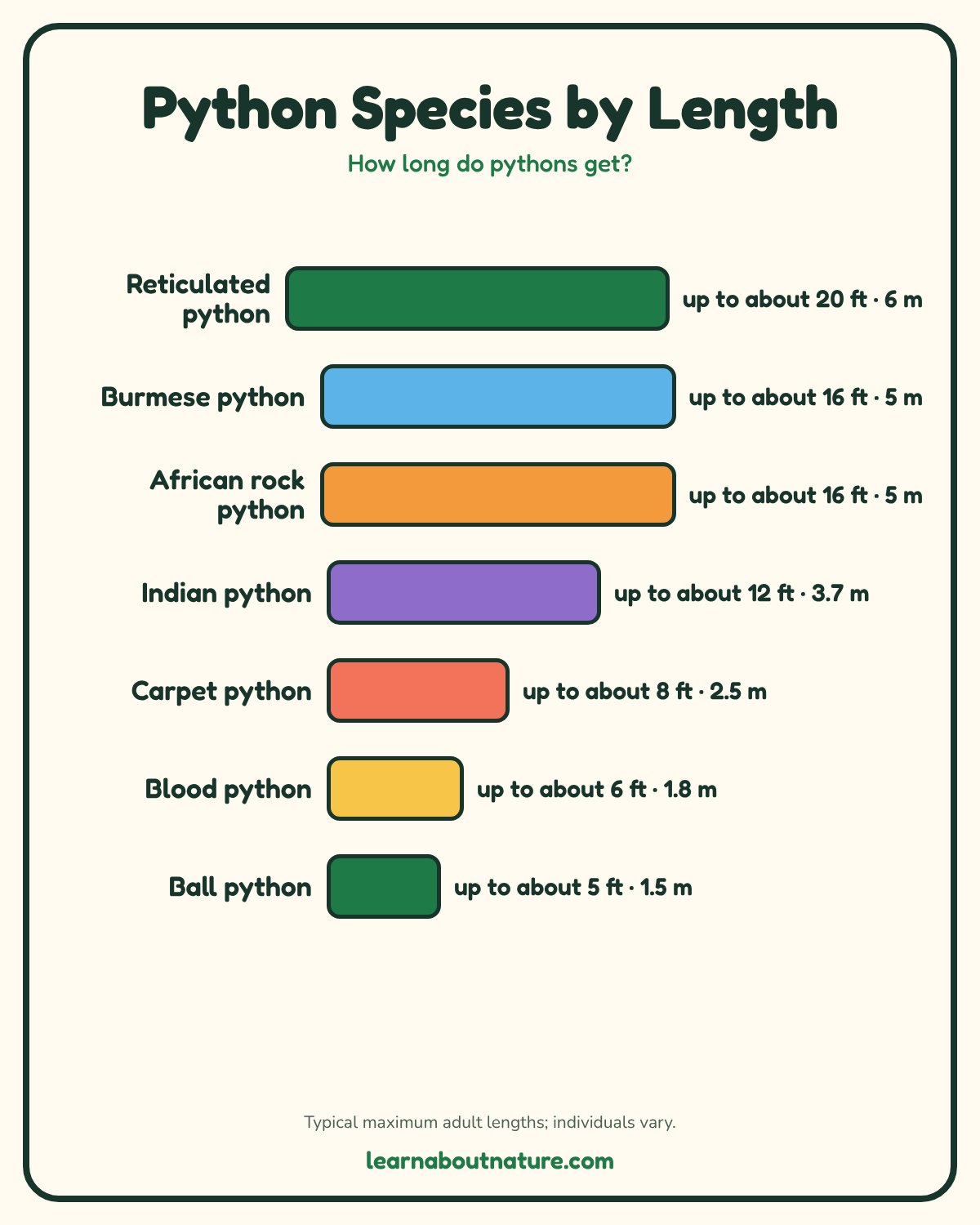
| Size | About 1 m to nearly 7 m long |
| Special feature | Kill by squeezing; some have heat-sensing lip pits |
Pythons belong to the family Pythonidae, a group of non-venomous snakes found in Africa, Asia and Australia. There are more than 30 recognized species in the family. The reticulated python (Malayopython reticulatus) is the longest among snake species in this world as well as reptiles extant. Even though humans are not exactly their food choice, there have been incidents where humans were killed and swallowed by pythons.
Pythons are cold-blooded like all other snakes They are non-venomous and they constrict their prey to kill them. There are different types of pythons like the ball python, carpet python, green tree pythons, Reticulated and Burmese pythons. Some of these species cannot be kept in captivity except by professionals. There are many other python species that make good pets.

What Are Pythons?
Pythons are non-venomous constricting snakes of the family Pythonidae, with more than 40 species in Africa, Asia and Australia. They kill prey by squeezing and swallow it whole. Sizes range from the 60 cm anthill python to the reticulated python, the world’s longest snake at nearly 7 metres. All pythons lay eggs.
Carpet Python

These types of pythons can be kept as pets. In the species, there are different types with varying colors. They climb trees. Carpet pythons feed on small mammals like rabbits and mice. They would not mind an occasional chicken. These snakes are natives of New Guinea and Australia.
Anatomy
You can find Northern carpet pythons having brown color with tan spots or the jungle (carpet) pythons with golden spots on black. Their length range from 5 to 10 feet.
Habitat
The Carpet Python is confined to Australia as well as New Guinea.
Food
Carpet Python usually feeds on small mammals, like mice and rabbits, and they may even consume chicken.
African Rock Python
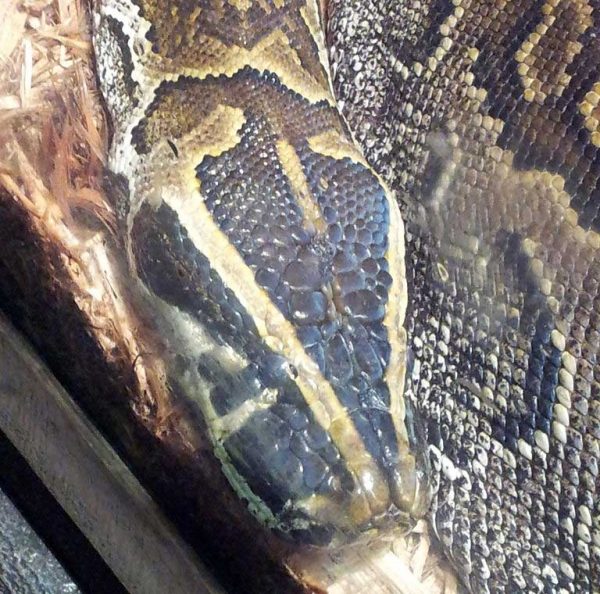
Rock Pythons are the largest snakes of Africa. They belong to the species Python Sebae. They possess long and stout bodies with blotched patterns. The blotches vary in color from brown to yellow with shades of olive and chestnut in between. The blotches often form broad, irregular stripes.
Anatomy
The rock pythons of Africa possess triangular heads. They have a number of sharp teeth curved backwards. There is a yellow Spear Head mark on top. There are distinctive sub ocular (under the eye) triangular marks. The scales of the African Rock Pythons are smooth and small. The scales around the lips have thermo-sensitive pits which help them to detect the presence of prey (warm blooded) even in absolute darkness.
Habitat
These snakes are distributed almost throughout the entire Sub-Saharan Africa. They range from Senegal to Somalia and Ethiopia in the east and south Africa to the south.
Food
These snakes have a varied diet in the wild. They consume Antelopes, monkeys, large rodents and Fruit Bats as well as Crocodiles and Monitor Lizards in the forests. In suburban areas, they make do with poultry, dogs, rats and goats. There have been reports of these pythons hunting human beings.
Asiatic Reticulated Python

Reticulated Pyhon (Asiatic) belong to the species Python Reticulatus. These are a species of pythons in southeast Asia. Adults can grow up to 6.95 meters in length. The average size ranges between 3 to 6 meters. They are the longest snakes and the longest reptiles in the world. These snakes are not heavily built. Like all pythons, they are non venomous. They kill prey by constriction. Attacks on human beings are rare, but large reticulated pythons can be dangerous.
Anatomy
The reticulated Python sport complex geometric patterns that incorporate many colors. They have characteristic irregular diamond markings on the back. These markings are flanked by smaller markings with light centers. There is a lot of variation in color, markings and size, depending upon the geographical location. The dorsal scales are smooth and they are arranged in rows (69 to 79) at mid body. There are deep pits in the upper and lower labials.
Habitat
These pythons live near the woodlands, rainforests and grasslands. They are associated with water bodies and they are found near streams, rivers and lakes. Reticulated pythons are excellent swimmers. They have been sighted, far out at sea and have even colonized some islands. You can find these in Southeast Asia, ranging from the Nicobar Islands, India’s northeast, Myanmar, Bangladesh, Cambodia, Thailand, Laos, Singapore and Malaysia.
Food
The natural diet of these species includes mammals and occasional birds. The smaller types feed primarily on rodents, mainly rats. And when they grow larger, they go for civets, pigs and primates.
Indian Python

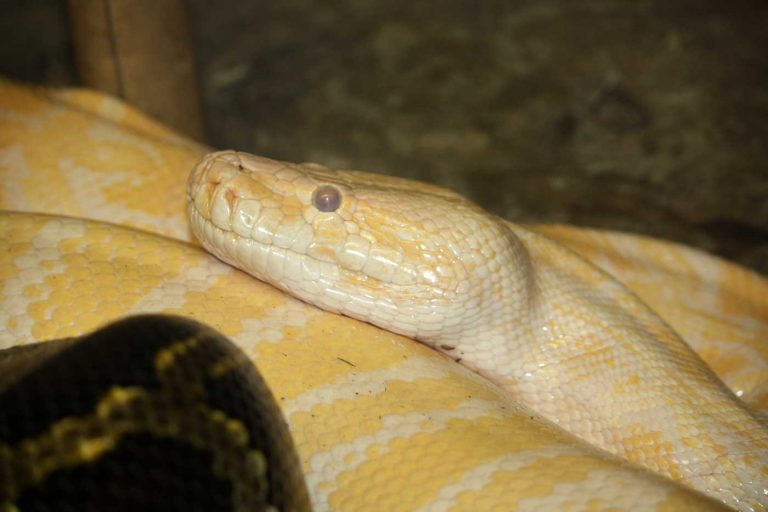
Indian pythons belong to the species Python molurus. They are a non venomous python species, They inhabit the tropical and subtropical areas of South East and Southern Asia. They are also called Indian (rock) python and Black-tailed python. This species is confined to Southern Asia. They are lighter in color compared to Burmese pythons.
Anatomy
The color is whitish or yellowish with the color of the blotches varying from light and dark tan to dark brown. They usually reach three meters in length. The 1990 study conducted by the national park of Keoladeo supports this assumption.
Habitat
This species is found in India, Pakisatan, Southern Nepal, Bhutan, Sri Lanka, Bangladesh, and the Northern parts of Myanmar. They inhabit a wide range of habitats, which include marshes, swamps, grasslands, river valleys, open jungles and even rocky foothills. They need a permanent water source.
Food
These pythons are carnivores, and they feed on reptiles, birds and mammals. They seem to have a preference for mammals.
African Burrowing Python

Calabaria Reinhardtii, the African Burrowing Pythons, otherwise known as the Calabar Pythons, are a non venomous Boa species confined or endemic to central and west Africa. The species is named after the Danish Herpetologist Johannes Reinhardt. There is a lot of confusion as to whether these pythons belong to the Boa family or the Python family, but one distinguishing feature is that these snakes are oviparous (like the pythons, and unlike most boas), but many experts believe that this is only an adaptation in its evolution, and tend to classify it as belonging to the python subfamily Pythoninae.
Anatomy
The adults of the species do not grow more than 1 meter in size. They have no palatal teeth. Different from other boas, these species have a pre-frontal bone in their compact skull. Thermo receptive labial pits are absent. The cylindrical shaped body and blunt head are adapted to burrowing. The tail is also blunt. The shape of the head and tail are similar, probably a defensive mechanism to confuse predators. They have strong, muscular bodies. Their eyes are red and small. The pupils are round.
Habitat
The African Burrowing Python dwells in rainforests. They are found in West and central Africa, from Liberia and Sierra Leone to Cameroon (including Bioko Island), the Central African Republic, Gabon and the Democratic Republic of the Congo
Food
These species eat small rodents and shrews. They invade he nests. They wait till the adults leave the burrows, then enter and devour the offsprings.
Burmese Python

The Burmese pythons are one of the five largest python species in the world. They are native to varied habitats in the subtropic and tropical areas of southeast and southern Asia. Very often, you can find them near water. They are semi-aquatic at times. These species can be found in trees also. Their average length in the wild is 3.7 meters but can very well grow up to 5.74 meters.
Anatomy
These pythons are dark in color with many black bordered brown blotches that run down the back. Though similar in color, the pattern itself is different from that of the African (rock) pythons. This could create confusion when the species are outside their natural habitats.
The patterns on the Burmese python are bolder like that of the giraffe.
Habitat
These pythons are widely spread out all through the southeastern and southern Asia which includes eastern parts of India, Western Bhutan, Nepal, South Eastern Bangladesh, Cambodia, Myanmar, Laos, Cambodia, Vietnam, Malaysia, Honkong, Southern China, Java, Sulawesi, Sumbawa and Bali. These pythons are very good swimmers and they need a permanent water source. You can find them in swamps, marshes, grasslands, river valleys, woodlands, rocky foothills and open clearings of jungles. They possess prehensile tails and are good climbers.
Food
These pythons are carnivores. They consume mammals and birds of appropriate size.
Ball Python

Ball Pythons are a non venomous python species native to Africa. These are the smallest of the African pythons. This, and their docile nature make them quite popular in the pet trade. There are no recognized subspecies. They are also called royal pythons. When stressed or frightened, these pythons curl themselves into balls, hence the name Ball Python. Rulers in Africa used to wear these pythons as jewelry. So they came to be called Royal Pythons.
Anatomy
These pythons are of stocky build with comparatively small heads. They have smooth scales. Both males and females have anal spurs on both sides of the vent. Males may have larger spurs, but this is not enough for sex determination. Sex is determined by the manual inspection of the hemipenes. Males have 8-10 subcaudal scales, while females have only 2-4. The color is black or brown with light brown and gold colored sides or blotches (dorsal). The belly is either white or cream colored and may have irregular black markings.
Habitat
These pythons seem to frequent savannas, open grasslands and areas with less trees. They love to inhabit termite hills and mammal burrows that are empty. These species are distributed in West Africa, especially in Sierra Leone, Senegal, Togo, Cameroon, Gambia, the Ivory coast, Liberia, Guinea Bissau, Central African Republic, Ghana, Niger, Benin, Burkino Faso, Mali, Uganda and the Democratic Republic of Congo.
Food
In the wild, they eat small mammals, Rodents and the like. Young specimens may feed on birds. Wild captured pythons may not respond to the food given to captive bred ones who do well on domestic mice and rats either live, killed or frozen.
New additions to Pythonidae family are given below:
Antaresia Maculosa or Spotted Python

Spotted Pythons belong to the species Antaresia Maculosa. They are a non-venomous species of pythons. We can find these Pythons in the northern regions of Australia. These Pythons are small in size and they possess an even temperament. This makes them quite popular among reptile Enthusiasts. The species have no recognized sub subspecies.
Apodora Irian or Papuan Python

Papuan Pythons or Irian pythons are a non-venomous Python Species belonging to the monotypic genus Apodora. You can find these species in New Guinea. There are no recognized subspecies for Irian Pythons.
Aspidites Melanocephalus or The Black-headed Python

Black-headed pythons belong to the species Aspidites Melanocephalus. They are a non-venomous python species native to Australia. The average length of the adults varies between1. 5 to 2 meters. They possess muscular bodies with flattened profiles. Their tapering tails end in a thin point.
Leiopython Hoserae or Southern White-Lipped Python

Leiopythons are of the species Leiopython Hoserae. They are also known as White Lipped(Southern) Pythons. These are a non-venomous species, native to New Guinea. The (northern) white-lipped pythons belonging to the species Leiopython Albertisii grow to a length of 213 centimeters while the white-lipped (southern) can grow to a length of 300 centimeters. These pythons ‘cast’ or regurgitate fur balls a couple of days after feeding.
Liasis Olivaceus or Olive Python

Olive Pythons belong to the species Liasis Olivaceus. These are a Python species in Australia. The adults reach over 4 meters in length. They have the distinction of being the second largest snakes in Australia. They have uniform chocolate brown or olive color, with cream colored bellies. Because of their similarity to the venomous king brown snake, these pythons are often killed.
Morelia carinata or Rough-scaled Python

Rough-scaled Pythons belong to the Morelia Carinata species. They are a large python species that are endemic to Australia. The adults average around two meters in total length. These snakes have a large scale near the parietal bone and keeled dorsal scales. They have slim muscular bodies. They have honey-tan color with dark reddish marks. There may be black spots on the white belly.
Brongersmai or Red Blood Python

Blood pythons are a non-venomous species of pythons with other names like (Red) short-tailed Python, Brongersma’s Short Tailed Pythons and the Blood Pythons. These are a non-venomous python species that you can find on the Malay Peninsula. The hatchlings range from 25 to 43 centimeters in length. The females are larger than the males, 120-180 cms against 91 -152 cms of the males. They look like heavyweights because of their strong structure. The color patterns can be bright red or orange or dull rusty red. There are also populations with yellow and brown colors.
Pythons as Pets
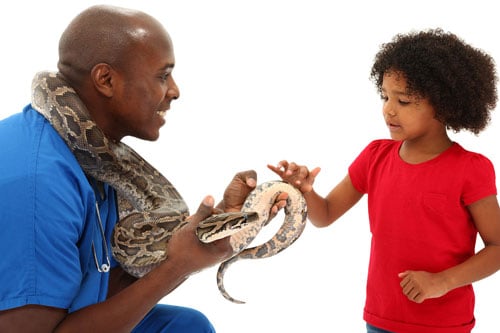
Many python species which include the Carpet pythons, the reticulated Pythons and Ball Pythons are very popular as pets because of the ease of care and remarkable color mutations. Controversies have risen from certain media reports, but pet pythons are comparatively safe if the Proper security measures are meticulously adopted. Deaths related to pet pythons are very rare.
Handling
Pythons are afraid of humans because of their high stature and as a rule, avoid people. Still, special care is needed when you try to handle them.
Some Interesting Facts About Pythons
- Among snakes, the pythons and anacondas are the biggest.
- Not all big snakes are venomous and not all venomous snakes are big. Pythons are definitely big in size, but actually very docile. They are definitely harmless, if you leave them alone. Pythons are very interesting reptiles.
- Pythons are constrictors, which means that they suffocate their prey to death. They swallow the prey whole after its heart stops beating. The whole prey is digested in the python’s stomach, except for fur and feathers that pass out. The duration of the digestion process depends on the size of the prey. The larger the prey, the longer the digestion process. The entire process may take even months. A python may eat only four to five times a year. A female python may not eat anything at all during the period of incubation.
- There is a direct relation between the python’s skin color and the region they inhabit. In spite of their size, most pythons are graceful swimmers. Many python species are identified as excellent swimmers.
- Pythons have pelvic spurs, very much like back legs. They seem to have inherited these appendages from their ancestors, namely, lizards. Pythons are basically ambush predators. They are not really fast. They depend on the element of surprise to catch their prey. They are always well camouflaged while waiting in ambush. Some pythons lie in water, fully submerged, except for the head and wait in ambush for prey. Some like the African Rock Python have been known to swallow very large prey like an antelope.
- Tree pythons, only seven feet long, hide high in the trees among the leaves. They strike out as birds fly by.
- The average speed of the python on the ground is One Mile Per Hour.
- Pythons depend on sunlight as well as their moods to regulate temperature. Pythons suffocate their prey to death. Usually neither do they literally crush the prey, nor do they break their bones.
- Pythons, at least a majority of them, are able to accurately detect warm blooded objects in their vicinity, using the sensing organs embedded in their lower lip.
- All pythons have overlapping scales, forked tongues, divergent patterns on their skin, a thick body and permanently open eyes.
- The longest reliably measured python was a reticulated python of about 6.95 metres (nearly 23 feet).
Python Species Compared: Size and Range
| Python | Typical adult length | Native range | Notes |
|---|---|---|---|
| Reticulated python | 3 to 6 m | Southeast Asia | Longest snake in the world |
| Burmese python | 3 to 5 m | South and Southeast Asia | One of the heaviest snakes; invasive in Florida |
| African rock python | 3 to 5 m | Sub-Saharan Africa | Africa’s largest snake |
| Indian python | About 3 m | South Asia | Lighter-coloured cousin of the Burmese python |
| Olive python | 2.5 to 4 m | Northern Australia | Plain olive-brown colour |
| Carpet python | 1.5 to 3 m | Australia and New Guinea | Many colour forms; popular pet |
| Ball python | 1 to 1.5 m | West and central Africa | Smallest African python; very popular pet |
| Anthill python | About 60 cm | Northwest Australia | Smallest python |
In the wild, many pythons live 20 years or more, and pet ball pythons often reach 20 to 30 years with good care, so owning one is a long commitment.
How Pythons Reproduce
All pythons lay eggs, which is one of the main differences between them and most boas, which give birth to live young. A female may lay from a handful of eggs in small species to 50 or even 100 in the largest ones.
Many female pythons stay coiled around their eggs until they hatch, which takes about two to three months. They protect the clutch from predators and keep the eggs from drying out. Some species, including Burmese and Indian pythons, can even warm their eggs by shivering, twitching their muscles to raise their body temperature. This is unusual for a cold-blooded animal.
Females usually do not eat while guarding their eggs and can lose a lot of weight. Once the eggs hatch, the mother leaves, and the young pythons must find food and shelter on their own.
Pythons vs Boas vs Anacondas
These big constrictors are often confused. They are related but belong to different families.
| Feature | Pythons | Boas | Anacondas |
|---|---|---|---|
| Family | Pythonidae | Boidae | Boidae (a type of boa) |
| Where they live | Africa, Asia, Australia | Mostly the Americas, also Madagascar and some Pacific islands | South America |
| Babies | Lay eggs | Most give birth to live young | Give birth to live young |
| Biggest record | Reticulated python, longest snake | Boa constrictor, up to about 4 m | Green anaconda, the heaviest snake |
So the longest snake is a python, but the heaviest snake is the green anaconda, a member of the boa family that spends much of its life in water.
Invasive Burmese Pythons in Florida
Burmese pythons are not native to the Americas, but they are now established in southern Florida, especially in and around Everglades National Park. Scientists believe the population grew from pets that escaped or were released, possibly helped by animals that escaped during hurricanes.
With no natural enemies big enough to control them, the pythons have spread widely. Studies have linked them to steep declines in raccoons, opossums, rabbits and other small mammals in the Everglades. They also eat wading birds and have even been found with deer and alligators in their stomachs.
Florida now runs programmes that pay trained hunters to remove pythons, and holds public python-removal challenges. Releasing any pet snake into the wild is illegal and harmful to native wildlife.
Pythons FAQs
Are pythons venomous?
No, pythons are not venomous. They kill their prey by squeezing it (constriction), and they usually are not dangerous to people.
Which python is the biggest?
The reticulated python of Southeast Asia, which can grow up to 6.95 metres (about 23 feet). It is the longest snake and the longest reptile in the world.
What do pythons eat?
Pythons eat mammals and some birds. Small ones eat rodents, while giants like the African rock python can eat antelopes, monkeys, and even crocodiles.
Where do pythons live?
Pythons live in Africa, Asia and Australasia, in woodlands, rainforests, grasslands and swamps. Many live near streams, rivers and lakes and are good swimmers.
Which pythons make good pets?
Carpet pythons, ball pythons and some others are popular pets because they are easy to care for. But some species can only be kept safely by professionals.

Randi Jones is the owner and founder of the Nature Gift Store, an online retailer specializing in nature-themed gifts, educational science projects, live animal nature kits and real butterfly artwork. A biology graduate who fell in love with insects, she founded the company in 2001 to make active learning about nature fun, accessible and engaging for children and adults. Her store offers real butterfly frames, home and garden decor and educational live animal kits, including ant farms, worm farms, tadpoles, ladybugs and hermit crabs, and she runs a bug museum in Washington featuring live animals like Eddie the Iguana alongside other reptiles and insects. Randi wrote most of the guides on this site. They first appeared on her long-running nature sites, including Monarch-Butterfly.com, Ladybug-Life-Cycle.com, Frog-Life-Cycle.com, Dragonfly-Site.com and Butterfly Pictures, which have now been brought together here at Learn About Nature.