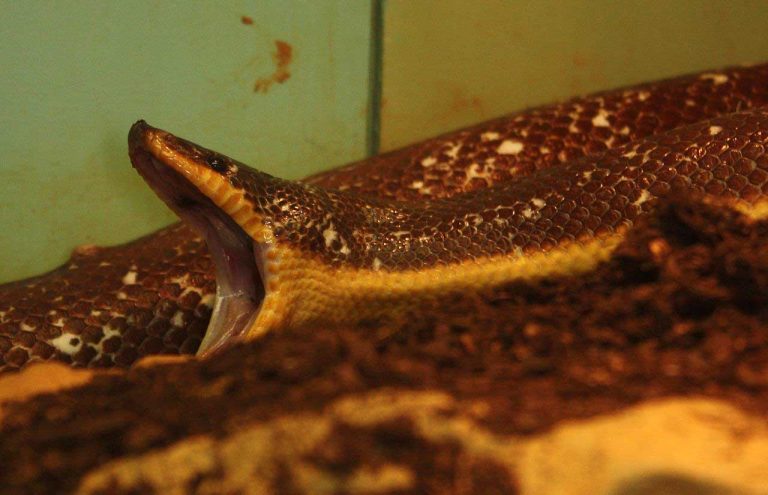
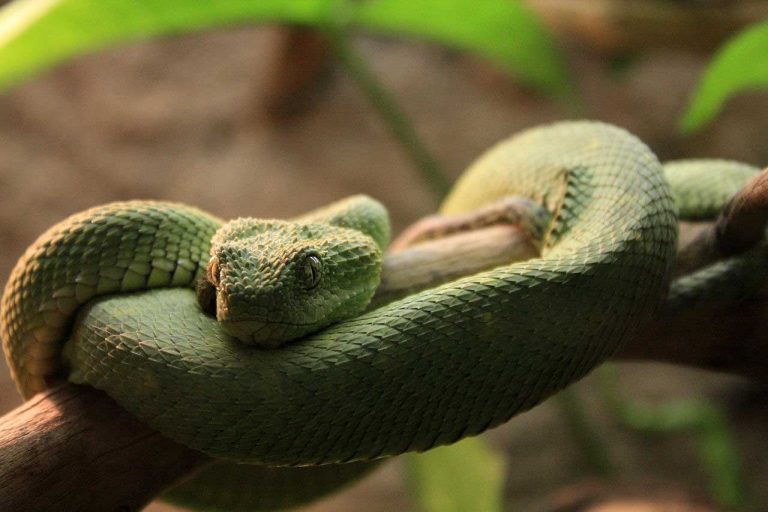
Indigo Snake

Scientific Classification & Quick Facts
| Common name | Eastern indigo snake |
| Scientific name | Drymarchon couperi |
| Kingdom | Animalia |
| Phylum | Chordata |
| Class | Squamata |
| Family | Colubridae |
| Genus | Drymarchon |
| Conservation status | Least Concern |
| Type | Reptile (non-venomous snake) |
| Diet | Lizards, frogs, snakes, turtles, birds, small mammals |
| Habitat | Pine flatwoods, dry prairies and gopher tortoise burrows |
| Native range | Southeastern United States, mainly Georgia and Florida |
| Size | Average 6-7 ft; record 280 cm (9.2 ft) |
| Colours | Glossy blue-black with cream or red throat |
| Special feature | Longest native snake in the United States |
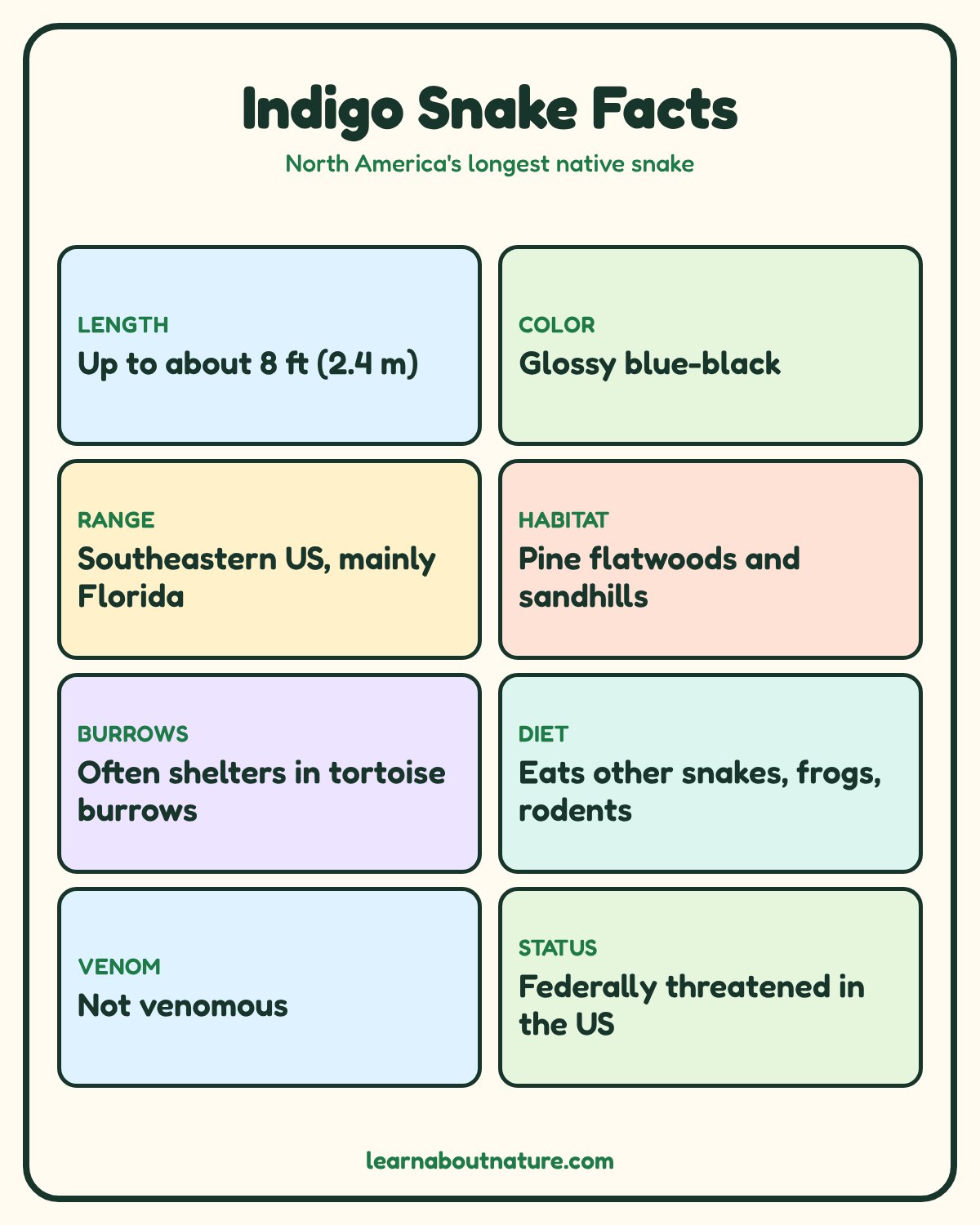
Eastern Indigo Snake, biologically called Drymarchon couperi, is an inhabitant of the Eastern United States. It is a big snake, recognized as the lengthiest inhabitant snake in the US, and a non-poisonous variety.

Anatomy

This non-poisonous big indigo snake has a tubby body, of an average length of six to seven feet
In the United States, the Eastern indigo snake is the biggest, and it is non-venomous. These indigo snakes have a uniform black color, except that on the throat, chin and perhaps on the cheek, where they have patches of cream and red. They also have big smooth scales, 17 in number arranged in rows in the middle of the body. The length of a full grown snake reaches 157.2 to 213.36 cm. But still the recorded length is 280.4 cm. The males of this sexually dimorphous Eastern Indigo Snakes grow bigger than their females. The young indigo snakes look alike, but round their bodies there is a white band
The scales on the lateral and dorsal side of the Eastern Indigo Snake is evenly displayed in a black-blue color, with the exception of some colored orange-red to tan colored throat, chin and cheek. This snake acquired its name from the ventral scales that shine and are smooth, with a blackish-purple appearance in brilliant light. In the United States this soft-scaled snake is believed as the longest resident snake.
Behavior
The Eastern Indigo Snakes are agile, vigilant and until they adapt in captivity, timid in nature.
Habitat
The southern province of Georgia and Florida are the places where you can often find the Eastern Indigo Snake. However, they are also found in most of the places like Alabama and South Carolina.
You can see them in scrub Flatwoods dry prairie, tall pine, hardwood hammocks of the tropics, agricultural grounds, banks of fresh water, human beings modified habitats and dunes on the coasts. These snakes fare well in environments of wetlands and not in xeric (extremely dry) states. Generally, you can see Eastern Indigo Snakes and gopher tortoises dwelling in the same habitats. The gopher tortoises dwell in the xeric environments, and the Eastern Indigo Snakes utilize the tortoise burrows as shelter.
As a Pet
Breeding

When your Eastern Indigo Snake attains a length of six feet, it is time for you to think of breeding / reproduction. In case you try breeding when your female indigo snakes are very young, it will lead to egg binding. Most keepers suggest breeding only when the female is four years of age and almost six feet in length.
During the fall, it is said that certain adult snakes lose appetite for food; this is the time for you to begin cooling them. For the Eastern indigos and the Texas indigos, gradually decrease the temperature at night till it falls to 60 F. For the others, you can retain the temperature from 68 to 70 F. Besides, at day time decrease the temperature of their hot areas to 80F
Housing
In general, these Eastern Indigo Snakes are agile at day and night. As such, they require enough space to wander. Most breeders suggest an enclosure of 6’ x 2’, which is the least space for a fully developed Drymarchon. It is not a real necessity that you provide space for the baby snakes, because most of the time they are in the hideouts. Shoe boxes are enough for babies. As the young snakes grow, you can shift them to a cage of size more or less 2’ x 1.5’. When they attain a length of 3’, shift them to a CB 70 rack till they are big enough to occupy the adult cage.
Similar to other reptiles, a gradient in temperature is ideal for Cribos (member – Drymarchon genus) and Indigos, enabling the snake to regulate the temperature on their own in the most precise manner, simulating a natural environment.
Provide them a big cage with an assortment of barriers for viewing (like sterilized driftwood, cork bark) and hiding places. A cage of capacity 20-30 gallons accommodates one or two young ones on a temporary basis. Still, for one or two adults you need a cage of volume 125 gallons or larger. Eastern Indigo Snakes are poor climbers. Still, when they are not scared, they coil themselves up and take shelter on raised shelves, if you make them available.
Substrate, Temperature and Water
The best substrates are aspen chips, fir, bark shards and cypress. The most suited temperature for the indigo snakes is 76 – 82 F at daytime and 68 F at night. For quite some hours a day, keep a hot area of 90F. Besides, always keep in place a big water bowl (Spick and span) and the snake will drink from it, and also, if the container is sufficiently big, immerse itself in the bowl
Food
Indigo snakes are usually voracious eaters. They do not squeeze their prey; rather they squash and gulp down their prey with their very strong jaws. Even though many breeders boast of maintaining their Drymarchon with the diet of just a rodent, the snakes would be fitter and content with a mixed diet. When in the wild, Eastern indigo snakes do not constrict their prey, but they have wide-ranging tastes. Their diet consists of salamanders, lizards, toads, baby turtles, other variety of snakes, smaller mammals, birds as well as frogs, even comprises of pit vipers. The younger indigo snakes consume certain insects, whereas a young indigo that is as long as 17 to 24 inches can subdue tiny rodents and also frogs. In captivity, they flourish well with rodents that are killed and really savor a diverse variety of food.
Therefore give your snake, chicken necks, quail, snake chicks, fish, mice, rats and several other snakes. Everything is frozen, then thawed and cut in small sizes. Maintain the size of the meat small for several reasons. First, they are unable to open their jaws wide enough like the other snakes. Remember, it is not possible for an indigo snake of about 8 feet in length to manage even an oversized rat. Food of smaller size given frequently, is good for them. Give your snake moderate/small feed weekly twice.
The desire for food of a grown up Drymarchon varies in accordance with the season. In winter the adult snakes go without food for a considerable period. When spring is on the way it is time for them to begin to eat constantly. In summer, when the weather is warm, pet snakes have a good appetite.
Handling
As a keeper it is apt that you take extra precaution while opening the enclosure to feed the snakes. It is usual that a Cribo or indigo dives out of the enclosure with mouth wide open. These reptiles are too strong and the grip of their jaws is as strong as a vice. In case you get a bite, be prepared for profuse bleeding and cuts. At the time of giving food be vigilant and prepare to run away.
Eastern indigo snake FAQs
How long is an eastern indigo snake?
Adults are usually 6 to 7 feet long (about 1.8 to 2.1 metres). The biggest recorded was 280 centimetres, about 9 feet, which makes it the longest native snake in the United States.
Are eastern indigo snakes venomous?
No, they are not venomous and do not squeeze their prey either. But they are strong, and their jaws grip like a vice, so a bite can bleed a lot.
What do eastern indigo snakes eat?
They eat many things, including salamanders, lizards, toads, frogs, baby turtles, other snakes (even pit vipers), birds and small mammals.
Why is it called an indigo snake?
In bright light its smooth, shiny scales look blue-black or purplish, like the dye indigo.
Where do eastern indigo snakes live?
They live in the southeastern United States, mostly in Georgia and Florida. They often share gopher tortoise burrows, which they use for shelter.

Randi Jones is the owner and founder of the Nature Gift Store, an online retailer specializing in nature-themed gifts, educational science projects, live animal nature kits and real butterfly artwork. A biology graduate who fell in love with insects, she founded the company in 2001 to make active learning about nature fun, accessible and engaging for children and adults. Her store offers real butterfly frames, home and garden decor and educational live animal kits, including ant farms, worm farms, tadpoles, ladybugs and hermit crabs, and she runs a bug museum in Washington featuring live animals like Eddie the Iguana alongside other reptiles and insects. Randi wrote most of the guides on this site. They first appeared on her long-running nature sites, including Monarch-Butterfly.com, Ladybug-Life-Cycle.com, Frog-Life-Cycle.com, Dragonfly-Site.com and Butterfly Pictures, which have now been brought together here at Learn About Nature.