Boa Snake
Scientific Classification
| Kingdom: | Animalia |
| Phylum: | Chordata |
| Subphylum: | Vertebrata |
| Class: | Reptilia |
| Order: | Squamata |
| Suborder: | Serpentes |
| Family: | Boidae |
| Subfamily: | Boinae |
| Genus: | Boa |
| Species: | B. constrictor |
| Binomial name: | Boa constrictor |
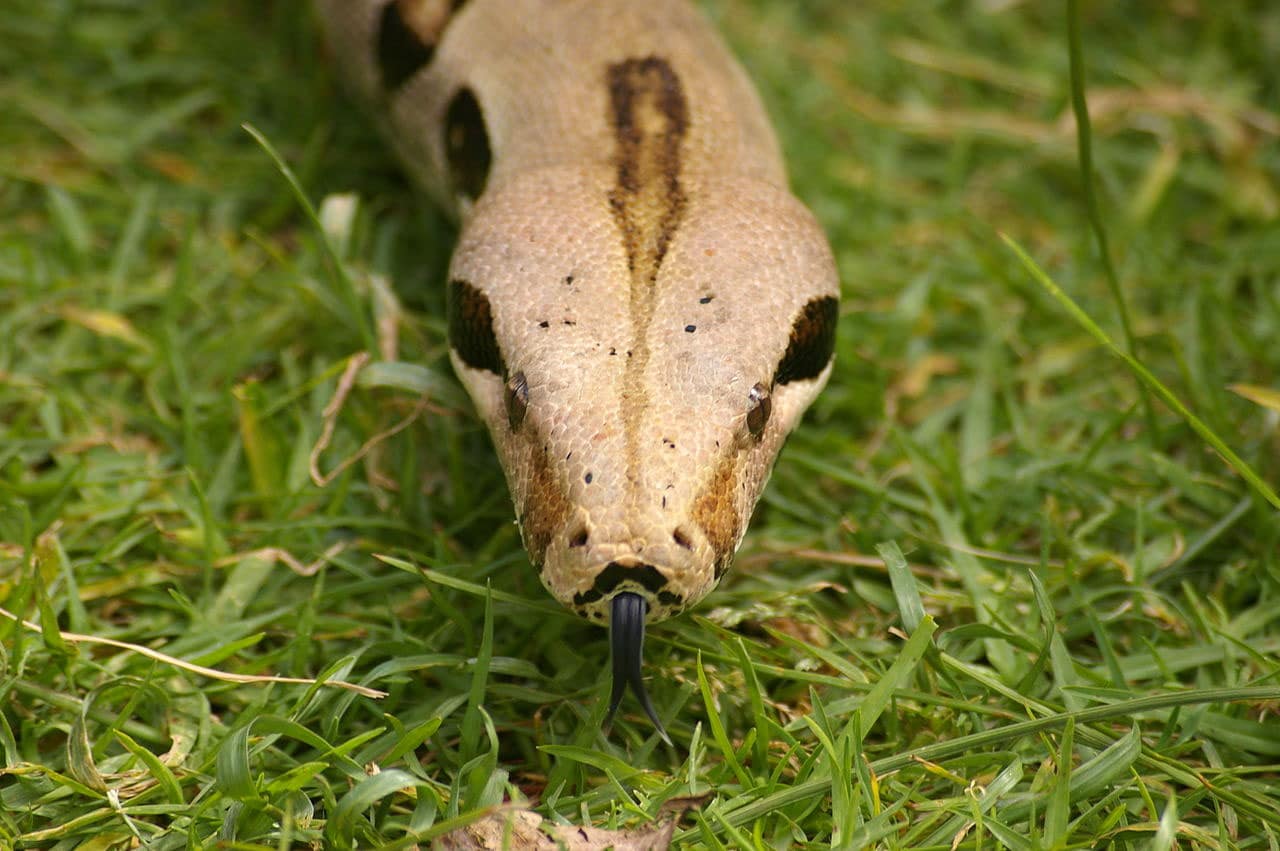
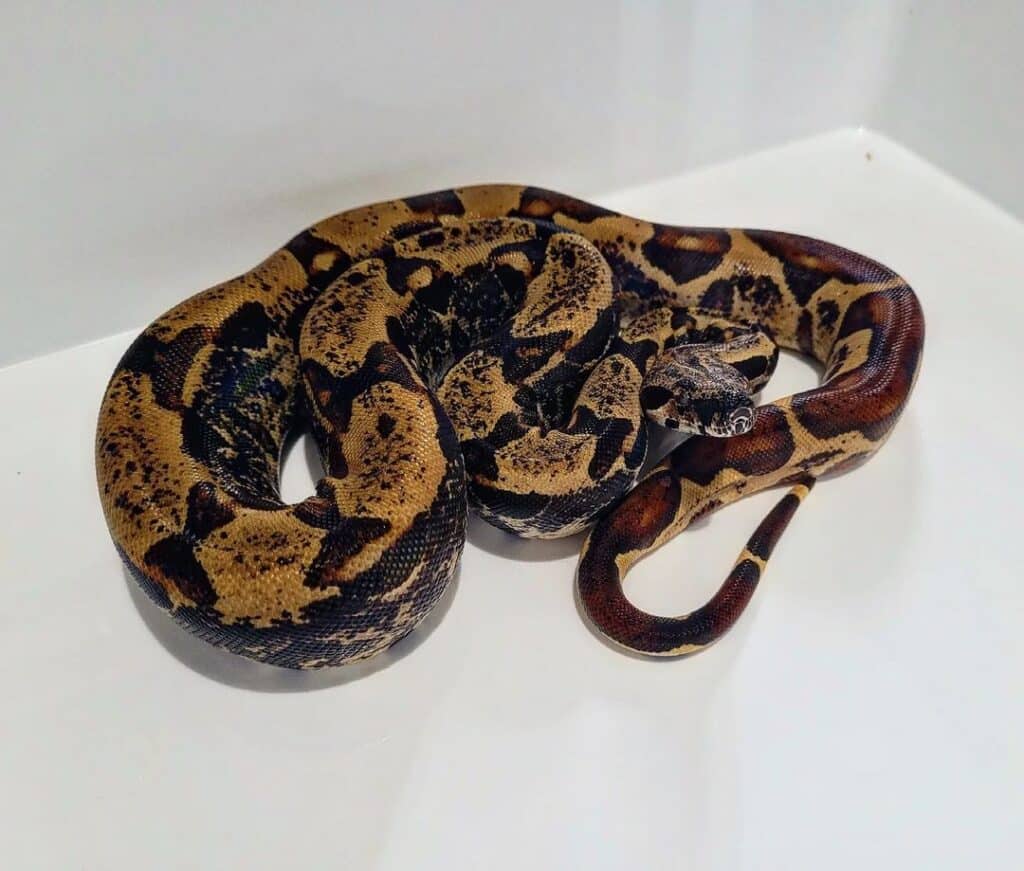
The Boa Constrictor is a heavy-bodied snake and a huge figure at that. It is associated with the Boidae family. We generally find these snakes in the Central, Northern, and Southern provinces of America, and also in certain islands of the Caribbean. It displays a variety of patterns and colors. Of the 10 sub-varieties presently identified, some are contentious.
The name boa is a general one for a snake that is non-venomous and constricting. These boas exist in 40 varieties and more of genuine Boas (family Boidae).
Anatomy
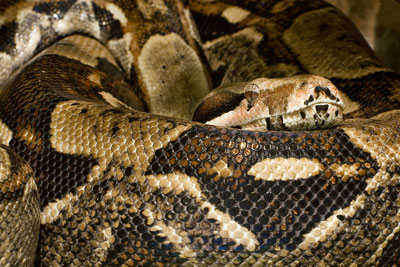
Boa constrictors are big snakes, but when compared to the several other huge snakes like the Burmese Python and the reticulated python, this is only of a moderate size. Its length differs from 3 to 13 feet (0.9 -3.96m) based on the area and accessibility of appropriate prey. There exists a clear demarcation in their sex. The females are in general, bigger, both lengthwise and in girth when compared to the males. Thus the standard size of a grownup female boa varies from 7 to 10 feet (2.1 to 3.0m), and that of males is 6 to 8 feet (1.8 to 2.4 m). In general a female boa snake grows more than 10 feet (3.0m), especially when they are in captivity; here we find the boa snakes grow from 12 feet to 14 feet (3.7 to 4.3m).
The body of the boa snakes is massive; a big snake can weigh about 27 kg (60 pounds). Normally, the females, which are bigger, generally weigh from 10 to 15 kg (22 to 35 pounds). In certain cases, some snakes weigh up to even 45 kg (100 pounds) and more, even though this does not occur commonly.
There are other areas where the boa snakes are considered as dwarf boas like the group of B. C. Imperator, dwelling in Hog Island. These tiny sub-varieties are usually an insular (Over many generations, reduction in size of large animals) group. The B. C. Constrictor, in its own right, is a large sub variety of boa constrictor snake.
Habitat
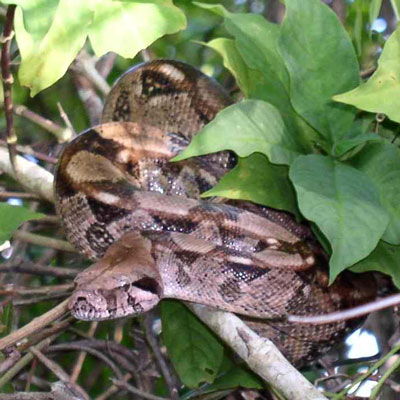
These boa snakes dwell in hot, tropical regions, we find them on trees as well as on the ground.
As a Pet
Breeding
Boas deliver young ones that are alive, in a sense they are fully formed within their mother’s womb. After birth, they are self supporting and understand very well about hiding and foraging.
Housing
Prior to bringing home the snake, you have to take crucial decisions about how you will house the snake when it grows to 12 feet. A snake of length 12 feet requires a cage of about 15 feet.
If your snake is 10’ long, then the ideal size of the cage is 5w x 5d, if not 4d x 6 w, fetch it. A snake of length 12 feet is cozy in a cage of size 8 x 4 etc. By all means have a cage that is longer than the snake. About the height, remember boa constrictor snakes do climb and you must make provision for this, as you can see them climbing across the branches of the tree placed above the cage. A height of 5’ may suit the snake fine. You would do well to use the front portion as an entrance for the snake, and consider using the top of the box a table for handling the snake.
Provide your snakes with the following:
Two hides – provide hideouts on either side of the cage (hot and cool sides). On either side, hideouts are necessary since the snake opts for a place with a suitable temperature. The temperature of the hideout is an essential factor, if your snake is not capable choosing the right temperature it will lead to illness. Make your hideout from either a carved out a bark or /log, simulating a cave. Irrespective of the material you use, keep it cleansed and free of parasites/chemicals/pesticides.
Water bowl – your boa snake requires a bowl for water, sufficiently big for it to immerse itself in. Place the water bowl at either end, but not just above the source of heat.
Food
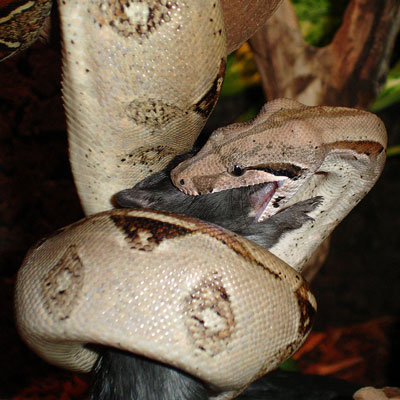
The diet of boa snakes is chiefly rodents. Their food differs in size; they consume pinky mice (when just born) to mature rats. If you have bigger Boas, you could consider feeding them with small sized rabbits. Feed the snakes with items of prey fairly accurate in breadth (not bigger than the broadest portion of the snake’s girth. Otherwise, it will cause it harm and make it regurgitate the food. Possibly feed your snake with rats and not mice. (A puppy rat and not a fully developed mouse) this is because rats have better nutritional value for your pet snakes.
Pre kill all the food items: kill the prey in the presence of the snake just before feeding it or kill the prey, freeze it and thaw it before feeding the snake, . As regards the frozen prey, store it in a polythene bag, remove it to room temperature or keep in warm water till it defrosts. Do not microwave or cook the prey! Snakes dislike cooked meat. Use microwave only for “thawing”
Handling
On the whole, the Boa Constrictors display a docile temperament, and do not resort to violent behavior. The young boa snakes are restless animals, In the course of their growth they become calm when you handle them frequently.
Having discovered a fondness for insects while pursuing her degree in Biology, Randi Jones was quite bugged to know that people usually dismissed these little creatures as “creepy-crawlies”.