Green Algae

Green algae are a large and varied group of mostly water-living organisms that make their own food from sunlight, just like plants. They range from single cells far too small to see, to long threads and leafy seaweeds such as sea lettuce, and they are the ancestors of all land plants.
Scientific Classification & Quick Facts
| Common name | Green algae |
| Scientific name | Chlorophyta |
| Kingdom | Plantae |
| Type | Plant-like algae, mostly aquatic |
| Diet | Makes food by photosynthesis |
| Habitat | Mostly water; also rocks, damp soil and tree bark |
| Special feature | Some live with fungi as lichens or inside animals |
What Are Green Algae?
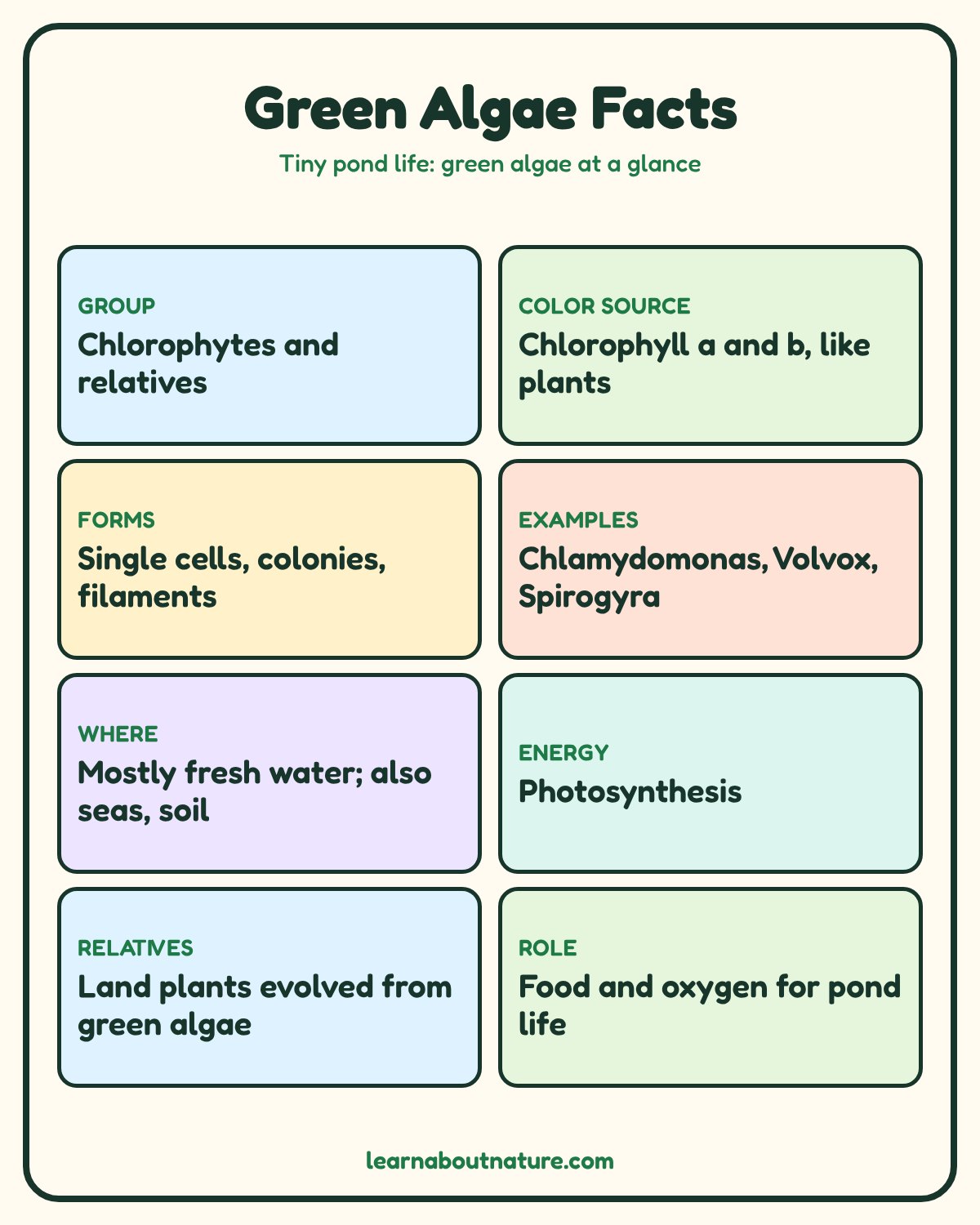
Green algae are split into two main branches: the chlorophytes, which include many familiar pond and ocean algae, and the charophytes, which include desmids and stoneworts. Land plants evolved from charophyte green algae hundreds of millions of years ago.
Because land plants are not usually counted as green algae, even though they evolved from them, scientists call green algae a paraphyletic group. That simply means it includes some, but not all, of the descendants of a common ancestor.
Thousands of species of green algae have been described, living in a huge variety of habitats. Like plants, they use two forms of chlorophyll to capture light energy and make sugar. Unlike most plants, though, the majority live in water.
Shapes and Forms
Green algae come in many forms:
- Single cells, many of which swim using two whip-like flagella, such as Chlamydomonas.
- Colonies, groups of cells that live together. Volvox forms hollow, rolling green balls made of thousands of cells.
- Filaments, long chains of cells such as Spirogyra, the slimy green threads often seen in ponds.
- Seaweeds large enough to see easily, such as sea lettuce on rocky shores.
Stoneworts, such as Chara, are freshwater green algae that look surprisingly like small plants, with stems and whorls of branches. They are among the closest living relatives of land plants.
Habitat
Most green algae live in fresh water, from lakes and ponds to puddles and birdbaths. Many others live in the sea. Some even live on land, on damp soil, tree bark, rocks, and snow, where certain kinds turn the snow pink or red.
Some green algae live inside other organisms in a partnership called symbiosis. They are found inside the green hydra (Hydra viridissima), the single-celled Paramecium bursaria and some marine flatworms. The algae get a safe home, and in return they share some of the food they make by photosynthesis with their host.
Green algae also team up with fungi to form many lichens. The genus Trebouxia is one of the most common lichen partners. In most lichens the fungus cannot survive on its own, but the alga often can live freely without the fungus.
Trentepohlia is an unusual filamentous green alga that often looks orange because of extra pigments. It grows on its own on rocks, damp soil and tree bark, and it also acts as the food-making partner in some lichens.
Anatomy/Cellular Structure

Photo by: Mykola Swarnyk
The chloroplasts of green algae contain chlorophyll a and b, which give them their bright green color. They also have helper pigments such as beta-carotene and xanthophylls, the same kinds of pigments found in plants.
Green algae store energy as starch, inside their chloroplasts, and most have cell walls made largely of cellulose. In both ways they are very much like land plants. Like other eukaryotic cells, their cells also contain a nucleus and mitochondria, the tiny structures that release energy from food.
Many green algae cells have two flagella, though some have four or more. These whip-like tails are anchored inside the cell by a supporting system of fibers and tiny tubes. In charophytes, flagella usually appear only on the male sex cells (sperm), if at all.
Green algae cells divide in a few different ways. In one large group, the chlorophyceans, a special set of tiny tubes called a phycoplast helps split the cell in two.
Reproduction
Green algae can reproduce asexually, for example by simply splitting in two or by making swimming spores. Many can also reproduce sexually.
Sexual reproduction varies a lot between species. In some, two sex cells that look exactly alike join together, which is called isogamy. In others, a small swimming sperm cell fertilizes a large egg cell that does not move, which is called oogamy. Some species fall in between.
When two sex cells, each with one set of chromosomes, fuse, they form a zygote with two sets. In some green algae, such as sea lettuce, the life cycle switches between two kinds of body, one with a single set of chromosomes and one with two. This is called alternation of generations, the same pattern seen in land plants.
In filamentous algae such as Spirogyra, sexual reproduction happens by conjugation. Neighboring filaments form little bridges between their cells, and the contents of one cell move across to join the other. Under a light microscope, the empty cell walls left behind look like a ladder.
Pheromones

Photo by: Nigel Mykura
Some green algae use chemical signals called sex pheromones to bring partners together or to switch on sexual reproduction. Scientists have studied this in only a few species, but it may be common across the group.
The best-known example is Volvox carteri, which forms colonies of thousands of cells and lives in temporary pools that dry up in summer. Ordinary Volvox colonies die if their pool dries out. But when conditions start to change, the colonies release an extremely powerful pheromone that tells other colonies to switch to sexual reproduction. This produces tough, dormant zygotes that can survive drying out and hatch when the pool fills up again.
Green algae FAQs
What are green algae?
Green algae are plant-like organisms that make their own food with chlorophyll. Some are single cells, some form colonies or long threads, and some are big seaweeds.
How many kinds of green algae are there?
There are around 8,000 kinds of green algae.
Where do green algae live?
Most green algae live in water, but some live on rocks, damp soil and tree bark.
Are green algae plants?
Not exactly. Green algae are not counted as true land plants, but their closest relatives, the charophytes, are the nearest relatives of land plants.
Can green algae live inside other living things?
Yes. Some live inside animals such as the green hydra, or inside a single-celled paramecium. Others team up with fungi to make lichens.

Randi Jones is the owner and founder of the Nature Gift Store, an online retailer specializing in nature-themed gifts, educational science projects, live animal nature kits and real butterfly artwork. A biology graduate who fell in love with insects, she founded the company in 2001 to make active learning about nature fun, accessible and engaging for children and adults. Her store offers real butterfly frames, home and garden decor and educational live animal kits, including ant farms, worm farms, tadpoles, ladybugs and hermit crabs, and she runs a bug museum in Washington featuring live animals like Eddie the Iguana alongside other reptiles and insects. Randi wrote most of the guides on this site. They first appeared on her long-running nature sites, including Monarch-Butterfly.com, Ladybug-Life-Cycle.com, Frog-Life-Cycle.com, Dragonfly-Site.com and Butterfly Pictures, which have now been brought together here at Learn About Nature.