Chicken

Gallus Gallus Domesticus, which is popularly known as chicken, belongs to the red jungle fowl group and is the most widespread and common poultry as records of 2003 show more than 24 billion chickens were bred. It is believed to be the most populated species in the world when compared to any other bird species. For humans, chicken is a prime source of consumption, as both its eggs and meat are very popular as culinary dishes.
Chicken Quick Facts
| Common name | Chicken |
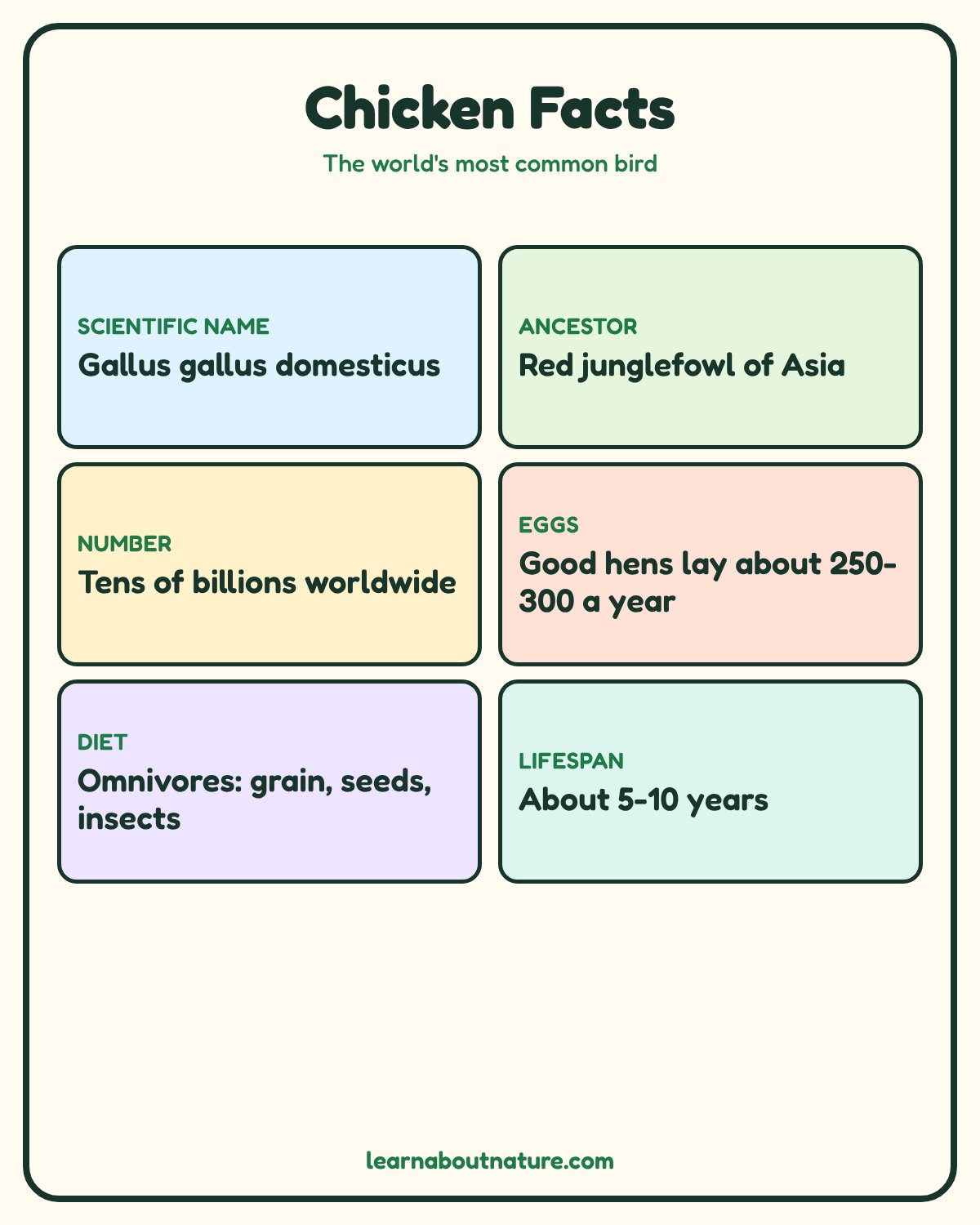
| Scientific name | Gallus gallus domesticus |
| Kingdom | Animalia |
| Phylum | Chordata |
| Class | Aves |
| Order | Galliformes |
| Family | Phasianidae |
| Genus | Gallus |
| Type | Domestic bird (poultry) |
| Diet | Omnivore: insects, seeds, small lizards and mice |
| Native range | Domesticated in Asia from the red junglefowl |
| Lifespan | Usually 5-10 years |
| Colours | Eggs from white and brown to green, blue or purple |
| Special feature | Lives in flocks with a pecking order |
Archeological evidence suggests that chickens were first domesticated in Asia several thousand years ago. But many studies also revealed different maternal origin from East, Southeast and South Asia.
Description
Chickens are known to be omnivores. They prefer to eat insects, seeds, as well as medium sized reptiles and creatures like lizards, young mice, and small snakes and so on. Normally, the life span of a chicken is around 5-10 years. But there are few species that are also known to live longer, and the oldest chicken was a hen that died at the ripe old age of 16.
Reproduction

Roosters look different than the normal hens as they possess beautiful plumage of flowing, long tails as well as bright tiny feathers on their back and neck. These plumages are generally brighter in color, compared to that of the females of the same breed. They can also be identified by viewing their comb or the spur on the legs of the male species. The adult form of chicken has a thick and fleshy crest, also known as cockscomb or comb on the head, and hanging skin or flaps under the beak area, which is referred as to as wattles. Domestic chicken is usually heavy weight, hence are not capable to fly long distances, whereas the lighter birds may fly into a tree or over a fence.
Behavior
Chickens usually live in flocks, and are known as a social bird that loves company. They approach communally to the incubation process and nurturing of the young ones. In the flock, individual chicken has the domination power to establish a pecking order, which gives them the priority to access food or choose locations for nesting. If a single rooster or hen is removed from the flock, the whole social order gets temporarily disrupted, which is regained after reestablishing a new pecking order.
Mating
Like other birds, the chickens also undergo courtship processes before mating. Some roosters are found to dance near or around the hen, termed as “a circle dance”. During that process, the rooster will lower his wings, which will be brought too close to the hen’s body. The dancing is believed to increase the interest in hens and trigger her to respond to the male’s “call”. Once the male receives the signal, it will mount over the female and start the mating process. Hens will look for nests to lay eggs that already contain eggs of the other hens, because they prefer laying eggs in a same location, even if there are more than one or two hens. To encourage laying eggs, many farmers are also known to use plastic or fake eggs in the nests of hens.
Farming

The chicken is so popular for its meat and eggs that around 50 billion chickens are bred every year as a source of food. To rear a large population of chickens, farms are more convenient. Around 74% of the total chicken meat, as well as 68% of the total eggs come from the farm production, according to the data from the “World Watch Institute”. Other than intensive farming, chicken can be grown in another method, known as free range farming. According to some environmentalists, intensive farming is harmful to the environment, along with human health. Whereas the ones who support the intensive farming method say that this method saves much environmental resources like land, food and water.
Other than that, backyard chickens or small-scale micro-flocks are getting popular, in which less than a dozen chickens are reared in the urban or suburban residential areas for many benefits like utilizing waste of the chicken as fertilizers for agriculture or for garden use, for best quality egg and meat and for controlling pest like bugs.
Reared For Meat (Broilers)
The chicken used mainly for meat is known as broiler chicken. Basically, they grow to market size within about 6 weeks. They are not kept in cages, instead grown in open huge structures termed as grow out houses. Within 5 to 9 weeks of growth, this broiler chicken is used in the slaughterhouse for meat purpose.
Reared For Eggs
Chickens that are brooded for eggs are referred to as egg-laying hens. Eggs are very popularly consumed worldwide. In the UK, the eggs consumed per day are more than 29 million. Some species of hens can produce around 300 eggs a year, and the highest was an egg laying hen producing 371 eggs in 364 days. Basically, these hens are kept in battery cages, which are designed to allow the waste of hens to drop down, as well as to collect the eggs laid by these hens into a conveyor belt.
Eggs Laying
The color of the eggs differs from pure white to brown shade, and in some areas, eggs of green, blue and even purple have been found. Generally, hens prefer to lay only up to 12 eggs, which is a complete clutch. Then they will incubate the eggs by sitting on it and imparting temperature. During the incubation period, the hens rarely leave their nest to eat, dust-bath or drink. It regularly turns the eggs during the initial period of incubation. In modern farming, anyway, brooding is less experienced among the hens. The incubation period takes around 21 days, after which small chicks emerge out of the egg shell. Every egg will hatch within a same period of time, maybe one or two days different from each other. The hens are excellent mothers that care for their little ones very well by brooding them whenever they require warmth. After reaching back to the nest at night, the hen leads its kids to water and food. It also guards fiercely while wandering outside to protect them from the predators. The mother hen will care for the chicks until they turn several weeks old, after which, the hen will start to lay the next batch of eggs.
As Food

Chicken is a favorite meat for most of the non vegetarian food lovers. A variety of dishes can be made with the chicken meat. Traditional methods to use chicken meat are to bake, roast, and deep fry, make into sausages, include in salads, broasting or just making stews. Eggs too are consumed by many people in the form of egg scramble, boiled egg, egg omelets, and fried egg and as an important ingredient in bakery preparations. Some also prefer eating it raw, but the body absorbs less of the protein from raw eggs than from cooked eggs.
Chicken FAQs
What do chickens eat?
Chickens are omnivores. They eat insects and seeds, and they will also catch small animals such as lizards, young mice and small snakes.
How long do chickens live?
A chicken usually lives about 5 to 10 years. The oldest one on record was a hen that died at age 16.
What is a pecking order?
It is the ranking system chickens set up in a flock. Birds higher up get first choice of food and nesting places, and if one bird is removed the order is briefly upset until a new one forms.
How long does it take for a chicken egg to hatch?
A chicken egg takes about 21 days to hatch. During this time the mother hen rarely leaves the nest and turns the eggs regularly.
Where do chickens come from?
Chickens belong to the red junglefowl group. Evidence suggests they were first domesticated in Asia thousands of years ago, possibly around 8000 BCE in northern China.

Randi Jones is the owner and founder of the Nature Gift Store, an online retailer specializing in nature-themed gifts, educational science projects, live animal nature kits and real butterfly artwork. A biology graduate who fell in love with insects, she founded the company in 2001 to make active learning about nature fun, accessible and engaging for children and adults. Her store offers real butterfly frames, home and garden decor and educational live animal kits, including ant farms, worm farms, tadpoles, ladybugs and hermit crabs, and she runs a bug museum in Washington featuring live animals like Eddie the Iguana alongside other reptiles and insects. Randi wrote most of the guides on this site. They first appeared on her long-running nature sites, including Monarch-Butterfly.com, Ladybug-Life-Cycle.com, Frog-Life-Cycle.com, Dragonfly-Site.com and Butterfly Pictures, which have now been brought together here at Learn About Nature.