Orangutan Facts for Kids: Habitat, Diet and Fun Facts
Quick answer: An orangutan is a large, red-haired great ape that lives in the rainforests of Borneo and Sumatra in Southeast Asia. Orangutans spend most of their lives in the trees and eat mostly fruit, along with leaves, bark and insects. All three species are Critically Endangered, mainly because their forests are being cut down.
High in the rainforest canopy, a shaggy orange ape swings slowly from branch to branch, using its long arms and grasping feet. As the sun sets, it bends leafy branches into a soft bed and settles down for the night. That is an orangutan, a red-haired great ape of Southeast Asia.
Orangutans are smart, gentle and patient. They learn which fruits to eat and how to find them from their mothers, who care for them for many years. Here are the orangutan facts every young explorer should know.
Teachers and students: you’re welcome to use this fact sheet in lessons and projects with credit to Learn About Nature.
Free printable: Download the Orangutan fact file worksheet (PDF) – draw the animal, fill in the facts and match key words. Answer key included.
Orangutan Quick Facts
| Class | Mammal |
| Order | Primates (great ape) |
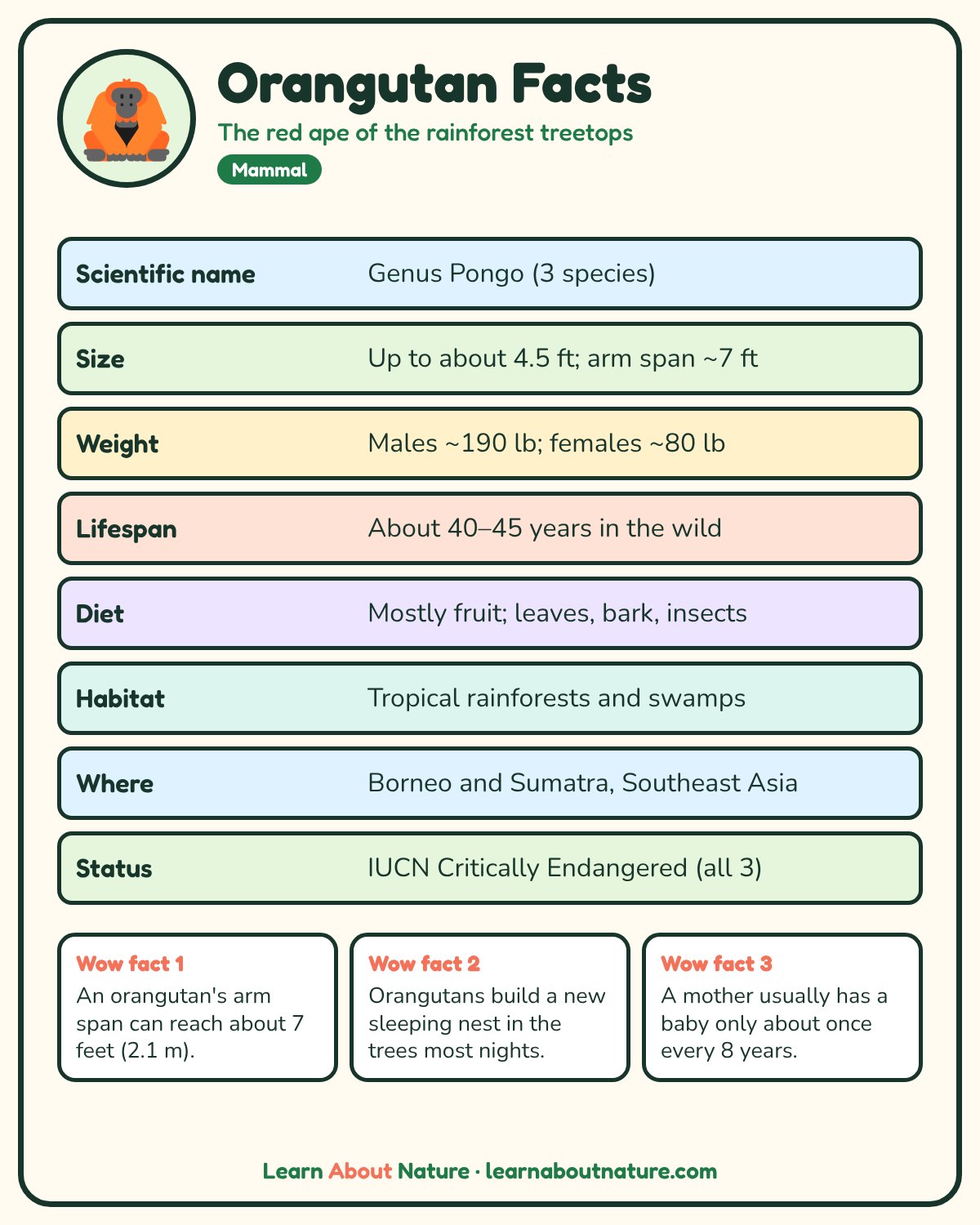
| Scientific name | Genus Pongo (3 species) |
| Height (standing) | Males about 4.5 ft; females about 3.75 ft |
| Weight | Males about 190 lb; females about 80 lb |
| Arm span | About 7 ft (2.1 m) |
| Lifespan | About 40–45 years in the wild |
| Baby name | Infant |
| Time between babies | About 8 years on average |
| Conservation status | Critically Endangered (IUCN), all 3 species |
What Is an Orangutan?
An orangutan is a great ape, part of the same group as gorillas, chimpanzees, bonobos and humans. Its name comes from Malay words that mean “person of the forest.” Orangutans are the only great apes that live in Asia, and they are easy to spot because of their long reddish-orange hair.
There are three species of orangutan, all in the genus Pongo. The Bornean orangutan (Pongo pygmaeus) lives on the island of Borneo. The Sumatran orangutan (Pongo abelii) and the Tapanuli orangutan (Pongo tapanuliensis) live on the island of Sumatra in Indonesia. Scientists announced the Tapanuli orangutan as a new species in 2017.
Where Do Orangutans Live?
Orangutans live only on the islands of Borneo and Sumatra in Southeast Asia. Their homes are warm, wet tropical rainforests, including lowland forests along rivers, swamp forests and the forested foothills of mountains.
Orangutans are mostly arboreal, which means they live in the trees. They climb using both their hands and their feet, and their long arms help them reach from tree to tree. They do sometimes walk on the ground on all fours, but usually only for short trips.
Today their forests are broken into patches. The Tapanuli orangutan, for example, survives only in a small area of forest called Batang Toru in North Sumatra.
What Do Orangutans Eat?
Orangutans are mainly fruit eaters. They especially like ripe fruit such as figs, lychees and mangosteens. When fruit is hard to find, they eat leaves, bark, seeds and insects. Scientists have recorded more than 400 different kinds of food in their diet.
Orangutans often drink water that collects in holes in trees. Because they eat so much fruit and travel through the forest, they spread the seeds of many plants in their droppings. This helps new trees and vines grow, and for a few plants, orangutans may be the only animals that spread their seeds.
Some orangutans use simple tools. In one area of Sumatra, orangutans use sticks to pull insects or honey out of tree holes and to pry seeds out of tough fruit.
Orangutan Bodies
Orangutans have long, strong arms. Their arms are about twice as long as their bodies, and their arm span can reach about 7 feet (2.1 m). Standing up, an adult male is about 4.5 feet (1.4 m) tall, and a female is about 3.75 feet (1.1 m) tall.
Males are much bigger than females. On average, adult males weigh about 190 pounds (87 kg), while females weigh about 80 pounds (37 kg).
Many grown-up males develop wide, flat cheek pads, called flanges, and a big throat pouch. These males make a very loud “long call” that echoes through the forest. The call helps females find them and tells other males to keep their distance.
Orangutan Babies
A baby orangutan is called an infant. A mother is pregnant for about eight to nine months and usually has one baby at a time. A newborn weighs about 3 to 5 pounds (1.5 to 2.3 kg).
For the first six to eight months, the baby clings tightly to its mother as she moves through the trees. It may keep nursing until it is five to eight years old. Young orangutans can move about on their own at around four to five years, but they usually stay near their mother until they are about seven.
Because mothers spend so long raising each child, they have babies very rarely. On average, a female has a baby only about once every eight years, one of the longest gaps of any mammal. Sumatran orangutans may wait more than nine years.
- Pregnancy: about 8–9 months
- Babies per birth: usually 1
- Weight at birth: about 3–5 lb
- Time between babies: about 8 years on average
How Orangutans Live
Orangutans live a semi-solitary life. Adult males spend most of their time alone; one study found they were by themselves about 91 percent of the time. Mothers travel with their young, and sometimes a mother has two or three of her offspring of different ages nearby.
Every evening, an orangutan builds a sleeping nest high in a tree by bending and weaving branches and leaves. It usually makes a new nest in a new spot each night. Orangutans also rest in day nests. When it rains, they sometimes hold large leaves over their heads like umbrellas.
Most of an orangutan’s day is spent eating and resting, with only a small part spent traveling.
Bornean vs Sumatran vs Tapanuli Orangutans
The three orangutan species look alike at first glance, but there are differences. Sumatran orangutans are more slender than Bornean orangutans, with paler, longer hair and a longer face.
Tapanuli orangutans look more like Sumatran orangutans in body shape and hair color, but their hair is frizzier and their heads are smaller, with flatter, wider faces. Males’ long calls also sound different. Tapanuli orangutans eat some unusual foods, such as caterpillars and conifer cones.
The biggest difference is how many are left. There may be about 55,000 to 104,000 Bornean orangutans and about 14,000 Sumatran orangutans. Fewer than 800 Tapanuli orangutans remain, making it the rarest great ape on Earth.
Threats and Conservation Status
The biggest threat to orangutans is the loss of their forests. Trees are cut down for timber and to make room for farms and plantations, such as oil palm. Fires and drought destroy more forest. Some orangutans are also hunted or taken illegally to be sold as pets.
Orangutans have babies so rarely that their numbers recover very slowly. A century ago there were probably more than 230,000 orangutans. Now all three species are listed as Critically Endangered on the IUCN Red List: the Bornean orangutan (assessed in 2016) and the Sumatran and Tapanuli orangutans (both assessed in 2017).
People are working to protect orangutan forests, stop illegal hunting and care for orphaned orangutans so they can return to the wild.
Fun Facts About Orangutans
Here are a few more orangutan surprises:
- Orangutans are the only great apes that live in Asia.
- Adult male orangutans can weigh more than twice as much as females.
- Young orangutans learn which foods to eat by watching their mothers.
- Orangutans spend about 43 percent of their day feeding.
- The Tapanuli orangutan was named a new species in 2017.
Fast Facts for Young Readers
- Orangutan means “person of the forest.”
- Orangutans are great apes with red hair.
- They live in rainforests on two islands in Asia.
- Orangutans spend most of their lives in the trees.
- They love to eat fruit.
- Orangutans make a new bed in the trees every night.
- Baby orangutans stay with their mothers for about seven years.
Key words: great ape – a large, tailless primate such as an orangutan, gorilla or chimpanzee; arboreal – living mostly in trees; flanges – the wide cheek pads on some adult male orangutans; semi-solitary – living mostly alone but sometimes spending time with others; seed dispersal – spreading seeds to new places so new plants can grow.
Try this: Measure each student’s arm span with string and compare it with an orangutan’s arm span of about 7 feet; then try building a “nest” from paper, leaves or blankets.
Related Guides
- Moose facts for kids
- Fox facts for kids
- Bat facts for kids
- Tiger facts for kids
- All animal facts for kids
Orangutan FAQs
What does orangutan mean?
The word orangutan comes from the Malay language and means “person of the forest.” It is a good name for these thoughtful apes, which spend nearly all their lives high in the rainforest trees of Borneo and Sumatra.
What do orangutans eat?
Orangutans eat mostly ripe fruit, such as figs, lychees and mangosteens. When fruit is scarce, they eat leaves, bark, seeds and insects. Scientists have recorded more than 400 different foods in their diet. They often drink rainwater that collects in tree holes.
How many orangutans are left?
Estimates suggest about 55,000 to 104,000 Bornean orangutans, about 14,000 Sumatran orangutans and fewer than 800 Tapanuli orangutans remain in the wild. A century ago there were probably more than 230,000 orangutans in total.
Why are orangutans endangered?
Orangutans are losing their rainforest homes to logging, plantations such as oil palm, farms, fires and drought. Some are also hunted or captured for the illegal pet trade. Because females have a baby only about once every eight years, populations recover very slowly.
Do orangutans live alone?
Mostly. Adult males usually live alone, and one study found they spent about 91 percent of their time by themselves. Mothers live with their young for many years, and females are more social than males, sometimes spending time near other orangutans.
Sources: San Diego Zoo Wildlife Alliance Library: Orangutans Fact Sheet; San Diego Zoo Wildlife Alliance Library: Orangutans Population & Conservation Status; San Diego Zoo Wildlife Alliance Library: Orangutans Reproduction & Development; San Diego Zoo Wildlife Alliance Library: Orangutans Behavior & Ecology; Britannica: Orangutan; Mongabay: The world’s newest great ape is already nearly extinct (2017)

Nato is a content writer and researcher with a background in psychology who’s eager to explore the wonders of nature. As a travel enthusiast and animal lover, she hopes to inspire others to discover and cherish the beauty and importance of the natural world. She also writes about the history of candy and snacks for Snack History and about food and healthy eating for The Fitchen.