Kangaroo Facts for Kids: Habitat, Diet and Fun Facts
Quick answer: A kangaroo is a large hopping marsupial from Australia. The red kangaroo, the biggest kind, lives on the dry, open plains of inland Australia and eats grasses and other plants. Kangaroos move by hopping on their strong back legs, and mothers carry their babies, called joeys, in a pouch.
Kangaroos are one of the most famous animals in the world and a symbol of Australia. They bound across open country on powerful back legs, using their long tails for balance.
There are several kinds of kangaroo. This page focuses mainly on the red kangaroo, the largest of them all, with a few notes on its relatives. Here is how kangaroos live, hop and raise their tiny joeys.
Teachers and students: you’re welcome to use this fact sheet in lessons and projects with credit to Learn About Nature.
Free printable: Download the Kangaroo fact file worksheet (PDF) – draw the animal, fill in the facts and match key words. Answer key included.
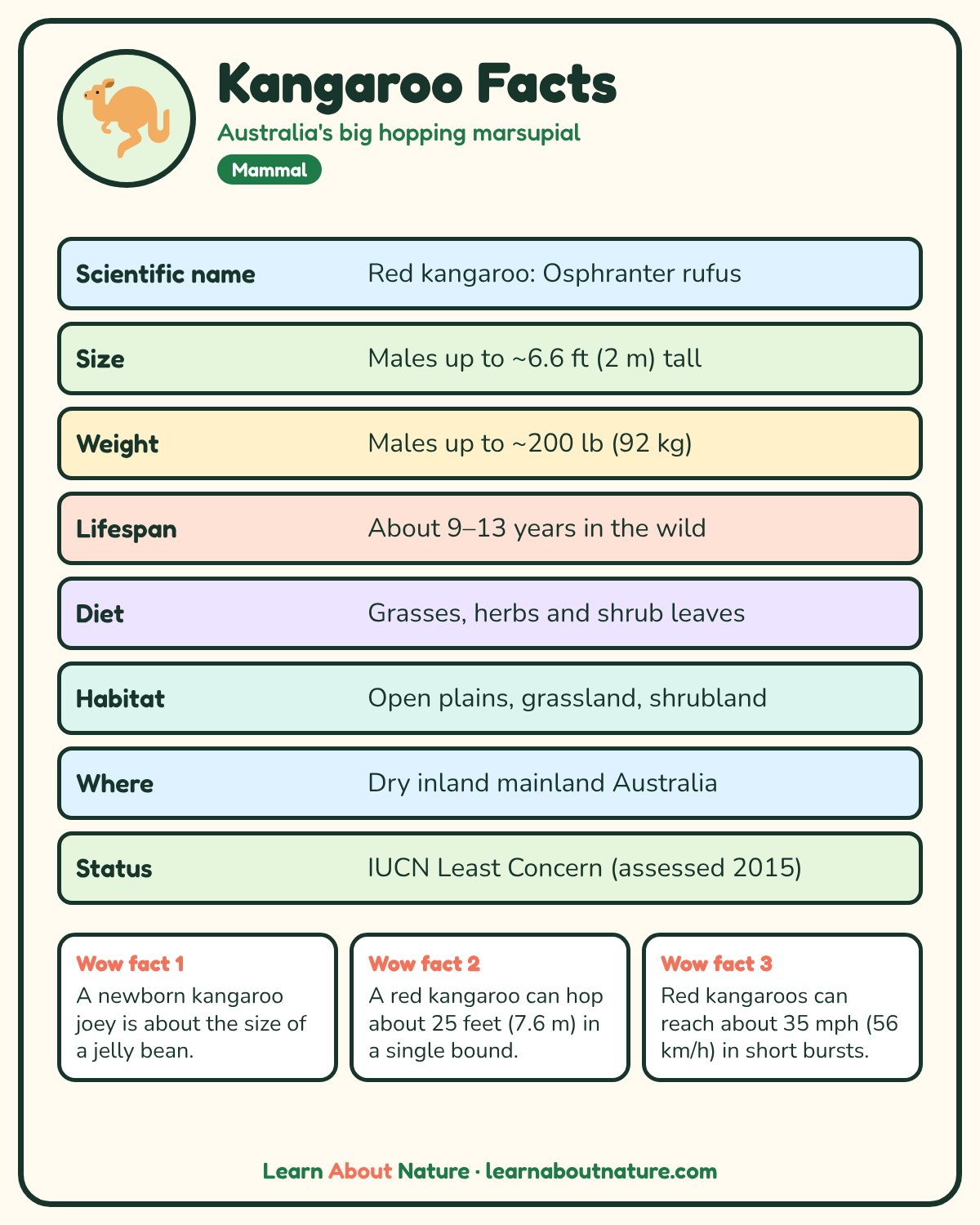
Kangaroo Quick Facts
| Class | Mammal (marsupial) |
| Family | Macropodidae (kangaroos and wallabies) |
| Scientific name | Red kangaroo: Osphranter rufus |
| Height | Males up to about 6.6 ft (2 m) |
| Weight | Males up to about 200 lb (92 kg); females up to about 86 lb (39 kg) |
| Top speed | About 35 mph (56 km/h) in short bursts |
| Pregnancy | About 33 days |
| Baby name | Joey |
| Group name | Mob |
| Conservation status | Least Concern (IUCN) |
What Is a Kangaroo?
A kangaroo is a marsupial, a mammal whose babies are born very small and then grow in a pouch on the mother’s belly. Kangaroos belong to a family of hopping marsupials called macropods, which means “big feet.” There are more than 50 kinds of macropods, including kangaroos, wallabies and tree kangaroos.
The red kangaroo (Osphranter rufus) is the largest living marsupial in the world. Other well-known kangaroos include the eastern gray and western gray kangaroos. Adult males are sometimes called boomers, and red kangaroo females are called blue flyers because of their blue-gray fur.
Where Do Kangaroos Live?
Wild kangaroos live only in Australia. Red kangaroos live in the dry and semi-dry inland parts of mainland Australia, away from the wetter coasts.
Their habitat is open country with few trees, such as grasslands, shrublands, open woodlands and the edges of deserts. They are most common in open savanna woodland. During the hottest part of the day they rest in the shade of trees and bushes.
What Do Kangaroos Eat?
Kangaroos are herbivores. Red kangaroos mainly graze on grasses, and they also eat small flowering plants and the leaves of shrubs.
Like cows, kangaroos have a stomach with chambers that help break down tough plant food. Red kangaroos can survive in places where water is scarce, because they get much of the water they need from the plants they eat.
When food is plentiful after rain, kangaroos can gather in large numbers. During long droughts, when plants dry up, their numbers can fall.
Hopping, Tails and Bodies
Red kangaroo males can stand about 6.6 feet (2 m) tall and weigh up to about 200 pounds (92 kg). Females are much smaller, up to about 86 pounds (39 kg). Males usually have reddish-orange fur, while females are often blue-gray. The tail can be up to about 3 feet (1 m) long. Look for the black and white patches on a red kangaroo’s cheeks and the broad white stripe that runs from the corner of its mouth toward its ear.
Kangaroos are built for hopping. Long ago, an extinct giant short-faced kangaroo weighed more than 440 pounds (200 kg) and was the largest hopping animal that ever lived. Stretchy tendons in their back legs store energy as they land and release it on the next jump, a bit like a spring. This makes hopping very efficient at higher speeds. A red kangaroo can travel at about 25 mph (40 km/h) for a long time and reach about 35 mph (56 km/h) in short bursts. A typical hop covers about 4 to 6 feet, but a big leap can cover about 25 feet (7.6 m).
When moving slowly, kangaroos use their tail like an extra leg. They lean on the tail and front paws, then swing their back legs forward.
Kangaroo Joeys
A baby kangaroo is called a joey. A red kangaroo mother is pregnant for only about 33 days and has one joey at a time. Red kangaroos can breed in any season, but most joeys are born in spring and summer.
The newborn joey is about the size of a jelly bean and blind. It crawls through its mother’s fur and into her pouch all by itself. There it attaches to a teat and drinks milk for about 70 days before letting go.
The joey leaves the pouch for good at around 235 days old, or almost 8 months, but keeps drinking milk until it is about a year old. If danger appears, a young joey dives back into the pouch, until it is about 8 months old.
Mother kangaroos have a special trick called embryonic diapause. A new tiny embryo can wait, paused, until the older joey has left the pouch.
- Pregnancy: about 33 days
- Joeys per birth: 1
- Size at birth: about the size of a jelly bean
- Time in pouch: about 8 months
Mobs and Behavior
Kangaroos live in groups called mobs. A red kangaroo mob usually has about 2 to 10 animals, often a leading male with several females and their young. Where there is plenty of grass, as many as 1,500 may gather in one area.
Red kangaroos are most active from evening to early morning and rest in shade during the heat of the day. To cool off, they lick their forearms, and the evaporating spit helps carry heat away.
Young males often test their strength in friendly-looking “boxing” matches. They grab each other’s shoulders, lean back on their tails and kick with their strong feet. These contests help decide which male is in charge. Kangaroos may also thump the ground with their feet when they sense danger.
Kangaroos vs Wallabies
Kangaroos and wallabies are close relatives. Both are macropods with big back feet, long tails and pouches, and both hop. The main differences are:
- Size: Kangaroos are the biggest macropods. Most wallabies are much smaller.
- Habitat: Red kangaroos live on wide, open plains. Many wallabies live in forests, scrub or rocky hills.
- Legs: Kangaroos have longer legs for their size, built for fast, long-distance hopping across open country.
- Names: The names are partly a matter of size, so some in-between species are hard to sort.
Threats and Conservation Status
The red kangaroo is not in danger as a species. The IUCN Red List lists it as Least Concern, based on an assessment carried out in 2015. A 2017 government estimate counted about 5.8 million red kangaroos.
Kangaroos still face problems. Long droughts reduce their food. Many are hit by cars, because the grass along roadsides attracts them. Dingoes hunt kangaroos, and large birds of prey may take very young joeys.
Some other macropods are much rarer. The parma wallaby, for example, was once thought to be extinct until a surviving group was found in 1965. Protecting Australia’s wild spaces helps the whole kangaroo family.
Fun Facts About Kangaroos
Here are a few more kangaroo surprises:
- Kangaroos cannot easily walk backward.
- A red kangaroo can leap about 6 feet (1.8 m) high.
- A big red kangaroo standing tall can be as tall as an adult person.
- A kangaroo’s tail helps it balance when hopping and acts like a prop when it sits.
- Female kangaroos can have a young joey at foot, a baby in the pouch and a paused embryo all at the same time.
Fast Facts for Young Readers
- Kangaroos live in Australia.
- The red kangaroo is the biggest kangaroo.
- Kangaroos hop on their strong back legs.
- A baby kangaroo is called a joey.
- A joey grows inside its mother’s pouch.
- A group of kangaroos is called a mob.
- Kangaroos eat grass and other plants.
Key words: marsupial – a mammal whose babies grow in a pouch on the mother’s body; joey – a baby kangaroo or other baby marsupial; macropod – a member of the kangaroo family; the name means “big feet”; mob – a group of kangaroos; embryonic diapause – when a tiny unborn baby pauses its growth until the time is right.
Try this: Measure out 25 feet on a playground or in a long hallway and mark it with chalk or tape. See how many jumps it takes each student to cover the same distance a red kangaroo can cover in one leap.
Related Guides
- Kangaroo life cycle
- Raccoon facts for kids
- Meerkat facts for kids
- Gorilla facts for kids
- Platypus facts for kids
- All animal facts for kids
Kangaroo FAQs
How far can a kangaroo jump?
A red kangaroo usually covers about 4 to 6 feet with each hop when moving normally. When it really leaps, it can cover about 25 feet (7.6 m) in one bound and jump about 6 feet (1.8 m) high.
How long does a joey stay in the pouch?
A red kangaroo joey stays in its mother’s pouch for about 235 days, almost 8 months. After that it hops beside her but still drinks her milk until it is about a year old. Young joeys dive back into the pouch when they are scared.
What do kangaroos eat?
Kangaroos are herbivores. Red kangaroos mostly eat grasses, plus small flowering plants and shrub leaves. They get much of their water from the plants they eat, which helps them live in the dry inland parts of Australia.
How fast can a kangaroo run?
Kangaroos hop rather than run. A red kangaroo can keep up about 25 mph (40 km/h) for long distances and reach about 35 mph (56 km/h) in short bursts. Springy tendons in its back legs help it hop using less energy.
Are kangaroos endangered?
No. The red kangaroo is listed as Least Concern on the IUCN Red List, and there are millions of them. Some smaller relatives, such as certain wallabies, are much rarer and need protection.
Sources: Australian Museum: Red Kangaroo; Animal Diversity Web: Macropus rufus (red kangaroo); San Diego Zoo Wildlife Alliance Library: Red kangaroo fact sheet; San Francisco Zoo: Red Kangaroo; Britannica: Red kangaroo

Nato is a content writer and researcher with a background in psychology who’s eager to explore the wonders of nature. As a travel enthusiast and animal lover, she hopes to inspire others to discover and cherish the beauty and importance of the natural world. She also writes about the history of candy and snacks for Snack History and about food and healthy eating for The Fitchen.