Meerkat Facts for Kids: Habitat, Diet and Fun Facts
Quick answer: A meerkat is a small, burrowing mammal in the mongoose family. It lives in dry grasslands and scrub in southern Africa, especially around the Kalahari Desert. Meerkats eat mostly insects, plus scorpions, lizards and other small animals. They live in family groups called mobs and take turns standing guard as lookouts.
Picture a small, sandy-colored animal standing up straight on its back legs, tail pressed to the ground for balance, staring at the sky. That is a meerkat on guard duty. If it spots an eagle, it gives a sharp alarm call and the whole family dives for cover.
Meerkats are some of the most social mammals in Africa. They dig, hunt, babysit and defend their home together. Here is how these little teamworkers live.
Teachers and students: you’re welcome to use this fact sheet in lessons and projects with credit to Learn About Nature.
Free printable: Download the Meerkat fact file worksheet (PDF) – draw the animal, fill in the facts and match key words. Answer key included.
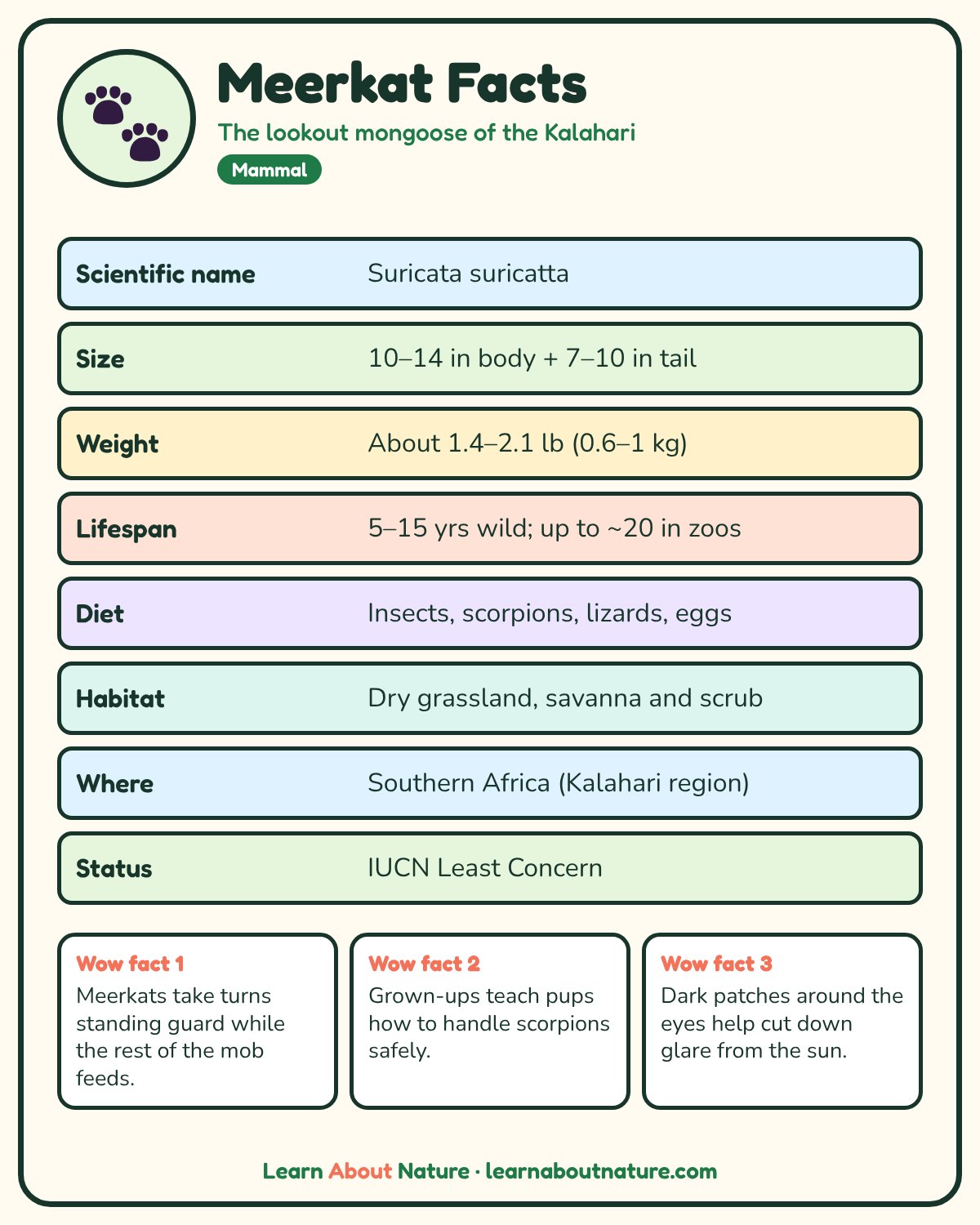
Meerkat Quick Facts
| Class | Mammal |
| Family | Mongoose family (Herpestidae) |
| Scientific name | Suricata suricatta |
| Size | Body 10–14 in (25–35 cm); tail 7–10 in |
| Weight | About 1.4–2.1 lb (0.6–1 kg) |
| Lifespan | 5–15 years wild; up to about 20 in zoos |
| Group name | Mob (also gang or clan) |
| Baby name | Pup |
| Pups per litter | Usually 3–5 |
| Conservation status | Least Concern (IUCN) |
What Is a Meerkat?
A meerkat is a small carnivore in the mongoose family, Herpestidae. Despite the name, it is not a cat, and it is not a rodent like a prairie dog, even though both stand up to look around. Its scientific name is Suricata suricatta, and in southern Africa people often call it a suricate.
Meerkats have slender bodies, short tan or gray fur with faint stripes across the back, and a thin tail with a dark tip. Each one has a dark patch around each eye.
Where Do Meerkats Live?
Meerkats live only in southern Africa. They are found in Namibia, Botswana, South Africa and a small part of southwestern Angola. Many live in and around the Kalahari Desert.
They like dry, open country: short grassland, savanna and scrubland where the ground is firm enough to dig. A mob shares a home range with several burrow systems. A big burrow can have more than a dozen entrances and tunnels on two or three levels. Underground, the burrow stays much cooler than the hot surface during the day.
What Do Meerkats Eat?
Meerkats eat mostly insects, especially beetles, larvae and caterpillars that they dig out of the sand. They also eat spiders, centipedes, millipedes, scorpions, lizards, small snakes, eggs and the occasional small bird or rodent. They sometimes dig up roots, which give them extra moisture.
They rarely need to drink. Most of the water they need comes from their food.
Meerkats are famous for eating scorpions, even venomous ones. They quickly bite off or disable the stinger before eating. Studies suggest meerkats have some resistance to scorpion venom, but they still avoid being stung when they can.
Body and Senses
A meerkat’s body is about 10 to 14 inches (25 to 35 cm) long, plus a tail of about 7 to 10 inches (18 to 25 cm). It weighs only about 1.4 to 2.1 pounds (0.6 to 1 kg), about as much as a small bottle of water.
Long, curved claws on the front feet make meerkats excellent diggers. Their sense of smell helps them find insects buried in the ground.
Their eyesight is sharp, and the dark rings around their eyes help reduce glare, a bit like the black smudges some athletes wear under their eyes. On cold mornings, meerkats stand facing the sun to warm up. Sunbathing like this saves energy on chilly desert mornings.
Meerkat Babies
In a mob, the top female, called the dominant female, usually has most or all of the babies. She is often the mother of many of the mob’s members. A pregnancy lasts about 60 to 70 days, around 11 weeks. Babies, called pups, are born in an underground burrow. A litter usually has about 3 to 5 pups, though it can range up to 7.
Pups stay underground for their first two to three weeks. Then they start coming out and following the group. They are weaned at around 6 to 9 weeks and can find most of their own food by about 3 months.
Raising pups is a team job. Older brothers, sisters and other helpers babysit at the burrow, bring food to the pups and protect them. Helpers even teach pups to handle scorpions. They first give very young pups dead scorpions, then scorpions with the stinger removed, and finally live ones as the pups get better at hunting.
- Pregnancy: about 60–70 days
- Pups per litter: usually 3–5
- Leave the burrow: about 2–3 weeks
- Grown up: about 1 year
How Meerkats Live Together
Meerkats live in groups called mobs (also called gangs or clans). A mob usually has about 10 to 30 members and can be as big as about 50. It often includes the dominant pair, their grown offspring and a few unrelated males.
Meerkats are active during the day. They leave the burrow in the morning, warm up in the sun, and spend most of the day searching for food. While the others dig, one meerkat acts as a sentinel. It climbs a mound, rock or bush and keeps watch. It makes quiet calls to say all is well and loud, different alarm calls for danger from the sky or the ground. Mob members take turns on guard.
If a snake or jackal comes close, the mob may bunch together, puff up their fur, arch their backs and hiss so they look like one big, scary animal. Neighboring mobs sometimes fight over territory.
Predators and Conservation Status
Meerkats have many enemies. Eagles, hawks and other birds of prey attack from above. Jackals, foxes and snakes hunt them on the ground. Young pups are the most at risk, which is why the mob works so hard to protect them.
The IUCN Red List lists the meerkat as Least Concern, which means it is not considered at risk of extinction right now, and its numbers appear stable. Much of its dry range is not good for farming, and many meerkats live in protected areas. Long-term research in the Kalahari has made them one of the best-studied small mammals in the world.
Meerkats vs Prairie Dogs
Meerkats and prairie dogs are often mixed up. Both live in big family groups, dig burrows, and stand up tall to watch for danger. But they live on different continents and are not closely related.
Meerkats are mongooses that live in southern Africa. They are carnivores with sharp teeth and eat mostly insects and other small animals. Prairie dogs are rodents, members of the squirrel family, that live on the grasslands of North America. They eat mostly grasses and other plants.
Their look-alike habits are a good example of convergent evolution. That is when unrelated animals living similar lives in similar places end up with similar features or behaviors. Living in open country with many predators, both animals benefit from digging, sharing lookout duty and warning each other with alarm calls.
Fun Facts About Meerkats
A few more things that make meerkats stand out:
- Meerkats have at least 10 different calls, including separate alarms for different dangers.
- A sentinel often stands on its back legs and uses its tail like a third leg to balance.
- Meerkats are related to mongooses, not to cats or prairie dogs.
- In the wild, a meerkat can live up to about 15 years, though many live much less.
Fast Facts for Young Readers
- Meerkats are small members of the mongoose family.
- They live in dry, sandy places in southern Africa.
- A family group of meerkats is called a mob.
- One meerkat stands guard while the others look for food.
- Meerkats love to eat bugs, and they even eat scorpions.
- Baby meerkats are called pups.
- Big brothers and sisters help babysit the pups.
Key words: mob – a family group of meerkats that lives and works together; sentinel – an animal that keeps watch for danger while the others feed; burrow – a system of underground tunnels where meerkats sleep and hide; dominant – the top-ranking animal in a group, often the main parent; mongoose – a family of small, quick carnivores that includes the meerkat.
Try this: Play a sentinel game: one person stands guard while the others search for hidden paper bugs, and the guard calls out a different signal for a sky danger and a ground danger.
Related Guides
- Bat facts for kids
- Orangutan facts for kids
- Zebra facts for kids
- Kangaroo facts for kids
- All animal facts for kids
Meerkat FAQs
Are meerkats related to cats?
No. Even with “cat” in the name, meerkats are members of the mongoose family. Mongooses and cats are both in a large group of meat-eating mammals called carnivores, but a meerkat is much more closely related to other mongooses than to any cat.
Why do meerkats stand up?
Meerkats stand up on their back legs to look out for danger. One meerkat, called a sentinel, keeps watch from a high spot while the rest of the mob feeds, and it calls out if it spots a bird of prey, jackal or snake. Meerkats also stand facing the sun to warm up.
Are meerkats immune to scorpion venom?
Meerkats seem to have some resistance to scorpion venom, but they are not fully protected. That is why they quickly bite off or disable the stinger before eating a scorpion, and why adults teach pups to handle scorpions step by step.
How many babies do meerkats have?
A meerkat litter usually has about 3 to 5 pups, though up to 7 is possible. The pups are born underground after a pregnancy of about 11 weeks. They come out of the burrow at about 2 to 3 weeks old, and the whole mob helps raise them.
Are meerkats endangered?
No. The IUCN Red List lists meerkats as Least Concern, and their population appears stable. They live across a large area of southern Africa, including many protected areas. Like all wild animals, they still need their natural habitat to survive.
Sources: Smithsonian’s National Zoo: Meerkat; Animal Diversity Web: Suricata suricatta; University of Cambridge: Wild meerkats school their young; Wikipedia: Meerkat (summary of IUCN 2015 assessment and range)

Nato is a content writer and researcher with a background in psychology who’s eager to explore the wonders of nature. As a travel enthusiast and animal lover, she hopes to inspire others to discover and cherish the beauty and importance of the natural world. She also writes about the history of candy and snacks for Snack History and about food and healthy eating for The Fitchen.