Octopus Life Cycle: From Egg to Paralarva to Adult
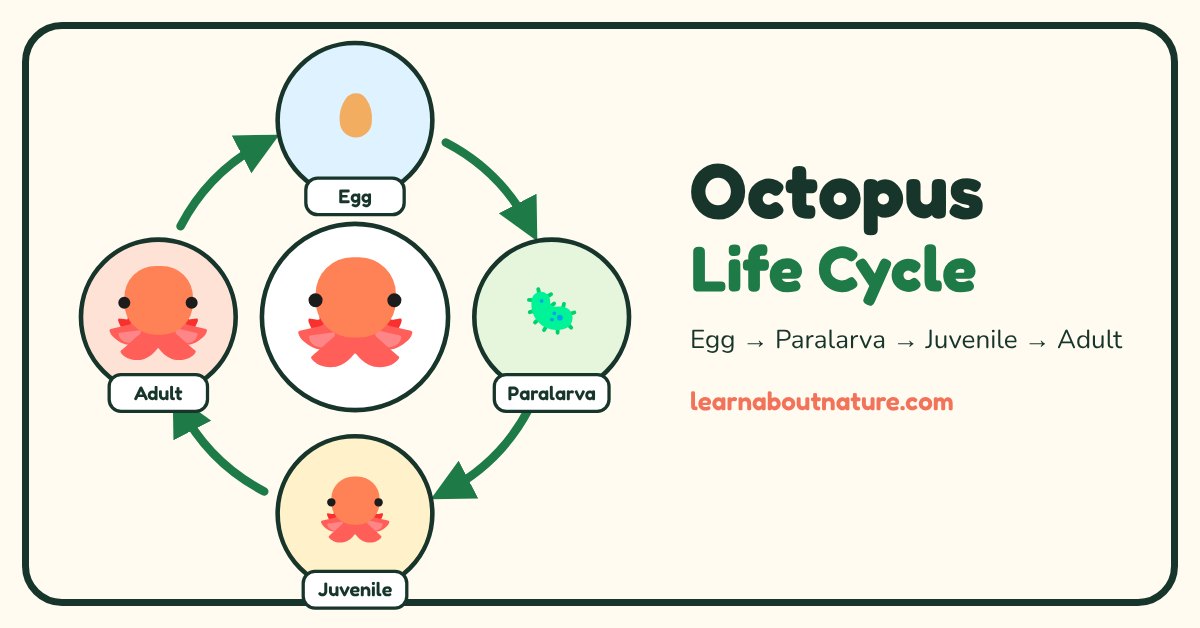
Quick answer: An octopus’s life cycle has four stages: egg, paralarva, juvenile and adult. In the common octopus, the female lays thousands of tiny eggs in a den and guards them until they hatch. The hatchlings, called paralarvae, drift in the plankton, then settle on the seafloor as juveniles and grow into adults that breed once and die.
Octopuses are soft-bodied animals related to squid, cuttlefish, snails and clams. They have eight arms, three hearts and blue blood, and they are among the smartest invertebrates in the ocean. Yet most octopuses live for only a year or two.
This page follows the common octopus (Octopus vulgaris), which lives in warm and temperate coastal seas. Its life cycle has a surprising twist: a mother octopus usually guards her eggs until they hatch and then dies, so she never meets her young.
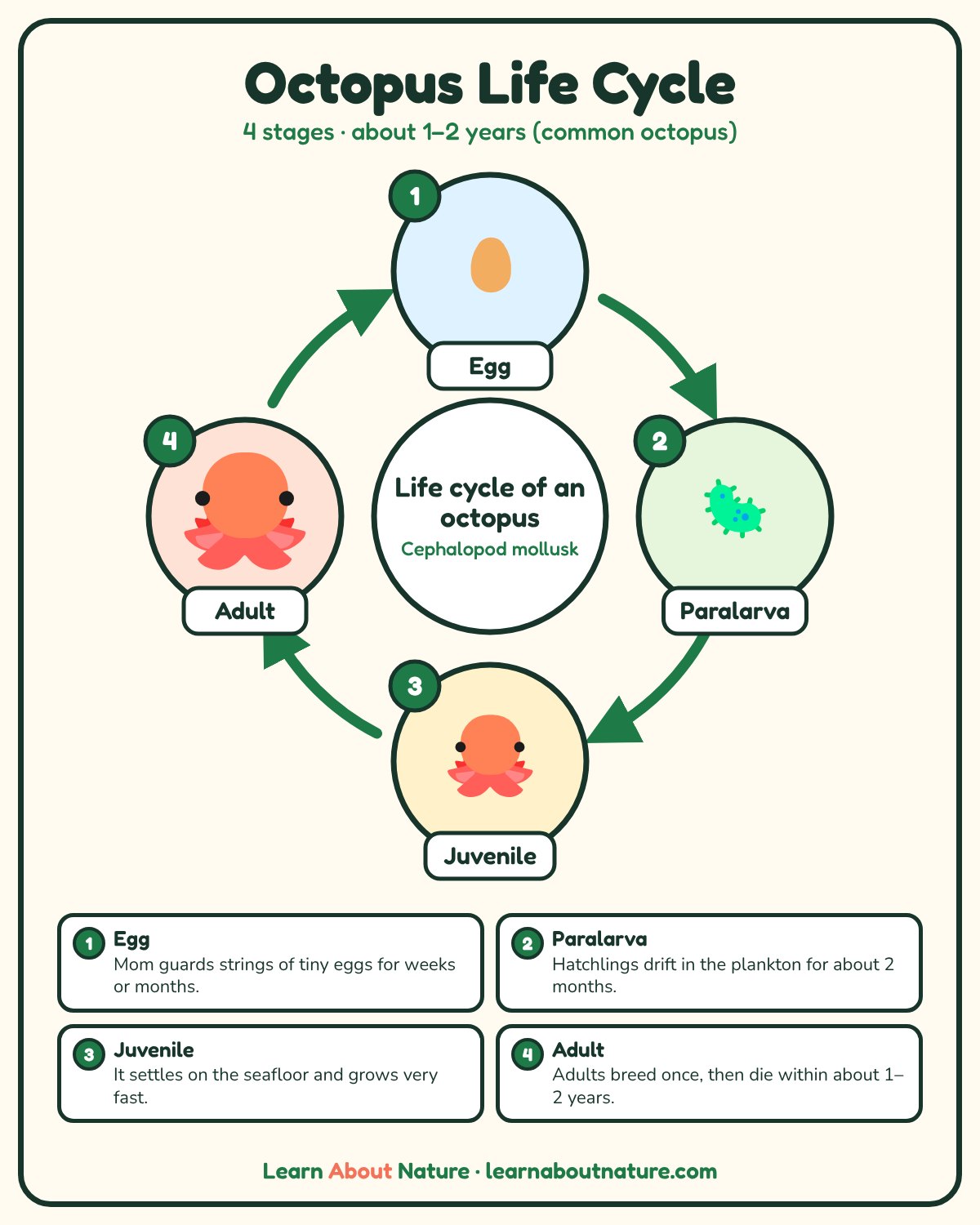
Teachers and students: you’re welcome to use this diagram in lessons and projects with credit to Learn About Nature.
Free printable: Download the Octopus life cycle worksheet (PDF) – label the diagram, cut and sequence the stages, and match key words. Answer key included.
Octopus Life Cycle Quick Facts
| Example species | Common octopus (Octopus vulgaris) |
| Eggs per female | about 100,000–500,000 |
| Egg length | about 2–2.5 mm |
| Time to hatch | about 2 weeks to 5 months (depends on temperature) |
| Hatchling size | about 1.5–2 mm body length |
| Drifting paralarva stage | about 7–8 weeks |
| Adult size | about 1–3 ft (30–90 cm) including arms |
| Lifespan | about 12–24 months |
| Breeding | once in a lifetime |
Mating
When a male common octopus is ready to breed, he uses a special arm called the hectocotylus. This arm is usually his third arm on the right side, and it has a groove that carries packets of sperm called spermatophores.
The male reaches this arm into the female’s body to pass the sperm packets to her. Mating can last for hours, and a pair may mate several times over about a week. The female can store the sperm until her eggs are ready.
After mating, males usually begin to grow weak and old quickly. Most males die within a few months, often without ever seeing the eggs.
Common octopuses live alone for most of their lives, so finding a mate is one of the few times two adults spend time together. During mating, the male often stays a short distance away from the female, reaching across to her with his long special arm.
Stage 1: Egg
The female finds a safe den, such as a rocky crevice, an empty shell or even a piece of human trash on the seafloor. There she lays her eggs in long strings, gluing them to the den ceiling or walls so they hang like bunches of grapes.
A common octopus lays a huge number of eggs, about 100,000 to 500,000 in total. Each egg is tiny, only about 2 to 2.5 mm long, about the size of a grain of rice.
How long the eggs take to hatch depends on the water temperature. In one study in warm water off West Africa, eggs hatched in as little as about 2 to 6 weeks at 27°C (81°F) and took nearly 3 months at 17°C (63°F). In colder water, brooding can last 4 to 5 months.
A Mother’s Last Job: Brooding
While the eggs develop, the mother octopus stays with them almost the whole time. This is called brooding. She gently blows water over the eggs to give them oxygen, cleans them with the tips of her arms, and chases away crabs, fish and other animals that try to eat them.
The mother usually stops eating while she broods. By the time the eggs hatch, she has used up her energy and may have lost about a third of her body weight. She dies soon after the last eggs hatch.
Animals that breed only once and then die are called semelparous. Octopuses, Pacific salmon and many insects follow this pattern. Instead of raising young for years, they put all their energy into one huge batch of eggs.
Stage 2: Paralarva
When a common octopus egg hatches, out comes a paralarva. It is only about 1.5 to 2 mm long and already looks like a tiny octopus, with eight short arms. At first, each arm has just three suckers.
Paralarvae do not stay on the seafloor. They swim up into open water and join the plankton, the mix of tiny living things that drift with ocean currents. Here they hunt even smaller animals, such as tiny shrimp-like creatures and crab larvae.
This drifting stage lasts about 7 to 8 weeks in the common octopus, though it is shorter in warm water and longer in cold water. Very few paralarvae survive. Fish, jellyfish and other plankton eaters gobble them up, which is one reason the mother lays so many eggs.
Stage 3: Juvenile
When a paralarva has grown more suckers and longer arms, it is ready to settle. It leaves the open water and sinks to the seafloor to live among rocks, reefs and seagrass. At this point a young common octopus weighs only about a fifth of a gram.
Juvenile octopuses grow at an amazing speed. They hunt crabs, shrimp, snails and small fish, and they turn a large share of what they eat into body weight. Within about a year, a speck that once drifted in the plankton can become an adult up to about 3 feet (90 cm) long from head to arm tips.
Young octopuses also learn to hide. They squeeze into tiny cracks and use special skin cells to change color and texture, blending in with rocks and seaweed. If a predator finds them, they can squirt a cloud of ink and jet away.
Stage 4: Adult
An adult common octopus usually measures about 1 to 3 feet (30 to 90 cm) from the top of its body to the tips of its arms. Adults live alone in dens and come out to hunt, mostly at dusk and at night.
Adults are known for their clever behavior. In experiments, octopuses learn to tell objects apart by sight and touch, solve simple puzzles and remember what they have learned. When an adult is ready, it mates, the female lays her eggs, and the life cycle starts again.
Their short lives mean octopuses have to learn fast. They do not get lessons from their parents, so every skill, from opening a clam to hiding from a moray eel, is figured out by trial and error.
How Long Do Octopuses Live?
The common octopus lives about 12 to 24 months. Water temperature makes a big difference. Octopuses in warm water grow and breed faster, so their lives are often shorter than those in cool water.
Some octopus species live longer. The giant Pacific octopus may live 3 to 5 years, and one deep-sea octopus was seen brooding her eggs for about four and a half years, the longest brooding period known for any animal.
Why Lay So Many Eggs?
Laying hundreds of thousands of eggs might seem like a lot, but it makes sense for an animal whose babies drift alone in the open sea. Most paralarvae are eaten, starve or are carried by currents to places where they cannot survive. Only a tiny fraction ever settle and grow up.
By producing so many young, a mother octopus improves the chance that at least a few will reach adulthood and breed. Drifting also helps the species spread out. Currents can carry paralarvae many miles from their mother’s den, so young octopuses end up on new reefs and rocky shores.
Not every octopus follows this plan. Some species, especially in cold or deep water, lay a small number of large eggs. Their young hatch bigger and better developed, and some skip the drifting stage and crawl straight onto the seafloor.
Interesting Octopus Facts
Octopuses are full of surprises, from their body plan to the way they solve problems.
- An octopus has three hearts: two pump blood through the gills and one pumps it around the body.
- Its blood is blue because it uses a copper-based molecule to carry oxygen.
- Each arm is packed with nerve cells, so the arms can sense and react on their own.
- Octopuses have no bones, so they can squeeze through any gap larger than their beak.
- Common octopuses are an important food for many fish, seals and people.
Octopus Life Cycle for Kids
Here is the octopus life cycle in simple steps:
- Egg: The mother octopus guards her tiny eggs in a rocky den.
- Paralarva: A baby octopus hatches and floats in the ocean like a speck of dust.
- Juvenile: The young octopus sinks to the seafloor and grows really fast.
- Adult: The grown-up octopus finds a mate, and the mother lays new eggs.
Key words: paralarva – a newly hatched octopus that drifts in open water; plankton – tiny living things that float and drift with ocean currents; brooding – when a parent guards and cares for its eggs; semelparous – breeding only once in a lifetime; hectocotylus – a special arm a male octopus uses to pass sperm; camouflage – colors or patterns that help an animal blend in.
Try this: Fill a clear jar with water and a pinch of tiny seeds or glitter, swirl it, and watch how the specks drift, then talk about why drifting paralarvae spread far from their mother’s den.
Related Life Cycles and Guides
- Octopus Anatomy
- Coral life cycle
- Whale life cycle
- Dolphin life cycle
- Shark life cycle
- Fish life cycle
- All animal & plant life cycles
See also: Octopus Facts for Kids
Octopus Life Cycle FAQs
Do octopuses die after laying eggs?
Yes, in most species. A female common octopus stops eating while she guards her eggs and dies soon after they hatch. Males usually die within a few months of mating. Breeding just once and then dying is called being semelparous.
How many eggs does an octopus lay?
It varies by species. A female common octopus lays about 100,000 to 500,000 tiny eggs in strings inside her den. Species with large eggs, such as some cold-water and deep-sea octopuses, lay far fewer eggs, but their babies hatch bigger.
What is a baby octopus called?
A newly hatched common octopus is called a paralarva (plural: paralarvae). It looks like a tiny octopus but drifts in the plankton for weeks before settling on the seafloor. Once it settles, it is usually called a juvenile.
How long do octopuses live?
Most octopuses live only one to two years. The common octopus lives about 12 to 24 months. Larger species, such as the giant Pacific octopus, can live around 3 to 5 years. Warm water usually speeds up growth and shortens life.
Does a mother octopus take care of her babies?
She cares for the eggs, not the babies. The mother guards, cleans and fans her eggs for weeks or months. When the paralarvae hatch, they swim away into open water on their own, and the mother dies soon after.
Sources: Octopus vulgaris (common octopus) – Animal Diversity Web; Octopus vulgaris larvae – Marine Species Identification Portal (Naturalis); Embryonic development of Octopus vulgaris eggs in Senegal (Caverivière et al., Aquatic Living Resources, 1999); Octopus cares for her eggs for 53 months, then dies – National Geographic

Nato is a content writer and researcher with a background in psychology who’s eager to explore the wonders of nature. As a travel enthusiast and animal lover, she hopes to inspire others to discover and cherish the beauty and importance of the natural world. She also writes about the history of candy and snacks for Snack History and about food and healthy eating for The Fitchen.