
Rabbit Life Cycle: Stages From Newborn Kit to Adult (With Diagram)

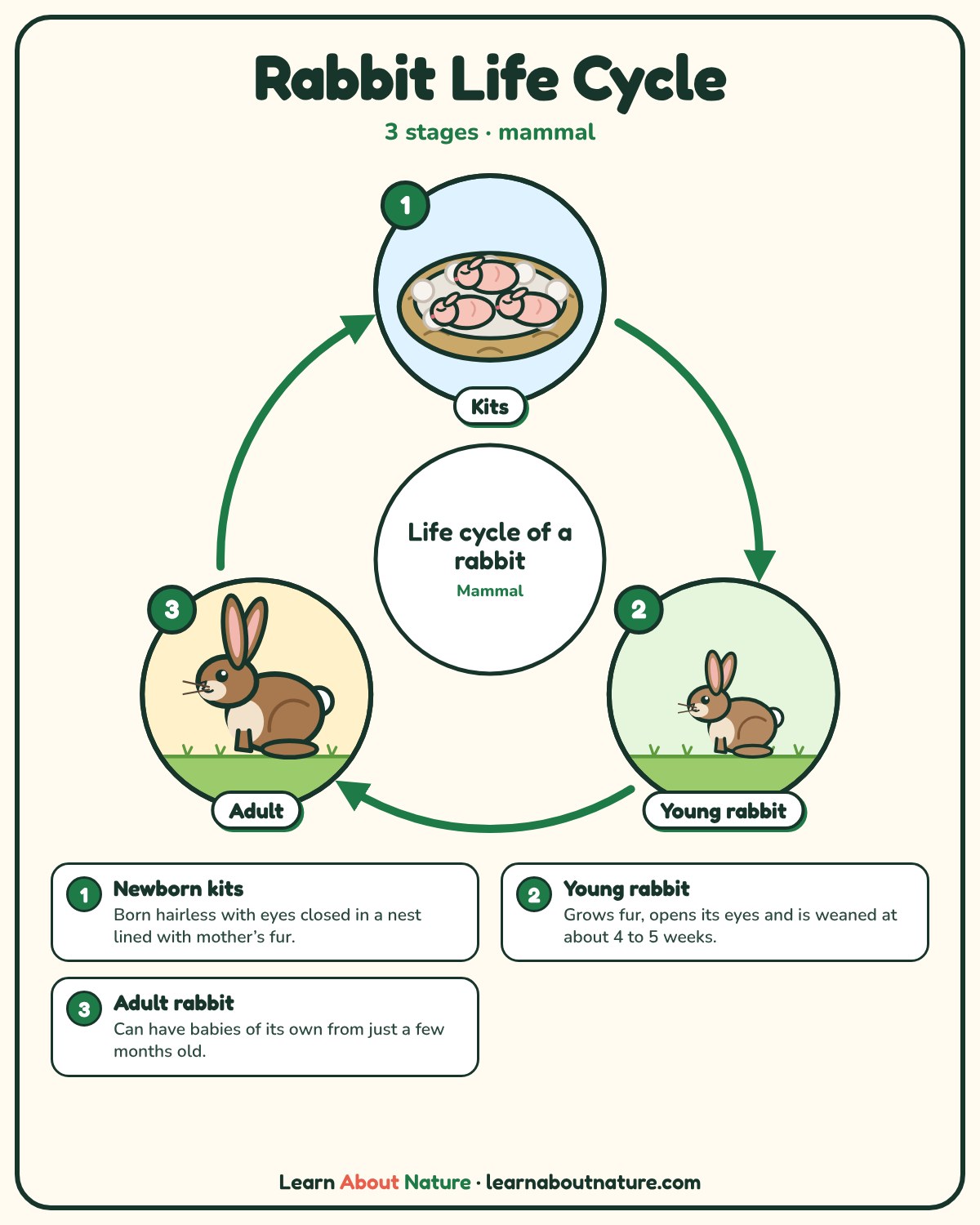
Quick answer: The rabbit life cycle has three main stages: newborn kit, young rabbit and adult. Kits are born hairless and blind after a pregnancy of about a month, open their eyes at around 10 days, are weaned at about 3 to 4 weeks and can breed at just a few months old.
The rabbit life cycle has three main stages: newborn kit, young rabbit and adult. Baby rabbits, called kits, are born helpless, hairless and blind in a fur-lined nest. Within about a month they are weaned and exploring on their own, and just a few months later they are adults that can have babies of their own.
Rabbit Life Cycle Quick Facts
| Common name | Rabbit |
| Scientific name | Oryctolagus cuniculus |
| Kingdom | Animalia |
| Phylum | Chordata |
| Class | Mammalia |
| Order | Lagomorpha |
| Family | Leporidae |
| Genus | Oryctolagus |
| Conservation status | Endangered |
| Life cycle stages | Newborn kit, young rabbit, adult |
| Type of development | Born live (hairless and blind) |
| Pregnancy | About 28 to 31 days |
| Time to adulthood | About 3 to 6 months |
| Lifespan | Wild: often 1 to 2 years; pet: about 8 to 12 years |
| Number of young | Usually about 3 to 8 kits per litter |
Rabbits are mammals, so they are born live and drink their mother’s milk. They are famous for breeding quickly, and that speed is the secret to their survival, because so many animals hunt them. This page mainly follows the European rabbit, the wild ancestor of all pet rabbits, with notes on the cottontails of North America. You can also see all our animal and plant life cycles.
Before Birth: Mating and Pregnancy
A female rabbit is called a doe and a male is a buck. Wild rabbits mostly breed from late winter through summer, when there is plenty of fresh grass to eat. Pregnancy is short, only about a month (roughly 28 to 31 days).
A few days before the kits are born, the mother builds a nest. A wild European rabbit doe usually digs a short, separate burrow called a stop, lines it with dry grass and then pulls soft fur from her own chest and belly to make a warm blanket. Cottontail mothers do not dig burrows. Instead, they scrape a shallow hollow in the ground, often in tall grass, and line it with grass and fur.
Stage 1: Newborn Kit
Baby rabbits are called kits or kittens. A litter usually has about 3 to 8 kits, though pet rabbits sometimes have more. Newborn kits are tiny, often weighing only about 1 to 2 ounces (30 to 60 grams). They are born with no fur, their eyes and ears are sealed shut, and they cannot walk well. They huddle together in the nest to stay warm.
Here is something that surprises many people: the mother rabbit stays away from the nest almost all the time. She usually comes back only once or twice a day, often around dawn or dusk, to nurse the kits for just a few minutes. Her milk is very rich, so the babies get all they need in that short time. Staying away helps keep predators from following her scent to the nest. When she leaves a burrow nest, a European rabbit often covers up the entrance with soil.
Kits grow fast. Soft fur starts to cover them within the first week, and their eyes open at around 10 days old.

If you find baby rabbits
Because the mother is away so much, people often think a nest of baby rabbits has been abandoned. Usually it has not. The best thing to do is leave the nest alone, keep pets away and let the mother return. If you are worried a baby is hurt, contact a local wildlife rescue for advice rather than taking it home.
Stage 2: Young Rabbit
At around 2 to 3 weeks old, the young rabbits start leaving the nest for short trips and begin nibbling grass and plants. Wild European rabbit kits are usually weaned, meaning they stop drinking milk, at about 3 to 4 weeks old. Pet rabbits are usually kept with their mother a bit longer, often until about 8 weeks old.
Young rabbits must learn quickly. They eat grasses, clover and other green plants, and you can read more about what wild rabbits eat. Like all rabbits, they also eat some of their own soft droppings, which helps them get more nutrients from tough plant food. Despite what cartoons show, root vegetables from the carrot patch are only an occasional treat, not their main food.
This is the most dangerous time in a rabbit’s life. Foxes, coyotes, weasels, hawks, owls, snakes, cats and dogs all hunt young rabbits. Rabbits are a key part of the diet of many hunters; see what owls eat and the fox life cycle. Bad weather, floods in nests and diseases also kill many young rabbits.
Stage 3: Adult Rabbit
Rabbits grow up remarkably fast. Wild European rabbits can be ready to breed at about 3 to 4 months old. Pet rabbits usually reach this stage at around 4 to 6 months, with larger breeds taking longer. They keep growing a little until they reach full adult size, which can be under 3 pounds for small breeds and over 10 pounds for giant ones.
Wild European rabbits live in groups in a network of tunnels called a warren. Each warren has a pecking order, with the top bucks and does getting the best spots. Cottontails, on the other hand, mostly live alone and rest in hidden hollows on the ground or in thick plants instead of digging their own burrows.
Why rabbits breed so fast
Rabbits have several tricks that let them have lots of babies:
- Pregnancy lasts only about a month.
- A doe can become pregnant again very soon after giving birth, so she can be nursing one litter while expecting the next.
- Wild rabbits can have several litters in one breeding season.
- Young rabbits can start breeding when they are only a few months old.
In the wild, this fast breeding balances out the huge number of rabbits lost to predators and disease. But when rabbits are taken to places with few predators, their numbers can explode. European rabbits brought to Australia in the 1800s spread across much of the continent and became a serious pest.

How Long Does a Rabbit Live?
Wild rabbits usually have short lives. Most die in their first year, and a wild rabbit that reaches 2 or 3 years old has done very well. Wild cottontails rarely live more than about 2 or 3 years either.
Pet rabbits are protected from predators and bad weather, so they live much longer. With good care, a healthy pet rabbit often lives about 8 to 12 years. Spaying or neutering, a diet based mostly on hay, plenty of exercise and regular vet visits all help. If you have questions about your rabbit’s health, ask a vet.

Rabbit Life Cycle vs Other Animal Life Cycles
Rabbits and hares look alike, but their babies start life very differently. Rabbit kits are born naked, blind and helpless in a nest. Baby hares, called leverets, are born with fur and open eyes in a simple dip in the ground, and they can hop around soon after birth.
The squirrel life cycle is a good match for comparison: squirrel babies are also born hairless and blind, but they stay in the nest much longer, often 2 to 3 months, before they are on their own. Squirrels are rodents, while rabbits belong to a different group of mammals called lagomorphs, even though both have front teeth that never stop growing. If you are thinking about a small furry pet, compare rabbits with guinea pigs as pets.
Fun Facts About the Rabbit Life Cycle
- Mother rabbits pull out their own fur to line their nests and keep their babies warm.
- Baby rabbits may drink milk for only a few minutes a day, yet they are ready to leave the nest at only about 3 weeks old.
- Rabbits are not rodents like the animals in our list of popular rodent pets. They are lagomorphs, a group that also includes hares and pikas.
- A rabbit’s front teeth keep growing all its life, so it has to chew lots of tough plants to wear them down.
- All the many breeds of pet rabbits, from tiny dwarfs to giants, come from the wild European rabbit.
More life cycles
- Fox Life CycleKit → juvenile → adult
- Squirrel Life CycleKit → juvenile → adult
- Wolf Life CyclePup → juvenile → adult
- Horse Life CycleFoal → weanling → yearling → adult horse
- Bird Life CycleEgg → hatchling → nestling → fledgling → adult
Rabbit Life Cycle FAQs
What are the stages of a rabbit’s life cycle?
A rabbit’s life cycle has three main stages: newborn kit, young rabbit and adult. Kits are born helpless in a nest, become independent within about a month and are adults that can breed a few months later.
What is a baby rabbit called?
A baby rabbit is called a kit or kitten. A female rabbit is a doe and a male is a buck.
How long are rabbits pregnant?
Rabbits are pregnant for only about a month, usually around 28 to 31 days. The mother builds a nest lined with her own fur a few days before the kits are born.
When do baby rabbits open their eyes?
Baby rabbits are born with their eyes closed and open them at around 10 days old. By then they are also covered in soft fur.
How long do rabbits live?
Wild rabbits usually live only 1 to 2 years because of predators and disease. Pet rabbits that are well cared for often live about 8 to 12 years.

Randi Jones is the owner and founder of the Nature Gift Store, an online retailer specializing in nature-themed gifts, educational science projects, live animal nature kits and real butterfly artwork. A biology graduate who fell in love with insects, she founded the company in 2001 to make active learning about nature fun, accessible and engaging for children and adults. Her store offers real butterfly frames, home and garden decor and educational live animal kits, including ant farms, worm farms, tadpoles, ladybugs and hermit crabs, and she runs a bug museum in Washington featuring live animals like Eddie the Iguana alongside other reptiles and insects.
