How Do Chinchillas Survive In The Wild?

Quick answer: Chinchillas survive in the wild by living in rocky burrows and crevices in the high, dry Andes Mountains of South America. Their extremely dense fur keeps them warm and protects against predators and parasites, and they escape danger by leaping and running over rocks.
Chinchillas are renowned for their captivating charm and ultra-soft fur. Despite their small size, these intriguing rodents possess remarkable survival skills that have allowed them to thrive in challenging environments for thousands of years.
This article delves into the unique strategies and adaptations chinchillas employ for survival in the wild, from their physical attributes and social behavior to their dietary habits and reproductive tactics.
The Habitat Of Chinchillas
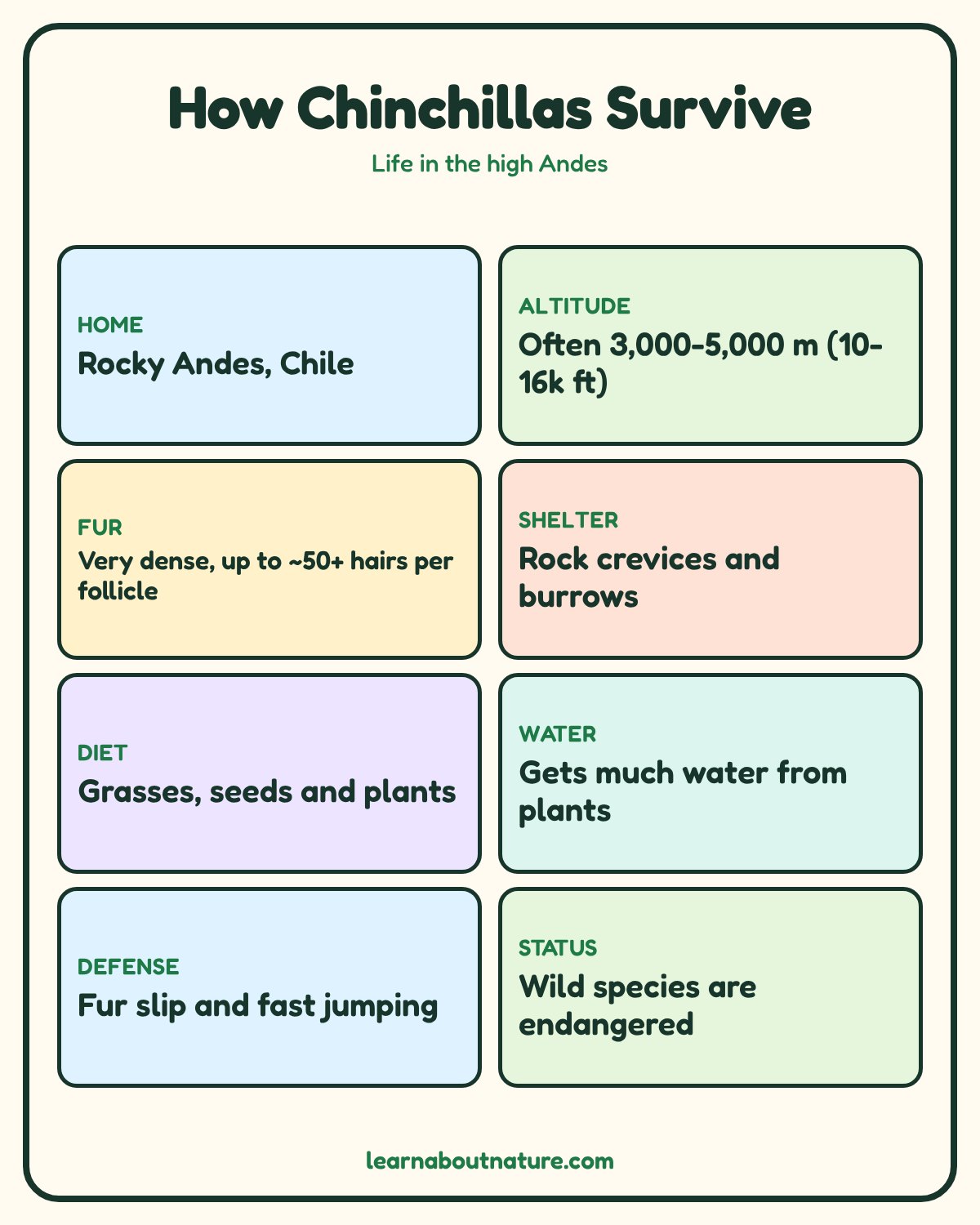
Chinchillas originate from the chilly, mountainous regions of South America. Their preferred habitat includes the rugged terrains of the Andes mountains, which stretch from the southern tip of the continent up through Peru and Bolivia. In these high-altitude environments, often above 12,000 feet, chinchillas have thrived for thousands of years.
The Andean ecosystem provides chinchillas with numerous natural advantages for survival. Firstly, the extreme changes in temperature between day and night require these creatures to have a robust thermal regulation mechanism. Chinchillas have incredibly dense fur that helps them withstand these temperature fluctuations. In addition, the rocky, mountainous landscape provides ample hiding spots, allowing them to evade predators.
However, life in the wild isn’t always ideal for chinchillas. They face multiple challenges, including the risk of predation, competition for food, and threats posed by harsh weather conditions. Yet, over the centuries, chinchillas have adapted to their environment, developing unique survival strategies to counter these adversities.

Physical Adaptations For Survival
Chinchillas boast a set of impressive physical adaptations that aid in their survival. Their fur, one of the densest among all land animals, serves a dual purpose—protection against the elements and evasion of predators. The fur’s thickness provides insulation during cold nights, while its ability to release in clumps when grabbed allows chinchillas to escape from the clutches of predators.
Their size and shape are another set of important adaptations. Compact and lightweight, chinchillas are built for agility and quick movements, necessary for finding food and evading threats. Their hind legs are muscular and designed for jumping. A chinchilla can leap up to 6 feet in a single bound, an impressive feat given their small size.
Finally, the chinchilla’s hearing and vision are keenly tuned for survival. Their large, round ears pick up on the faintest sounds, alerting them to potential dangers. Likewise, their eyes, situated on the sides of their head, provide a wide field of vision, enabling them to spot predators and threats from various angles.
Social Behavior And Group Dynamics
Chinchillas are highly social animals, often living in colonies that can range from a few individuals to groups of over a hundred. This social nature provides several survival benefits. Foremost, living in groups allows chinchillas to maintain constant vigilance against predators. While some members feed or rest, others keep watch, ensuring the safety of the entire colony.
Moreover, the social structure within a chinchilla colony also plays a role in survival. Typically, colonies are organized hierarchically, with dominant individuals enjoying certain privileges like better access to food and mating opportunities. This structure helps to minimize conflict and promote cooperation among members.
Lastly, group living facilitates communal burrowing. Chinchillas dig intricate burrow systems, often shared among the colony members. These burrows provide a safe space for chinchillas to rest, reproduce, and evade predators. The shared responsibility of maintaining these burrows is a testament to the cooperative nature of these animals.
Diet And Foraging
Chinchillas are primarily herbivores, consuming a diet that consists of grasses, leaves, seeds, and fruits. This diet is readily available in their natural habitat, reducing competition for food resources. Their large, chisel-shaped front teeth are well-adapted for gnawing plant materials, while their digestive system, featuring a large cecum, is specialized for processing high-fiber foods.
Foraging for food is a major part of a chinchilla’s daily routine. They typically forage during the dusk and dawn hours, a pattern known as crepuscular activity. This behavior minimizes their exposure to daytime predators and the harsh midday sun.
To supplement their diet, chinchillas also consume small insects and bird eggs on occasion. This opportunistic feeding behavior provides them with additional protein and nutrients, enhancing their overall fitness and survival.
Evasion And Defense Tactics
Chinchillas employ a range of evasion and defense tactics to survive in the wild. As discussed earlier, their fur plays a crucial role in escaping predators. When caught, they can release patches of fur, a process known as fur slip, creating an opportunity for escape.
Furthermore, their excellent jumping abilities allow them to quickly flee from threats. Coupled with their keen senses of hearing and vision, chinchillas can often detect and evade predators before they become immediate threats.
Lastly, their group living arrangement adds an extra layer of protection. Multiple sets of eyes and ears on constant alert significantly increase the chances of detecting threats early. If a predator is spotted, alarm calls are issued to warn the entire colony, allowing everyone to seek shelter or flee.

Conclusion
In their wild Andean habitats, chinchillas exhibit a myriad of adaptive strategies that aid their survival. These strategies include physical adaptations, social behavior, diet, reproduction, and defense mechanisms.
However, human-induced threats have pushed these resilient creatures to the brink of extinction. As understanding of their survival tactics grows, it becomes clear that conservation efforts must also evolve to preserve these unique rodents and their intriguing way of life.
Chinchillas in the Wild FAQs
Where do chinchillas live in the wild?
Wild chinchillas live in the rocky, arid slopes of the Andes Mountains in South America, mainly in northern Chile, with historical ranges extending into Peru, Bolivia, and Argentina. They inhabit high altitudes, often above 10,000 feet, where they shelter in rock crevices and burrows.
Are chinchillas endangered?
Yes. Both wild chinchilla species, the long-tailed and short-tailed chinchilla, are listed as endangered. Their populations collapsed in the nineteenth and early twentieth centuries because of heavy hunting for their fur. Habitat loss and mining continue to threaten the small remaining populations.
Why is chinchilla fur so dense?
Chinchillas have one of the densest coats of any land animal, with dozens of hairs growing from each follicle. This thick fur insulates them against cold mountain nights. It is so dense that parasites such as fleas struggle to survive in it, and it should never get wet.
What do wild chinchillas eat?
Wild chinchillas eat mainly grasses, leaves, seeds, roots, and other tough vegetation, and occasionally insects. Their continuously growing teeth are worn down by this fibrous diet. In captivity they need unlimited hay, chinchilla pellets, and very limited treats to mimic their natural diet.
How do chinchillas escape predators?
Chinchillas rely on speed, agility, and powerful jumps to escape predators such as foxes and birds of prey. They hide in rock crevices and can release clumps of fur when grabbed, a defense called fur slip. Living in colonies also helps them spot danger early.

Randi Jones is the owner and founder of the Nature Gift Store, an online retailer specializing in nature-themed gifts, educational science projects, live animal nature kits and real butterfly artwork. A biology graduate who fell in love with insects, she founded the company in 2001 to make active learning about nature fun, accessible and engaging for children and adults. Her store offers real butterfly frames, home and garden decor and educational live animal kits, including ant farms, worm farms, tadpoles, ladybugs and hermit crabs, and she runs a bug museum in Washington featuring live animals like Eddie the Iguana alongside other reptiles and insects. Randi wrote most of the guides on this site. They first appeared on her long-running nature sites, including Monarch-Butterfly.com, Ladybug-Life-Cycle.com, Frog-Life-Cycle.com, Dragonfly-Site.com and Butterfly Pictures, which have now been brought together here at Learn About Nature.