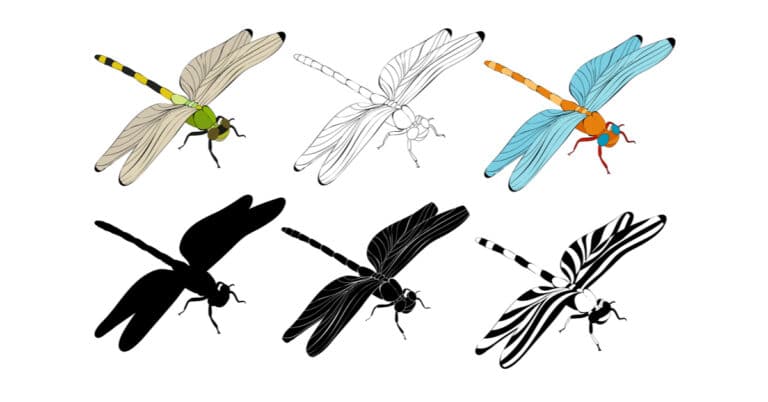
Red Dragonfly

Scientific Classification & Quick Facts
| Common name | Red-veined darter |
| Scientific name | Sympetrum fonscolombii |
| Kingdom | Animalia |
| Phylum | Arthropoda |
| Class | Insecta |
| Order | Odonata |
| Family | Libellulidae |
| Genus | Sympetrum |
| Conservation status | Least Concern |
| Type | Insect (dragonfly) |
| Diet | Mosquitoes, flies, butterflies; larvae eat tadpoles and small fish |
| Habitat | Near water to breed; also far from water |
| Native range | Southern and central Europe, Middle East, parts of Asia |
| Size | About 4 cm long; wingspan 6 cm |
| Colours | Males have a bright red abdomen and red wing veins |
| Special feature | Migrates and can fly about 56 km/h |
The Red Dragonfly, also known as the Red-Veined Darter or Nomad is technically known as Sympetrum fonscolombii, and belongs to the Sympetrum genus. It is widespread in the southern parts of Europe, and since the 1990s, it has also become a common species in the northwestern part of Europe including Ireland and Britain. The behavior and the genetic evidence prove that this species is very much different from the other species of this same genus, and may be moved to a separate genus in the future.

Description
The normal Red Dragonfly attains a length of 4cm, and a wingspan of 6cm. The male Red Dragonfly possesses a red abdomen, brighter than the other species of the Sympetrum genus. Their wings display red veins, and the base of the wings on the hind part are shaded yellow. The Pterostigma of this species is often pale that has a black vein in the border, and the under part of the creature’s eye has a grayish blue shade. The female Red Dragonfly also looks similar to the male, but their wings have yellow veins, and the abdomen shaded in yellow color. The legs of both the male and the female have a black and yellow shade. The juvenile Red Dragonfly looks similar to the female Red Dragonfly but has redder shade in their body.

Distribution and Habitat

This Red Dragonfly occurs in most parts of southern and central Europe, including the islands of Mediterranean regions, the regions of the Middle East and some regions of southwestern Asia like Sri-Lanka, India, and Mongolia. It was widely spread in the south of Europe, but now the range has extended towards the northern parts as well. It also occurs in the Madeira and Canary Islands, and supposed to be the only Libellulid (Wiki: the skimmers or perchers and their relatives form the Libellulidae, the largest dragonfly family in the world) present in the Azores.
Like the other dragonflies, it is also found near the water habitat for breeding, but otherwise, being a migrating creature, it is found away from the water. It can be seen flying over and around the sea area.
Behavior
The Red Dragonfly prefers to fly throughout the year around the area of the Mediterranean and its southern parts. But the main period of flight is from May to October, which declines by the winter period. This Red Dragonfly is referred as a territorial species, in which the male dragonfly is often seen resting on a perch. After mating, the male and the female dragonfly fly in tandem for laying eggs. As the time approaches for laying eggs, the female dragonfly is seen dipping her abdomen in the water to release the eggs. Like other insects, the dragonflies do not attain the pupa stage, instead they directly transform from the larvae stage to an adult Red Dragonfly. This species has more than one generation developing in a year, because the egg and the larval development take less than a period of 3 months. The speed of an adult Red Dragonfly may be about 56 km per hour.
Food
Like other dragonflies, the Red-Veined dragonfly is also an agile and voracious eater. They prefer eating a wide variety of insects. The adult dragonfly feeds on mosquitoes, ants, flies, fleas, butterflies and sometimes even other dragonflies too. The larvae dragonflies are also carnivorous in nature, and feeds on the insects found in the water habitat. It feeds on tadpoles, eggs of the fish, small fish and larvae of mosquitoes. The lower jaw, also termed as labium rests under their body, but shoot rapidly when its eyes fall on a prey. It is armed with hooks that help them to catch their prey.
Red-veined darter FAQs
What do red dragonflies eat?
Adults eat mosquitoes, flies, ants, butterflies and sometimes other dragonflies. Their larvae eat tadpoles, fish eggs, small fish and mosquito larvae.
Where do red dragonflies live?
They live in southern and central Europe, the Middle East and parts of southwestern Asia. Since the 1990s they have also become common in Ireland and Britain.
How big are red dragonflies?
A red dragonfly is about 4 centimetres long, with a wingspan of about 6 centimetres.
What does a red dragonfly look like?
The male has a bright red abdomen and red veins in its wings. Females look similar but are yellow, with yellow wing veins.
When can you see red dragonflies?
Their main flying season is from May to October. Around the Mediterranean they can fly all year.

Randi Jones is the owner and founder of the Nature Gift Store, an online retailer specializing in nature-themed gifts, educational science projects, live animal nature kits and real butterfly artwork. A biology graduate who fell in love with insects, she founded the company in 2001 to make active learning about nature fun, accessible and engaging for children and adults. Her store offers real butterfly frames, home and garden decor and educational live animal kits, including ant farms, worm farms, tadpoles, ladybugs and hermit crabs, and she runs a bug museum in Washington featuring live animals like Eddie the Iguana alongside other reptiles and insects.