Rummynose Tetra Fish
Hemigrammus Rhodostomus, commonly known as Rummy Nose Tetra belongs to the family of Characin fish that inhabits the tropical freshwaters. They are endemic to the South American regions and are a favorite of the fish hobbyist. They are the small tetra species that grow up to 5cm when mature. They look very similar to the other species known as Petitella Georgie and Hemigrammus bleheri. All these similar-looking fish are commonly known as Rummy Nose Tetras.
Description
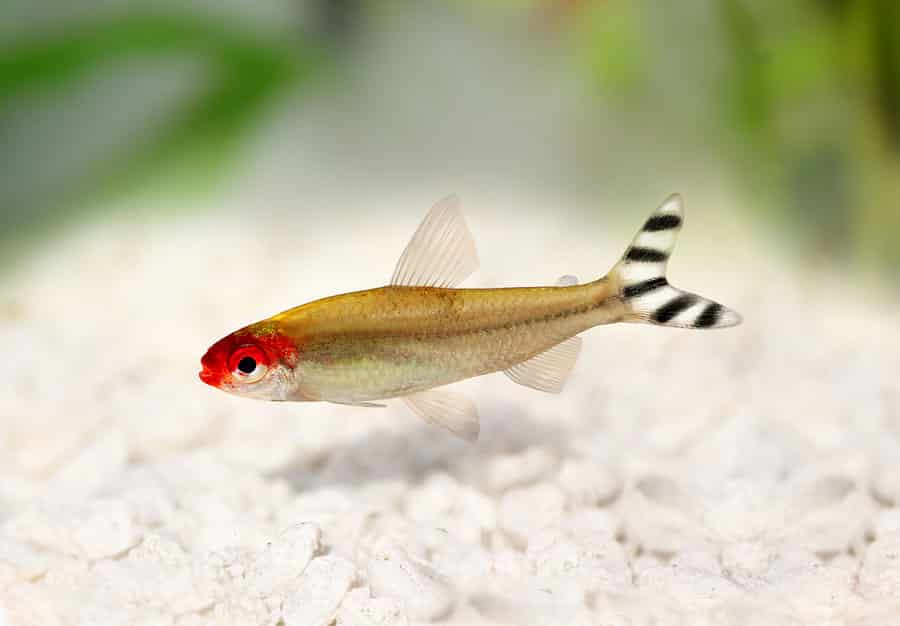
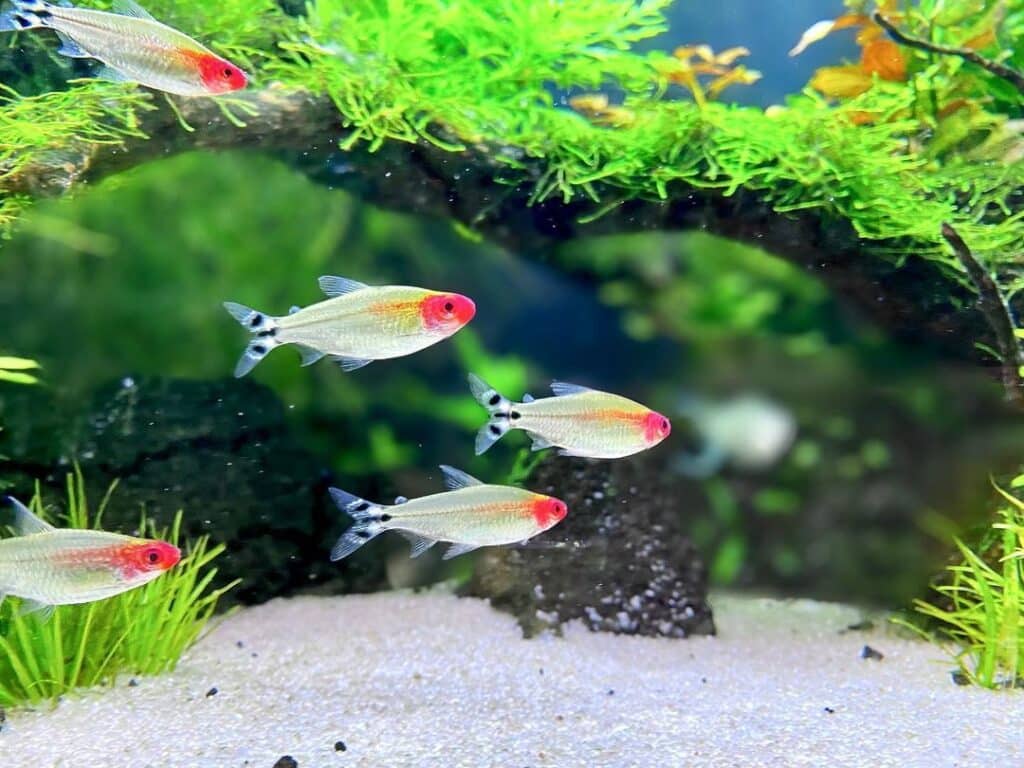
This fish has a torpedo shape with stunning color combinations. The basal part of the body has a transparent or more silver shade along with a tint of green. Some types are found with iridescent green colored scales near the area where the body meets the fontanel (Wiki: A part of the head corresponding to the human forehead). The fins have a glassy appearance, but the tail fins are exceptional. These tail fins display a beautiful combination of white and black horizontal stripes. The total black stripes count around 5 on the caudal fin lobe and on the central part of the tail fin. The head of this fish is covered in bright and lustrous red shade, which continues towards the eyes. The iris and sometimes even the gill plate or Operculum is covered in red color. Some similar types in this species are found with 3 black stripes on the tail.
Habitat
The Rummy Nose species and the remaining other subspecies are found in the water bodies which have soft water or mineral deficiencies and acidic water. Such water containing decay products of Humic Acid formed from the leaf litter is known as Blackwater. These fish prefer to inhabit the mid-lower and middle areas in the water.
Breeding
These fish should be placed in a breeding tank that needs to be sterilized before use for a successful result. It is because the eggs of the Rummy Nose Tetra are very sensitive to fungal infections and bacteria. The pair should be placed into the breeding fish tank about 7 days before the breeding period. They should be given heavy food and should be provided with subdued lighting to induce the reproduction process. They also prefer a quiet and clean ambience for spawning. Hence the fish tank should be placed in a less human-populated place. The preferable temperature is 32 to 33 degree C for spawning; hence it should be set with the help of heaters. The spawning takes place in dim light; hence, never increase the brightness until the spawning process is over. This lighting condition should continue till the eggs are laid and hatched, because the eggs are very sensitive to light and it can hinder the development of the eggs. Once the eggs are laid, use a fungal remedy to prevent the growth of fungi on the just laid eggs. The fertile eggs hatch only after 72 to 96 hours depending on the temperature that should be at least 32 degree C and many other conditions. After the eggs hatch, the fry will take another 24 to 36 hours to be a free swimming fish.
Water
Water is an important aspect to keep the fish healthy and growing. They will be active and full of fun if provided with a habitat similar to the natural one. They are basically Blackwater fish; hence, they prefer soft and acidic water. They will not survive in a new condition as well as in an unstable water conditions. The required pH level is between 5 and 5.7. They can adjust in a water temperature of about 72 to 77 degree F. They are very sensitive fish and easily get affected by polluted and dirty water. Hence regular changing of water is recommended.
Food
The Rummy Nose Tetra belongs to the mid-water feeder group. They are omnivores by nature, and eat both plants and animals in their diet. You can provide them with simple fish food. In their original habitat, they love eating live food; the best option for you is to provide live blood worms like aquatic larvae or different species belonging to the Chironomus Genus. You can also provide them with mosquito larvae. Frozen food will also be suitable for their health. The best suited food for their health is a highly nutritious flake diet, which can be provided everyday without any concern. You can also give brine shrimp as a treat. Tablet pellets and vegetables can also be included in their diet. As they have a small mouth, make sure, what you provide is small or in grounded texture suitable for them to chew. These Tetras can be fed several times a day, but the quantity should be very minimal. Only provide the food that can be consumed in 3 minutes.
Tank
The suitable tank for the Rummy Nose Tetras should have a size of 10 gallons. Numerous hardy plants along with roots and different types of aquarium wood should be placed to mimic their natural habitat. You can also place the different types of floating plants that can help to diffuse the lights. Filters are essential as these fish can remain healthy only in clean and clear water. They suffer from Ich (white, “Protozoan” spot disease‘) and other problems if the water is polluted. Heaters are also essential to maintain a suitable temperature for them to thrive well. They require a lot of space to swim and play.
How to Set up a Fish Tank for Rummy Nose Tetra
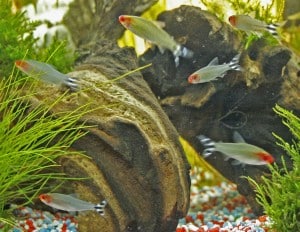
These fish are hardy in nature, and are easy to breed after they adjust to their new environment. But comparing to the other Tetras, it will be moderately difficult to breed, especially for the beginners. There are many requirements to be followed while breeding this species, or they cannot survive. Always try to create a fish tank that resembles their original habitat. This will keep them healthy and active. Following are the points to set up a fish tank for the Rummy Nose Tetra-:
- Firstly, wash and clean all the tank materials like substrate, ornaments, hardy plants and the tank itself. The substrate like the gravel can be cleaned by stirring in the water several times and clearing the dirt present in it. Never use detergents or soaps as they can be toxic to these creatures.
- Fill the water in the tank, and place all the materials with care.
- A high quality filter should be installed for pure and clean water. Experts recommend placing a peat filter or any other filter that has the capability to frequently turn over the water and check the stable water level. A filter kept under the gravel is also preferable as it helps to keep the water oxygenated, and clears the waste between the substrates.
A Biotope tank with less lighting is preferable by these fish. Other than floating plants and woodwork, a few dried leaves and river sand will impart a natural look and a good feel to these fish.
Having discovered a fondness for insects while pursuing her degree in Biology, Randi Jones was quite bugged to know that people usually dismissed these little creatures as “creepy-crawlies”.