Bubble Eye Goldfish
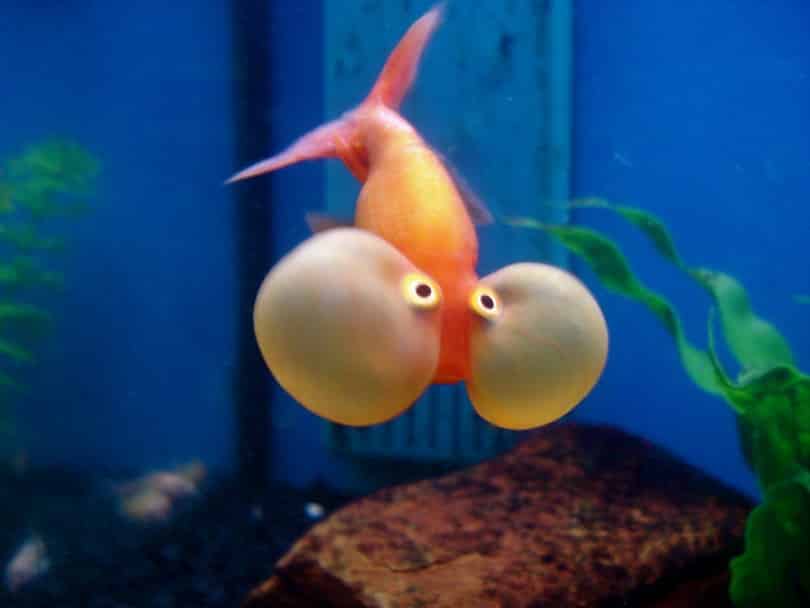
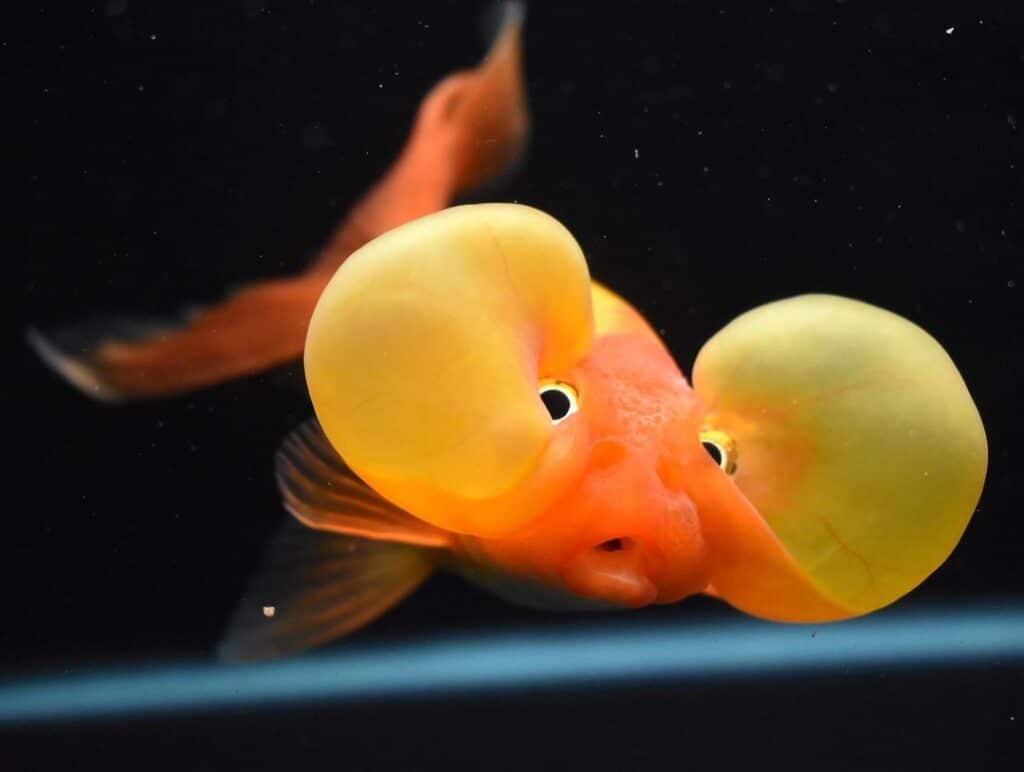
The Bubble Eye Goldfish, hailing from the Cyprinidae family is a distinguished variety of small Goldfish. As the name suggests, the versatile feature of this Goldfish is the big sacs under the eyes. This fish does not possess a dorsal fin; instead, it has a plain back. These are very sensitive creatures and bad swimmers owing to their large fluid-filled bubble eyes. These bubbles usually get sucked into the filters in an aquarium. The Japanese call them Suihogan, and they are very popular in many other regions among fish hobbyists.
Description
The Bubble Eye Goldfish attains a body length of 3 to 4 inches. They have a curved back and metallic scales. The eye sacks are very delicate and filled with fluids. It causes partial blindness in these species, as these sacks grow bigger under the eyes, almost covering a part of the eye. These water pouches jiggle, when the fish swims. Generally, these fish are born with normal eyes, but after 3 months, the pouch under the eyes start to bulge. These fish are prone to infections, if their bubbles pop, thereby exhibiting the interior part of the sac. They have double tails, but lack the dorsal fin. The average life expectancy is 10 to 15 years, but in exceptional cases, if provided with good care and proper environmental conditions, some fish also live up to 20 years or more.
Reproduction
The Bubble Eye Goldfish does not spawn easily, and usually the hobbyists struggle to help these fish to spawn. In the hand spawning method, at first, the pair has to be placed into a breeding aquarium. Then the male if first milked. Milking is the process where the fish is held upside down in the aquarium, and then the belly part is smoothly massaged with two fingers from the upper part of the belly till the anus. When the male fish is milked, it releases milt in the aquarium. Then the female fish has to be milked to release eggs. A Goldfish species have the capability to release around 1000 eggs in each spawning, but only a very few percent fertilizes and survive to grow. These eggs stick to the aquarium walls, bottom or any other substrate.
Bubble Eye Goldfish at Home
Food
These fish are omnivorous in nature. Hence, they can be provided with any type of food. Instead of providing the same food daily, introduce varieties in their diet. They should be fed more than 3 times a day with a small proportion of food. Providing small amount of food is essential to control the waste formation in the water, as these fish can consume only less due to the absence of a stomach. Food that can be included in their diet are nutritious pellets, flakes, frozen food like brine shrimp, krill, bloodworm and other food containing vegetables and fruits contents.
Water
Although, the Bubble Eye Goldfish is a Cold water fish, they require a water temperature of around 76 to 78 degree F. They must be provided with a suitable habitat having water conditions similar to their original habitat. They require a pH value between 6.0 to 8.0, and the hardness should be from 5 to 19 dGH. The water conditions should be regularly checked, and around 30 to 50% of the water should be changed daily.
Tank
The fish tank suitable for these fish should be of 20 to 30 gallon size. The gravel should be as big as a coffee bean, or the Bubble Eye Goldfish can swallow it and get choked. A filter is essential to clear the waste accumulated in the tank. You can also add decorative items like hardy plants, pebbles, shells, wood pieces and castles to give a natural look of a pond or a river.
Having discovered a fondness for insects while pursuing her degree in Biology, Randi Jones was quite bugged to know that people usually dismissed these little creatures as “creepy-crawlies”.