Capybara
Scientific Classification & Quick Facts
| Common name | Capybara |
| Scientific name | Hydrochoerus hydrochaeris |
| Kingdom | Animalia |
| Phylum | Chordata |
| Class | Mammalia |
| Order | Rodentia |
| Family | Caviidae |
| Genus | Hydrochoerus |
| Conservation status | Least Concern |
| Type | World’s largest rodent |
| Diet | Grass, water plants, fruit and vegetables |
| Habitat | Near water: flooded grasslands and marshes |
| Native range | South America |
| Size | 107-134 cm long |
| Weight | 35-66 kg |
| Special feature | Webbed feet; mates and swims in water |
Among the varieties of rodents, Capybaras (capybara hydrochoerus) are the biggest, almost a man’s weight. These extraordinary animals, like pigs have, to a great extent adapted to an aquatic style of life; they mate even in water. The nearest of their associates are rock cavies and guinea pigs. Their far relations are chinchillas, agouti and coypu.
Anatomy
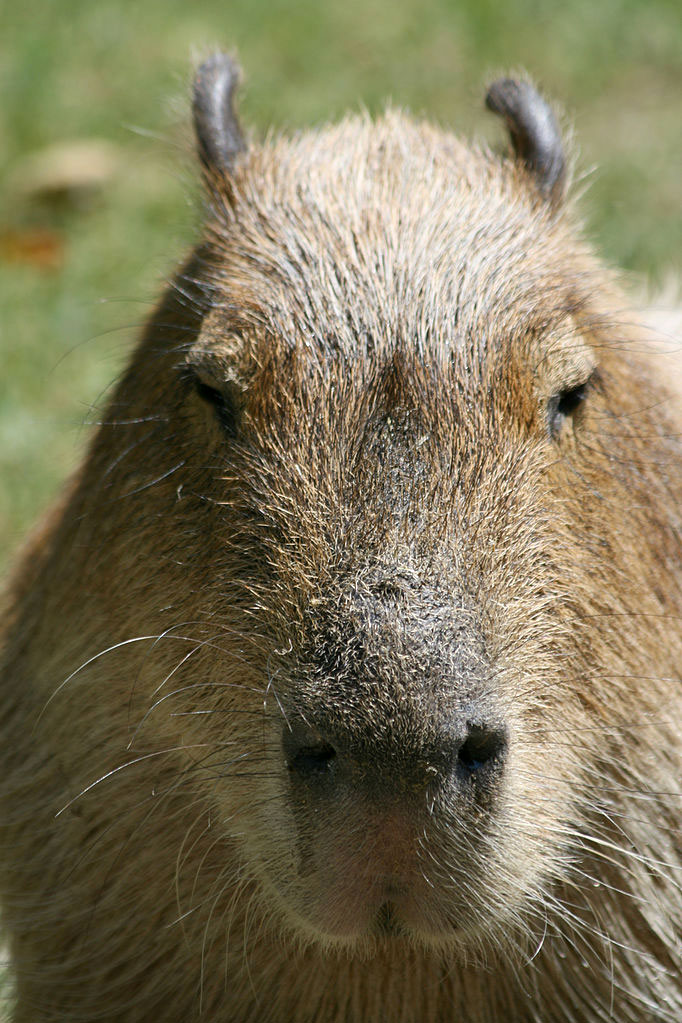
The head of the capybara is short whilst the body is barrel-shaped. Reddish-brown fur covers the upper part of its body and gradually fades to yellowish-brown beneath its body. We see the sweat glands on the surface of the hairy parts of its skin. This is not common among rodents. This rodent does not have hair on its underside and there is a no big difference between the guard hair and the over hair. The adult capybara grows to a length of 107 to 134 cm (3.51 to 4.40 ft). When upright it is 50 to 64 cm (20 to 25 in) in height at the shrivels, and it weighs 35 to 66 kg (77 to 146 lbs) the average weight of the Venezuelan ilanos is 48.9 kg (108 lb) the weight of a wild female of Brazil is 91 kg (201 lb) and the wild male Uruguay is 73.5 kg (162 lb) ; these are record weights. The capybaras have vestigial tails and somewhat webbed feet with their fore legs slightly shorter than their hind legs. Their front feet have four toes and rear feet three toes. They have blunt muzzles, and their eyes, ears and nostrils are adjacent to the top of their heads. Males are not so heavy as the females.
Behavior
Capybaras are sociable, but live on their own at times. You often seen in groups with an average of 10 to 20 individuals consisting of 2 to 4 adult males, 4 to 7 adult females and the remaining young ones. Even though people keep capybaras as pets they are wild animals. When they perceive a threat they impulsively react to it and at times they bite.
Habitat
You can see Capybaras near water bodies of which they favor flooded grasslands, lowland forests and marshy borders where they graze easily and there is water throughout the year. On the other hand, they reside in a series of environments, such as grasslands, waterless forests and scrubs all over the South American Continent.
As a Pet

Breeding
Breeding of a pet capybara takes place all through the year; their peak breeding period is at the start of the rainy season. A male capybara goes behind a female for long periods when she comes into estrus before they mate. At this time a stronger and dominant male drives away the weaker male, to take its place. They copulate under water and it lasts for a few seconds.The female copulates many times during each estrus period.
Housing
Make available a cage as big as a dog house for this rodent pet. Provide a bed with hay to keep up warmth during the cold winter and a heat lamp when the temperature falls below 45°F. In order to keep your capybara cool and hydrated, keep a water bowl in the enclosure. Make a hole as deep as 3.5 feet for swimming; the hole may go up to 6 feet or deeper so make it inclined to enable your capybara to walk in and out of the water. See that his body immerses fully and preferably there is space enough for it to swim.
Food
Provide a diet of vegetation to your capybara. When they are in the wild they live on grass and supplements of vegetables, fruits as well as water plants. Your capybara is a natural lawn mower, which maintains the height of your grass shorter. Supply them with treats and supplements such as fruits, bread, grass hay, vegetables as well as either rabbit or cattle pellets that suit their diet that you can feed along with the untreated grass in your yard.
Handling
Capybaras love social connections with their family members, people, or at times other type of animals. Provide a capybara a companion or spend quality time with your pet.
Capybara FAQs
How big do capybaras get?
Capybaras are the biggest rodents. An adult is about 107 to 134 centimetres long and usually weighs 35 to 66 kilograms, roughly as much as a person.
What do capybaras eat?
In the wild they mostly eat grass, plus water plants, fruit and vegetables.
Where do capybaras live?
Capybaras live in South America, usually near water such as flooded grasslands, lowland forests and marshy edges. Their eyes, ears and nostrils sit high on the head so they can stay mostly underwater.
Do capybaras live in groups?
Yes. They are social and live in groups of 10 to 20, with 2 to 4 adult males, 4 to 7 females and young.
Are capybaras good pets?
The article says capybaras are wild animals that can react suddenly and bite. They need a big enclosure with a pool to swim in and lots of company.

Randi Jones is the owner and founder of the Nature Gift Store, an online retailer specializing in nature-themed gifts, educational science projects, live animal nature kits and real butterfly artwork. A biology graduate who fell in love with insects, she founded the company in 2001 to make active learning about nature fun, accessible and engaging for children and adults. Her store offers real butterfly frames, home and garden decor and educational live animal kits, including ant farms, worm farms, tadpoles, ladybugs and hermit crabs, and she runs a bug museum in Washington featuring live animals like Eddie the Iguana alongside other reptiles and insects.