Mulberry Tree

Mulberry trees are fast-growing trees in the genus Morus that produce sweet, juicy berries in shades of white, red and deep purple-black. There are roughly 10 to 16 species, and their fruit has been eaten fresh and used in pies, tarts, jams and wines for thousands of years.
Scientific Classification & Quick Facts
| Common name | Mulberry |
| Scientific name | Morus |
| Kingdom | Plantae |
| Phylum | Tracheophyta |
| Class | Magnoliopsida |
| Order | Rosales |
| Family | Moraceae |
| Type | Fruit tree, fast-growing when young |
| Habitat | Deep, moist, well-drained, fertile soil in full sun |
| Native range | Warm regions of Asia, Africa and the Americas |
| Colours | Deep purple or red fruit |
| Height | Rarely above 15 m |
| Edible parts | Sweet fruit, 2-3 cm long |
The Three Main Mulberries
Three kinds of mulberry are grown most often as fruit trees:
- Black mulberry (Morus nigra) comes from southwestern Asia. Many people think its dark, tangy-sweet berries have the best flavor of all.
- Red mulberry (Morus rubra) is native to eastern North America. Its dark red to purple berries are also very tasty.
- White mulberry (Morus alba) comes from China. Its berries can be white, pink or purple and are sweet but milder in flavor. Its leaves are the main food of silkworms, the caterpillars that make silk.
Breeders have also crossed these species to create hybrid varieties, some of which look and taste quite different from their parents.
What Mulberry Trees Look Like
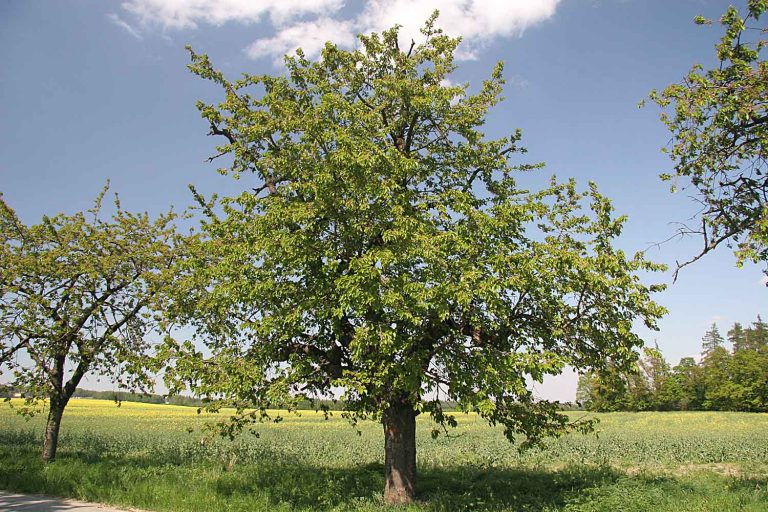
Mulberries grow quickly when young, then slow down as they get older. Most reach about 10 to 15 meters (30 to 50 feet) tall, while the black mulberry is usually smaller, often forming a wide, rounded tree with a short trunk.
Their leaves are toothed around the edges. On the same tree, some leaves may be simple and heart-shaped while others have deep lobes, a bit like mittens. The berries are actually clusters of many tiny fruits joined together, similar to a blackberry. They are usually about 2 to 3 cm (1 inch) long.
Where Mulberries Grow
Wild mulberries are found in warm temperate and subtropical regions of Asia, Africa and the Americas. Most species come from Asia. Today mulberries are planted in gardens, parks and farms in many countries.
White mulberry has spread far beyond its homeland. In parts of North America it grows wild and even crosses with the native red mulberry, which is a problem for the red mulberry’s survival in some areas.
Growing a Mulberry Tree
Soil
Mulberries grow best in deep, fertile soil that holds moisture but drains well. They prefer soil that is rich in organic matter, with a pH from slightly acidic to slightly alkaline, roughly 6.0 to 7.5. Very shallow, stony or waterlogged soils are not a good choice.
A layer of mulch over the root area helps keep the soil moist and adds nutrients as it breaks down. In poorer soils, a balanced slow-release fertilizer in spring can help.
Sunlight and Climate
Mulberry trees need plenty of sun, ideally at least six to eight hours of direct sunlight a day. They will grow in some shade, but they produce less fruit.
The three main species handle cold differently:
- White mulberry is the toughest and handles cold winters best.
- Red mulberry is also fairly cold-hardy and grows well across much of the eastern United States.
- Black mulberry is the most tender. It needs warm summers and fairly mild winters to grow and fruit well.
Planting

Photo by: David Hawgood
Choose a sunny, open spot with room for the tree to spread. Dig a hole wider than the roots and about as deep. Set the young tree at the same depth it was growing before, fill in with soil, firm gently and water well. Keep the soil moist while the tree settles in, especially during its first summer.
Mulberries can be grown from seed, but seedlings may not be like the parent tree and can take many years to bear fruit. Many gardeners grow them from cuttings instead, which root easily, or buy grafted trees of a named variety. These usually start fruiting within a few years. Mulberries can also be grown in large pots for a number of years, as long as they are watered regularly.
Watering
Water young trees regularly so the soil does not dry out. Established mulberries are fairly drought-tolerant, but watering during long dry spells, especially while the fruit is forming, gives a better crop.
Care, Pruning and Problems
- Spread a few inches of mulch around the tree each spring, keeping it away from the trunk.
- Prune only when the tree is dormant in late autumn or winter. Mulberries bleed a lot of sap if cut in spring or summer.
- Remove dead, damaged or crossing branches and any shoots growing from the base. Keep pruning light, as heavy cutting is not needed.
- Long, low branches can bend or split under the weight of fruit. Support them with a forked prop padded with sacking.
- Watch for bacterial leaf spot and dieback. Cut off and destroy badly affected branches.
- Birds love mulberries. Netting small trees can save some fruit for you.
Harvesting and Storing the Berries
Most mulberries ripen in summer. In cooler places, black mulberries ripen later, often in late summer. The fruit ripens a little at a time over several weeks, so you can pick it again and again.
The easiest way to harvest is to spread a clean sheet or tarp under the branches and gently shake the tree. The ripe berries drop, while unripe ones stay on to ripen later. Only eat fully ripe berries. Unripe berries and the milky sap from leaves and stems can upset your stomach or irritate your skin.
Mulberry juice stains hands, clothes and pavements, so wear old clothes and gloves when picking. The berries are very soft and only keep for a few days in the fridge, but they freeze well for pies, smoothies and jam.
Mulberry FAQs
What color are mulberries?
Mulberries are deep purple or red. They grow in clusters, are about 2 to 3 cm long and taste sweet.
How many kinds of mulberry are there?
There are 10 to 16 kinds in the genus Morus. The three best known are the black mulberry from Asia, the white mulberry from China and the red mulberry from eastern North America.
How long does a mulberry tree take to make fruit?
A mulberry tree begins to bear fruit about 8 or 9 years after planting.
How do you pick mulberries?
Wait until the fruit is ripe in early autumn. Spread a sheet under the branches and shake the tree gently so the ripe berries fall, and wear gloves so your hands don’t get stained.
How much sun does a mulberry tree need?
At least 8 hours of direct sun a day. In the shade the tree is weaker and makes less and poorer fruit.

Randi Jones is the owner and founder of the Nature Gift Store, an online retailer specializing in nature-themed gifts, educational science projects, live animal nature kits and real butterfly artwork. A biology graduate who fell in love with insects, she founded the company in 2001 to make active learning about nature fun, accessible and engaging for children and adults. Her store offers real butterfly frames, home and garden decor and educational live animal kits, including ant farms, worm farms, tadpoles, ladybugs and hermit crabs, and she runs a bug museum in Washington featuring live animals like Eddie the Iguana alongside other reptiles and insects.