
Do Butterflies Migrate? Where Do They Go?

Quick answer: Yes, some butterflies migrate. The monarch is the best-known, flying thousands of miles from the U.S. and Canada to Mexico and California for winter. Painted ladies, red admirals, and others also migrate, though often not as far.
Have you heard of the Monarch butterfly migration? Well, other butterflies migrate too! There are many other species of butterflies that also migrate. For example, the Painted Lady, Common Buckeye, American Lady, Red Admiral, Cloudless Sulphur, Skipper, Sachem, Question Mark, Clouded Skipper, Fiery Skipper, and Mourning Cloak are all butterflies that migrate as well.
Why Do Butterflies Migrate?
There are different reasons why butterflies will migrate toward other places. Did you know that all butterflies are cold-blooded creatures? They simply can not handle the colder weather so have to travel somewhere warmer. They also need to stay where their food source is if it’s winter and there are no flowers, they can not stay there.
If weather changes are not a problem, like for the butterflies in the tropics, butterflies will often migrate away in order to establish new colonies. The reason for this is that if they stay in one place for too long, the butterfly caterpillars will consume all of their food in that one area, and so the butterflies will starve to death. So migrating to new places will ensure their survival and their food source.
The Monarch Butterfly Migration
Monarch butterflies are not able to survive the cold winters of most of the United States so they migrate south and west each autumn to escape the cold weather. The monarch migration usually starts in about October of each year, but can start earlier if the weather turns cold sooner than that.
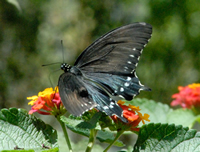
The monarch butterflies will spend their winter hibernation in Mexico and some parts of Southern California where it is warm all year long. If the monarch lives in the Eastern states, usually east of the Rocky Mountains, it will migrate to Mexico and hibernate in oyamel fir trees. If the monarch butterfly lives west of the Rocky Mountains, then it will hibernate in and around Pacific Grove, California in eucalyptus trees. Monarch butterflies use the very same trees each and every year when they migrate, which seems odd because they aren�t the same butterflies that were there last year. These are the new fourth generation of monarch butterflies, so how do they know which trees are the right ones to hibernate in? Monarch butterflies are the only insect that migrates to a warmer climate that is 2,500 miles away each year.

The Monarch butterfly migrates for 2 reasons. They can not withstand freezing weather in the northern and central continental climates in the winter. Also, the larval food plants do not grow in their winter overwintering sites, so the spring generation must fly back north to places where the plants are plentiful. Would you like to help track monarch butterfly migrations? Visit Monarchwatch for lots of information on tracking migrations with a color map.

Explore next



Threats to Monarch Overwintering Sites
The monarch overwintering sites are under threat because of people cutting down their favorite trees to build roads, houses and farms. What will happen to the monarchs if they do not have their special trees to spend the winter? There are groups that collect money to save the important trees and educate people about monarch conservation. You can learn more about helping monarchs here.
Butterfly Migration FAQs
Which butterflies migrate besides the monarch?
Many species migrate, not just monarchs. The Painted Lady, Red Admiral, American Lady, Common Buckeye, Cloudless Sulphur, Question Mark, Mourning Cloak and several skippers all make seasonal journeys. The Painted Lady is especially famous, travelling thousands of miles between Africa and Europe over several generations each year.
Why do butterflies migrate?
Butterflies are cold-blooded, so most cannot survive freezing winters as adults. They migrate to reach warmer places and to stay near food sources such as nectar flowers and the host plants their caterpillars need. In the tropics, some species move to establish new colonies when local food plants are used up.
Where do monarch butterflies go in the winter?
Monarchs east of the Rocky Mountains fly to the mountains of central Mexico, where they cluster in oyamel fir forests. Monarchs west of the Rockies overwinter along the California coast, gathering in eucalyptus, pine and cypress groves at sites such as Pacific Grove. Millions may gather together in a single forest.
How do monarchs find the same trees every year?
No single monarch makes the round trip, so the butterflies arriving in Mexico have never been there before. Scientists believe they navigate using a sun compass linked to an internal body clock, possibly helped by sensing the Earth’s magnetic field. Exactly how they find the same small forest patches remains partly a mystery.
Why are monarch overwintering sites threatened?
The forests where monarchs spend the winter are being cut down for logging, roads, housing and farming. Without the shelter of the trees, the butterflies are more exposed to cold, rain and predators. Conservation groups work to protect these forests, and people can help by planting milkweed and nectar flowers.

Randi Jones is the owner and founder of the Nature Gift Store, an online retailer specializing in nature-themed gifts, educational science projects, live animal nature kits and real butterfly artwork. A biology graduate who fell in love with insects, she founded the company in 2001 to make active learning about nature fun, accessible and engaging for children and adults. Her store offers real butterfly frames, home and garden decor and educational live animal kits, including ant farms, worm farms, tadpoles, ladybugs and hermit crabs, and she runs a bug museum in Washington featuring live animals like Eddie the Iguana alongside other reptiles and insects. Randi wrote most of the guides on this site. They first appeared on her long-running nature sites, including Monarch-Butterfly.com, Ladybug-Life-Cycle.com, Frog-Life-Cycle.com, Dragonfly-Site.com and Butterfly Pictures, which have now been brought together here at Learn About Nature.


