Oyster

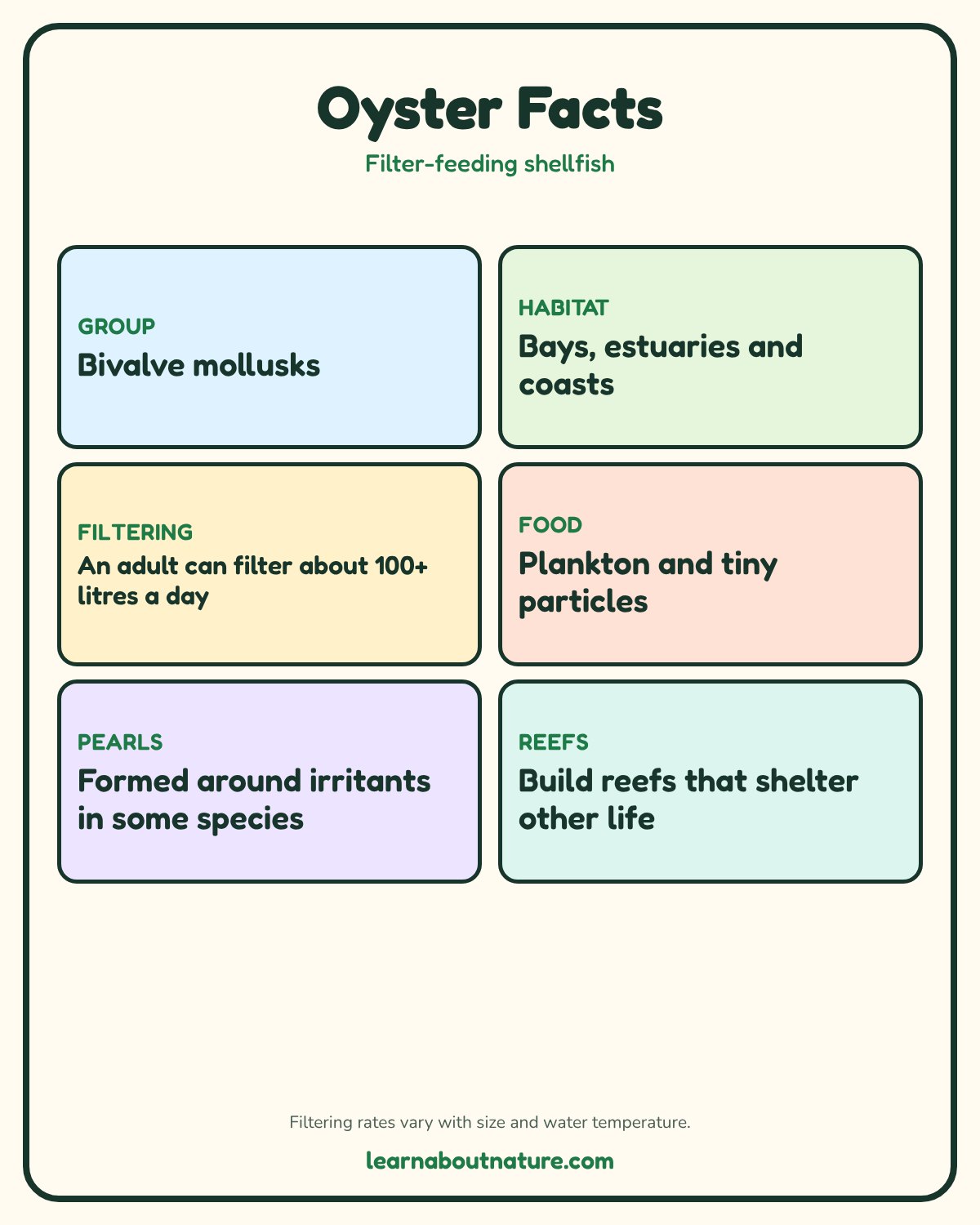
Oysters are saltwater shellfish with two rough, hinged shells that live in oceans, bays, and estuaries where rivers meet the sea. They are bivalve mollusks, related to clams, scallops, and mussels, and they are important both as food for people and as builders of underwater reefs that shelter many other animals.
Oyster Quick Facts
| Common name | Oyster |
| Scientific name | Ostreidae |
| Kingdom | Animalia |
| Phylum | Mollusca |
| Class | Bivalvia |
| Order | Ostreida |
| Type | Bivalve mollusc |
| Diet | Filter feeder: plankton and tiny particles |
| Habitat | Brackish and salty water, forming reefs |
| Special feature | One oyster can filter over 5 litres of water an hour |
What Is an Oyster?
The word “oyster” is used for several groups of bivalves. The “true oysters” that people usually eat belong to the family Ostreidae. Their shells are thick, made mostly of calcium carbonate, and often oddly shaped, because each oyster grows to fit the spot where it is attached.
Some animals called oysters are not true oysters at all. Pearl oysters belong to a different family and are farmed for the shiny pearls that form inside them. Windowpane oysters have thin, see-through shells that people in parts of Asia once used instead of glass in windows, and still use for lamps and decorations.
How Oysters Eat
Oysters are filter feeders. Tiny hair-like structures called cilia beat back and forth to pull water over the oyster’s gills. Plankton and other tiny food particles get trapped in sticky mucus on the gills and are moved to the mouth. Particles the oyster does not want are wrapped in mucus and spat out as “pseudofeces.”
A single adult oyster can filter up to about 50 gallons (around 190 liters) of water a day. Oysters feed most actively in warm water and slow down a lot when the water drops below about 50°F (10°C).
All that filtering helps clean the water. Scientists estimate that when oysters were very plentiful in Chesapeake Bay, before overharvesting in the 1800s, they could filter a volume of water equal to the whole bay in about a week or less. Today far fewer oysters live there, and restoring oyster reefs is a big part of efforts to clean up the bay.
Oyster Reefs: Underwater Cities
Oysters like to settle on top of other oyster shells, so over many years they build up large reefs. These reefs are home to hundreds of kinds of animals, including barnacles, sea anemones, mussels, worms, crabs, and small fish that hide in the gaps between the shells. Bigger fish such as striped bass, croaker, and black drum come to the reefs to hunt.
Because so many other species depend on them, oysters are called a keystone species. Reefs also protect shorelines by softening the force of waves.
Different oysters prefer different zones. Many Crassostrea and Saccostrea oysters live in the intertidal zone, which is covered at high tide and uncovered at low tide, while many Ostrea oysters live in deeper water that is always covered.
Reproduction
Many oysters can change sex during their lives. The eastern oyster often starts out as a male and later becomes a female, and some may switch back and forth. Oysters usually begin breeding within their first year.
In warm summer water, oysters release clouds of eggs and sperm into the sea. When one oyster spawns, it can trigger its neighbors to spawn too. A large female can release tens of millions of eggs in a single season.
The fertilized eggs hatch into tiny swimming larvae that drift for about two to three weeks. Then they look for a hard place to settle, and their favorite spot is the shell of another oyster. Once a larva glues itself down, it is called spat. Young spat are smaller than a fingernail, under about 1 inch (25 mm) across.
Oyster Farming
People have farmed oysters for a very long time. The ancient Romans raised oysters in coastal ponds more than 2,000 years ago. Today, the most widely farmed oyster in the world is the Pacific oyster (Crassostrea gigas).
Oyster farmers usually start by letting larvae settle onto shells or other surfaces in hatcheries or nursery areas. The young “seed oysters” are then moved out into the water to grow, using one of two main methods:
- Bottom culture: seed oysters are spread over oyster beds on the seafloor, where they grow naturally and are later harvested like wild oysters. This is cheaper, but more oysters are lost to predators and silt.
- Off-bottom culture: oysters are grown in bags, cages, or racks kept above the seafloor. Farmers simply lift the gear to check or harvest the oysters. It costs more, but protects the oysters from many predators and produces cleaner, better-shaped shells.
Off-Bottom Farming in the Gulf of Mexico
Off-bottom farming has grown quickly along the U.S. Gulf Coast in places such as Alabama and Louisiana. Farmers there grow high-quality oysters for restaurants and markets that want premium half-shell oysters.
Around 2010 and 2011, researchers working with the Mississippi-Alabama Sea Grant Consortium and local oyster farmers ran trials to find the best ways to farm oysters in the northern Gulf. Their work included:
- Growing oyster seed at several sites and regularly measuring growth and survival
- Comparing ordinary (diploid) oysters with specially bred triploid oysters, which are sterile and often grow faster
- Testing different kinds of farming gear to see how each affected size, growth, and survival
- Studying production costs to find the most practical farming methods
Oysters as Food

Oysters are eaten raw on the half shell or cooked in many ways, such as fried, grilled, steamed, or in stews. A live oyster keeps its shell tightly closed or snaps it shut when tapped. An oyster whose shell stays open is probably dead and should be thrown away. When oysters are cooked in the shell, the shells pop open.
Raw oysters can carry harmful bacteria, especially in warm months, so eating them raw is risky, particularly for young children and people with weak immune systems. Cooking oysters thoroughly makes them much safer.
Oyster shells are useful too. Crushed oyster shell is fed to chickens as a source of calcium for strong eggshells, and many coastal communities recycle shells back into the water to help build new reefs.
Oyster FAQs
What do oysters eat?
Oysters are filter feeders. They beat tiny hairs called cilia to pull water over their gills, which trap plankton and other small particles to eat.
How much water can an oyster clean?
One oyster can filter more than 5 litres (1.3 gallons) of water in an hour when the water is warmer than about 10 C.
Do oysters change from male to female?
Yes. In their first year they release sperm as males. In the next two to three years they switch to releasing eggs as females.
How many eggs can an oyster lay?
A single oyster can release as many as 100 million eggs in a year. The young larvae look for a place to settle, often on another oyster shell.
Why do oyster reefs matter?
Oyster reefs give homes to many animals, such as barnacles, sea anemones and small mussels, and they feed bigger fish like striped bass and black drum.

Randi Jones is the owner and founder of the Nature Gift Store, an online retailer specializing in nature-themed gifts, educational science projects, live animal nature kits and real butterfly artwork. A biology graduate who fell in love with insects, she founded the company in 2001 to make active learning about nature fun, accessible and engaging for children and adults. Her store offers real butterfly frames, home and garden decor and educational live animal kits, including ant farms, worm farms, tadpoles, ladybugs and hermit crabs, and she runs a bug museum in Washington featuring live animals like Eddie the Iguana alongside other reptiles and insects. Randi wrote most of the guides on this site. They first appeared on her long-running nature sites, including Monarch-Butterfly.com, Ladybug-Life-Cycle.com, Frog-Life-Cycle.com, Dragonfly-Site.com and Butterfly Pictures, which have now been brought together here at Learn About Nature.