Snake Plant

The snake plant is a tough, upright houseplant with stiff, sword-shaped leaves striped in dark and pale green. It is also called mother-in-law’s tongue or Saint George’s sword, and it is famous for staying alive even when people forget to look after it.
Scientific Classification & Quick Facts
| Common name | Snake plant |
| Scientific name | Dracaena trifasciata |
| Kingdom | Plantae |
| Phylum | Tracheophyta |
| Class | Liliopsida |
| Order | Asparagales |
| Family | Asparagaceae |
| Genus | Dracaena |
| Type | Evergreen perennial houseplant |
| Habitat | Disturbed sites, open woodland and roadsides in warm regions |
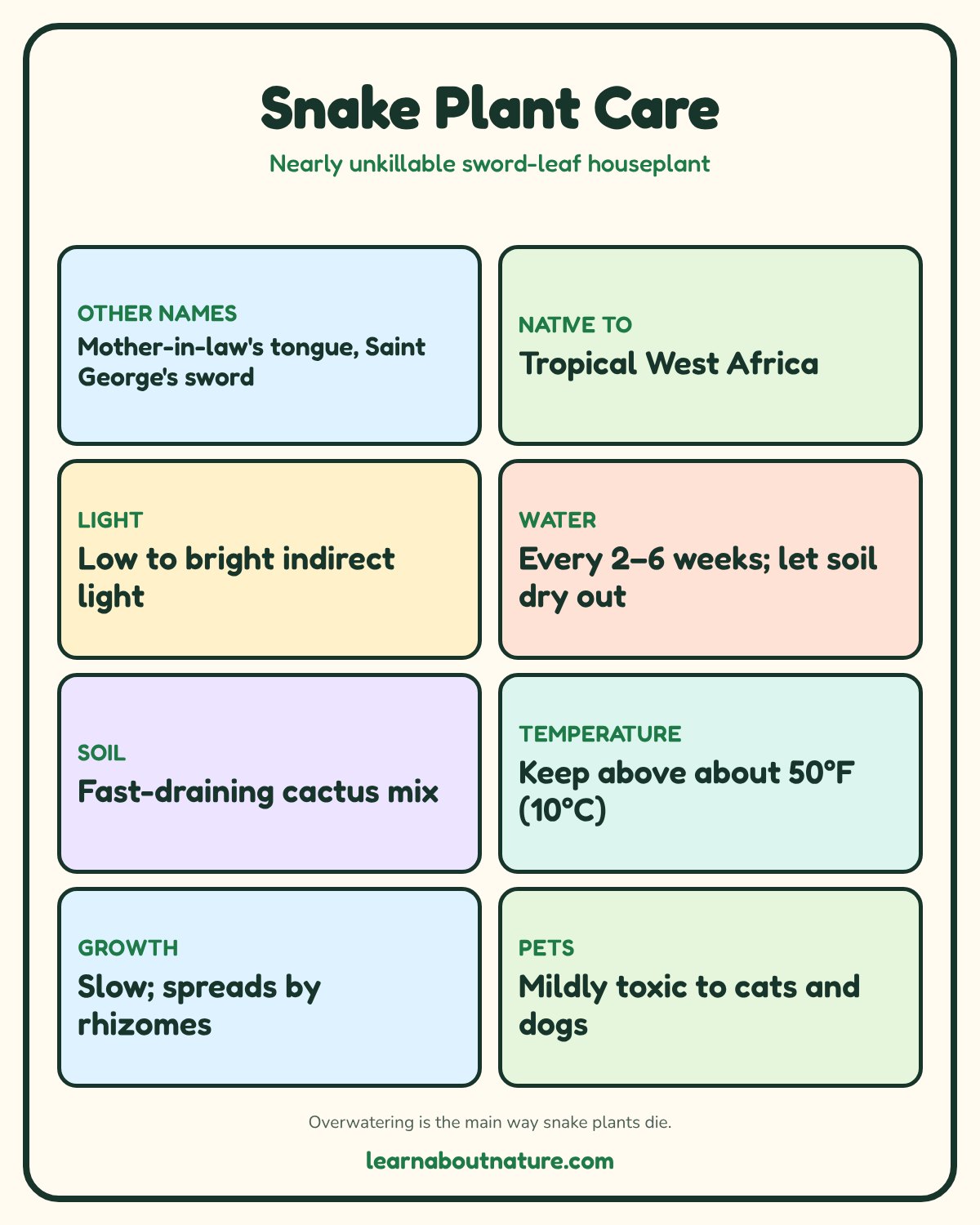
| Native range | Tropical West Africa, from Nigeria to Congo |
| Size | Leaves 70 to 90 cm long |
| Colours | Deep green leaves with pale grey-green bands |
| Special feature | Survives even when mostly ignored |
What Is a Snake Plant?
For many years the snake plant was known by the scientific name Sansevieria trifasciata. In 2017, botanists moved it into the genus Dracaena, so today its official name is Dracaena trifasciata. You will still see the old name on plant labels and in garden centers.
It belongs to the asparagus family (Asparagaceae) and comes from tropical West Africa, from Nigeria east to the Congo region. Snake plants have been popular houseplants for a long time, and they became especially common in homes and offices from the middle of the 20th century.
There are many cultivated varieties. Some have yellow edges on their leaves, such as ‘Laurentii’. Others, like ‘Hahnii’ (sometimes called bird’s nest snake plant), ‘Golden Hahnii’ and ‘Silver Hahnii’, stay short and grow in a neat rosette.
History and Folklore
Snake plants have a long history alongside people. In parts of Africa, the strong fibers inside the leaves were used to make rope and bowstrings, which is why one old name for the plant is “bowstring hemp.”
The plant also has a place in folklore. A popular story says that in China the plant was believed to bring good luck, and that eight gods would grant eight virtues to anyone who grew it: long life, prosperity, intelligence, beauty, art, poetry, health and strength. People sometimes placed the plant near their front door so these good things could come inside. Stories like this are part of tradition rather than science, but they show how much people have valued this plant.
What Does a Snake Plant Look Like?
The snake plant is an evergreen perennial, which means it keeps its leaves all year and lives for many years. It spreads by rhizomes, thick stems that creep along or just under the soil and send up new leaves. Over time this creates a crowded clump of leaves.
The leaves are stiff and grow straight up from a rosette at the base. A mature leaf is dark green with wavy, light gray-green bands, a bit like the markings on a snake. Leaves are usually about 70 to 90 cm (28 to 35 in) long and 5 to 6 cm (2 to 2.4 in) wide, though potted plants are often smaller.
Indoors it rarely flowers, but now and then a happy plant sends up a tall stalk of small, greenish-white, sweet-smelling flowers.

Snake Plant – Photo by: Derek Ramsey
Snake plant. Photo by: Derek Ramsey
Where Do Snake Plants Grow in the Wild?
In its native West Africa, the snake plant grows in rocky, dry places and open woodland. It stores water in its thick leaves, so it can survive long dry spells.
Because it is so tough, it has escaped from gardens in many warm parts of the world. There it grows in old gardens, along roadsides, on disturbed ground, in coastal scrub and at the edges of forests. In some places, such as Florida and parts of Australia and the Pacific, it is treated as an invasive weed.
How to Grow a Snake Plant
Soil and Pots
Snake plants rot easily if their roots sit in wet soil, so good drainage is the most important thing. Use a free-draining potting mix, such as a cactus and succulent mix, or regular houseplant mix with some sand or perlite added. Don’t use heavy soil dug from the garden.
Choose a pot with a drainage hole. Clay pots are a good choice because they let the soil dry out faster. Repot only when the roots fill the pot or start to push against it, usually every few years.
Making New Plants
Snake plants are easy to propagate, or multiply. The simplest way is division: take the plant out of its pot and, with an adult’s help, cut through the rhizome with a clean, sharp knife so that each piece has roots and leaves. Pot each piece in fresh, well-drained mix.
You can also root pieces of leaf in damp potting mix or water, but this is slower. New plants grown from leaf cuttings of yellow-edged varieties usually lose their yellow edges.
Light
Snake plants grow best in bright, indirect light, such as near a window facing east or west. They can also cope with fairly low light, which is why they are so popular in offices. They will grow more slowly in dim spots. A little direct sun is fine, but very strong sun through a south-facing window can scorch the leaves, so keep the plant a short distance back from the glass.
Watering
Too much water is the most common way people harm a snake plant. It is better to water too little than too much. Let the soil dry out completely before you water again, then water thoroughly and let the extra drain away.
Water around the base of the plant, not into the middle of the leaf rosette, because water sitting there can cause rot. In spring and summer, watering every two to three weeks is often enough. In winter, when the plant grows slowly, once a month or even less is usually plenty.
The plant will give you clues. If it is too dry for a long time, its leaves may wrinkle, curl or lean over. If it gets too much water, the leaves turn soft, mushy or yellow at the base. Remove any rotting leaves right away, and let the soil dry out before watering again.
Feeding and Care
Once it is settled in, a snake plant needs very little care. Feed it with a weak, all-purpose houseplant fertilizer a few times during spring and summer, and not at all in winter. Wipe dust off the leaves now and then so they can soak up light.
Temperature
Snake plants like the same temperatures most people do. Daytime temperatures of about 60 to 80°F (16 to 27°C) and nights of about 55 to 70°F (13 to 21°C) suit them well. Keep them away from cold drafts. If the temperature drops below about 50°F (10°C), the leaves can be damaged and scarred, so bring outdoor plants inside before cold weather arrives.
Is the Snake Plant Safe for Pets?
Snake plant leaves contain natural chemicals called saponins. If a cat or dog chews them, they can cause drooling, vomiting or an upset stomach. Keep the plant out of reach of pets and small children, and call a vet if you think your pet has eaten some.
Interesting Facts
- A 1989 NASA study tested the snake plant among houseplants that can remove some chemicals from the air. In a real home, though, you would need a huge number of plants to make a big difference, so good ventilation still matters most.
- Like many plants from dry places, the snake plant opens its tiny leaf pores mainly at night to take in carbon dioxide. This helps it save water during the heat of the day.
- A snake plant can live for many years, and a big clump can be split again and again to make new plants to share with friends.
Snake plant FAQs
Where does the snake plant come from?
The snake plant is native to tropical West Africa, from eastern Nigeria to Congo. It is also called mother-in-law’s tongue.
How often should you water a snake plant?
Water it only sparingly and let the soil dry out completely in between. In winter it needs water just once or twice a month. Too much water makes the leaves slimy.
How big do snake plant leaves get?
The stiff, upright leaves are usually 70 to 90 cm long and 5 to 6 cm wide. They are deep green with pale grey-green cross bands.
Does a snake plant need direct sunlight?
No, it does best out of direct sun, especially in winter. A windowsill facing north, east or west works well.
How can you grow a new snake plant?
Cut off a fleshy piece of the underground stem (rhizome) with a sharp knife and pot it in loose, well-draining soil. Sandy soil is ideal.

Randi Jones is the owner and founder of the Nature Gift Store, an online retailer specializing in nature-themed gifts, educational science projects, live animal nature kits and real butterfly artwork. A biology graduate who fell in love with insects, she founded the company in 2001 to make active learning about nature fun, accessible and engaging for children and adults. Her store offers real butterfly frames, home and garden decor and educational live animal kits, including ant farms, worm farms, tadpoles, ladybugs and hermit crabs, and she runs a bug museum in Washington featuring live animals like Eddie the Iguana alongside other reptiles and insects. Randi wrote most of the guides on this site. They first appeared on her long-running nature sites, including Monarch-Butterfly.com, Ladybug-Life-Cycle.com, Frog-Life-Cycle.com, Dragonfly-Site.com and Butterfly Pictures, which have now been brought together here at Learn About Nature.