Pharaoh Ants

Scientific Classification & Quick Facts
| Common name | Pharaoh ant |
| Scientific name | Monomorium pharaonis |
| Kingdom | Animalia |
| Phylum | Arthropoda |
| Class | Insecta |
| Order | Hymenoptera |
| Family | Formicidae |
| Genus | Monomorium |
| Type | Tiny indoor pest ant |
| Habitat | Heated buildings, including hospitals |
| Native range | Tropical; exact origin unclear |
| Size | About 2 mm long |
| Lifespan | Queens live about 4 to 12 months |
| Colours | Yellow to reddish brown |
| Special feature | Many queens; colonies split by budding |
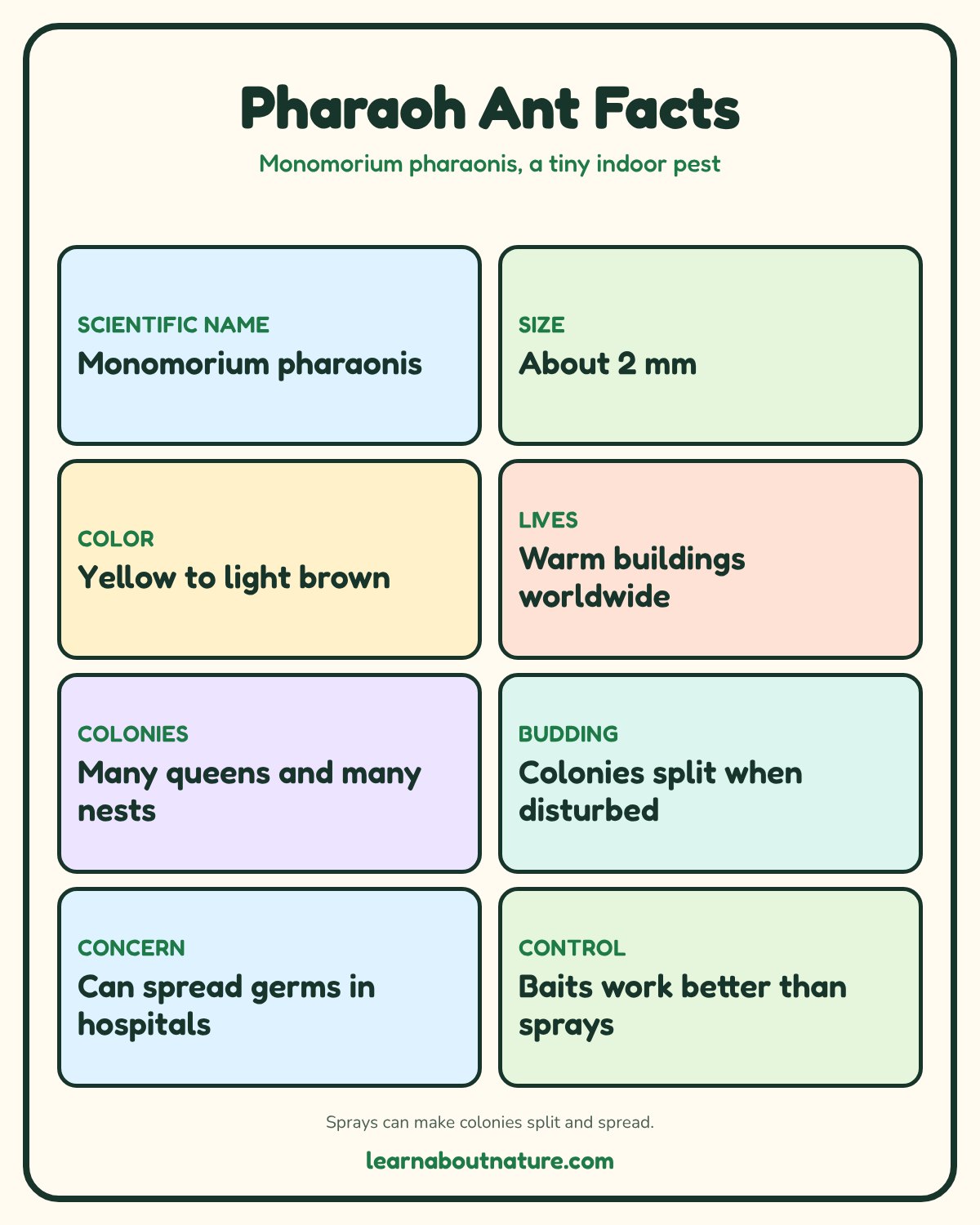
The Pharaoh ant (Monomorium pharaonis) is a tiny yellow to light brown ant, about 2 mm long, that is almost see-through. It is a well-known indoor pest, especially in hospitals. No one is sure exactly where it came from, but it has now spread to almost every continent, including the Americas, Europe, Southeast Asia and Australasia. Pharaoh ant colonies are polygynous, which means they have many queens instead of just one.
The polygynous nature of this species leads to an exclusive system of distinctive behavior in interactions of cast and the colony, allowing the colonies to split quickly as bud colonies. Another peculiarity here is the feature called unicoloniality, where no aggression is evident between colonies. These ants have a multifaceted foraging system that includes several pheromones helping to lay complex food trails. Of special interest is the fact that this was the primary species seen to use negative repellent pheromones. Pharaoh ants, even though tropical in origin, seem to adapt to diverse living conditions and you can find them living in buildings all over the world including the temperate zones with central heating.
Anatomy

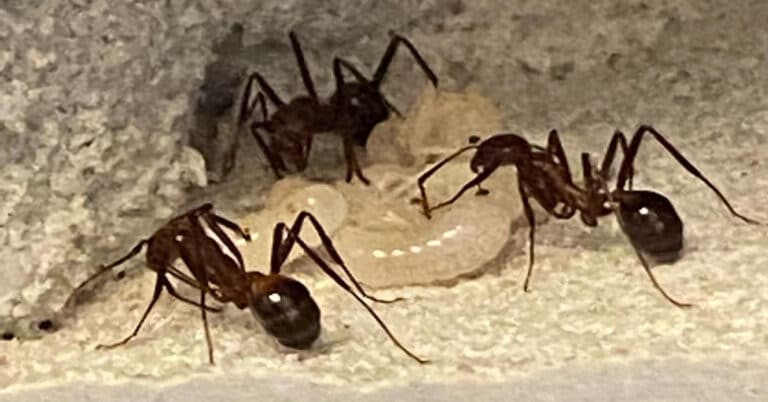
Pharaoh Ant – Photo by: Julian Szulc
Pharaoh ant workers grow to about 2 millimeters, or one sixteenth of an inch, long. They are yellowish to reddish-brown, with a darker abdomen. Their stinger does not work for stinging; instead it is used to lay down scent chemicals called pheromones. The narrow waist between the thorax and abdomen (the petiole) has two bumps, called nodes, and there are no spines on the thorax. These ants have poor eyesight, and the last three segments of their antennae form a club. Pharaoh ants are considered a serious pest in many places, including Australia, Europe and the United States.
Colonies
Pharaoh ant colonies spread by a process called “budding” (also called “satelliting”). A group of workers and queens leaves the old nest, carrying eggs, larvae and pupae with them, and sets up a new nest nearby. Because the new nest is a branch of the old one, the two colonies stay friendly.
Pharaoh Ants-Life Cycle

Pharaoh Ant
Unlike many ants, Pharaoh ants mate inside the nest instead of during mating flights, and queens usually mate with males from their own colony. A queen can lay around 400 eggs in her lifetime, in batches of about 10 to 12 at a time. The eggs hatch in about 5 to 7 days when it is warm, around 80 °F (27 °C), and the air is humid.
Eighteen to nineteen days represent the period as larvae, 3 days for the pre-pupal and about nine days account for the pupal period, leaving another four days to form exclusive sexuality of males or females. In total, Pharaoh ants require, on an average, around 38 – 45 days from the egg stage to the sexually mature stage. Temperature and humidity are critical factors here. These ants go through a process of incessant breeding the year round in their nests located in buildings that have warmth from heating. A mature colony will house multiple queens, workers, winged males, eggs, larvae, many pre-pupae/ pupae, the queen in the nest has a lifespan of about four to twelve months.
The Trail Leaving Pheramones and Food
Three varieties of pheromones serve the Pharaoh ants.
The first is one that they use for long leaving lasting trail network, that is traceable even if the ants leave them unused for long periods.
The second one is a pheromone chemical that loses its effect in a little time, unless it is re-applied, and these ants use it only for purposes of marking a food source.
The third one is a repellent pheromone. The use of negative trail pheromones was first noticed in Pharaoh ants that used it to indicate an unprofitable food source or some other inherent danger. A scout will release a repellent pheromone to warn others not to waste time looking for food at that spot.
Pharaoh scouts forage for food, using a positive feedback system. Immediately on locating a good food source, the scout will return to the nest with the news, laying a pheromone trail that the other ants, in large groups, use to reach the food source.
Pharaoh Ant Control
These ants, being extremely small, can be eradicated only by effective baiting, and you must do this in a systematic process, and not haphazardly, if you want to see tangible results in Pharaoh ant control, and in cases of large infestations, it may take a year of persistent work to clear the problem.Using sprays is not effective for these ants.
Pharaoh ant FAQs
How big are pharaoh ants?
Pharaoh ants are tiny, only about 2 mm long. They are yellow to reddish brown and almost see-through.
Why are pharaoh ants hard to get rid of?
Each colony has many queens and splits into new colonies by budding. Sprays do not work well, so baiting, done carefully, is the best way, and large infestations can take a year to clear.
Where do pharaoh ants live?
They are found on almost every continent, often inside warm buildings like houses and hospitals, even in cooler places with central heating.
How do pharaoh ants find food?
Scouts lay scent trails for other ants to follow. Pharaoh ants also use a repellent scent to warn others about a bad food spot or danger.
How long does it take pharaoh ants to grow up?
It takes about 38 to 45 days to go from egg to adult. Eggs hatch in 5 to 7 days in warm, humid conditions.

Randi Jones is the owner and founder of the Nature Gift Store, an online retailer specializing in nature-themed gifts, educational science projects, live animal nature kits and real butterfly artwork. A biology graduate who fell in love with insects, she founded the company in 2001 to make active learning about nature fun, accessible and engaging for children and adults. Her store offers real butterfly frames, home and garden decor and educational live animal kits, including ant farms, worm farms, tadpoles, ladybugs and hermit crabs, and she runs a bug museum in Washington featuring live animals like Eddie the Iguana alongside other reptiles and insects. Randi wrote most of the guides on this site. They first appeared on her long-running nature sites, including Monarch-Butterfly.com, Ladybug-Life-Cycle.com, Frog-Life-Cycle.com, Dragonfly-Site.com and Butterfly Pictures, which have now been brought together here at Learn About Nature.