
Lion Life Cycle: Stages From Cub to Adult
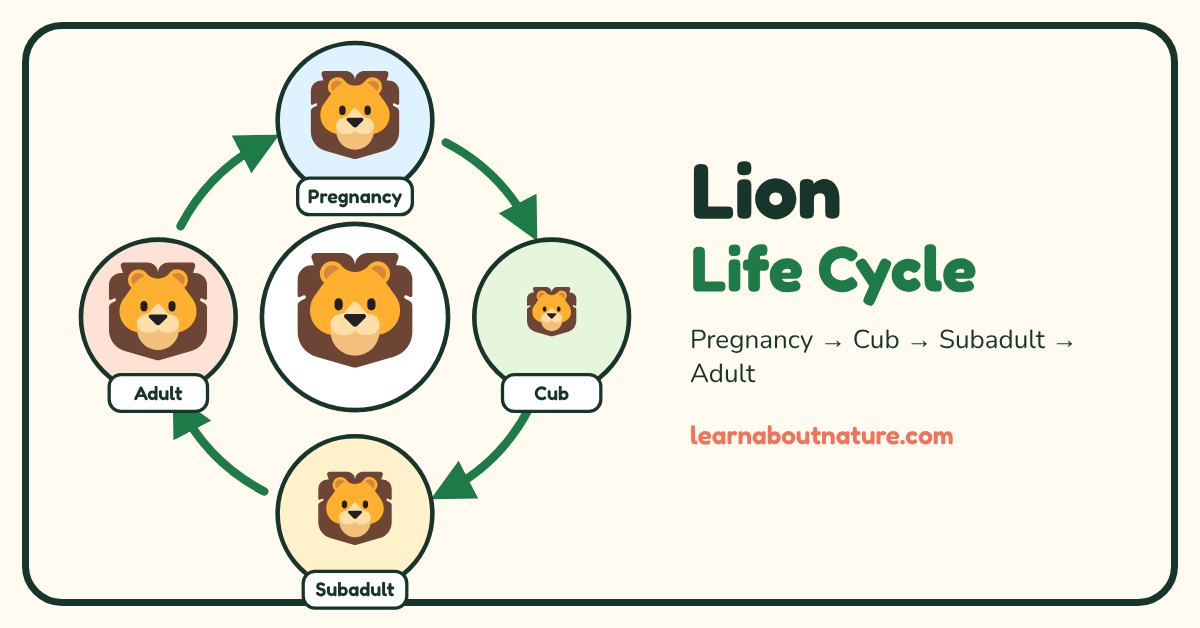
Quick answer: The lion life cycle has four stages: pregnancy, cub, subadult and adult. A lioness is pregnant for about 110 days and usually has one to four cubs. Cubs nurse for about six months, learn to hunt with the pride, and become adults at around three to four years old.
Lions are the only cats that live in large family groups. That social life shapes every stage of a lion’s growth, from the first weeks hidden in a den to the day a young male walks away from his family to find a pride of his own.
This page follows the lion life cycle step by step. Most of the numbers come from long-term studies of African lions in places such as the Serengeti in Tanzania and Kruger National Park in South Africa. A small population of lions also lives in India’s Gir Forest.
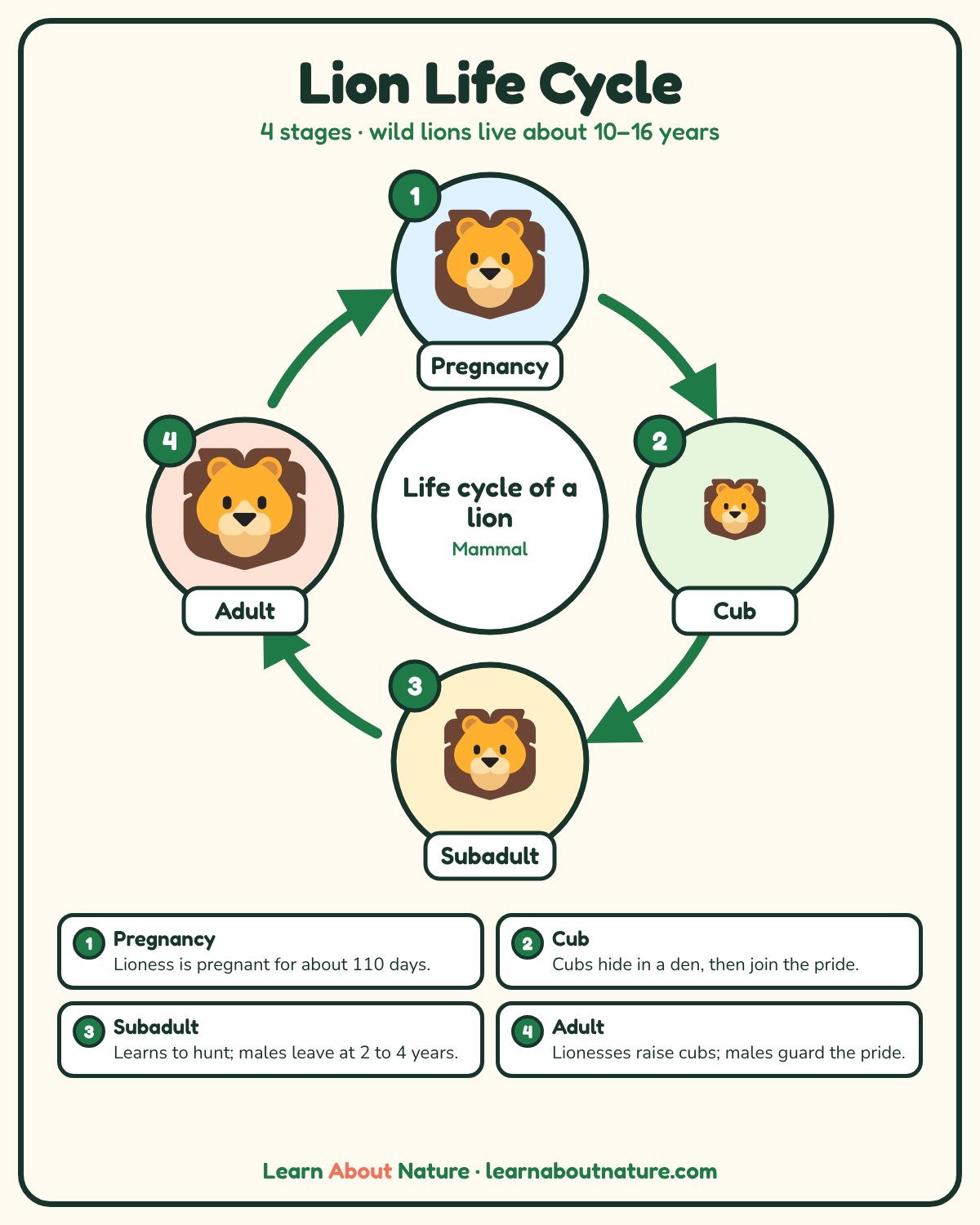
Teachers and students: you’re welcome to use this diagram in lessons and projects with credit to Learn About Nature.
Free printable: Download the Lion life cycle worksheet (PDF) – label the diagram, cut and sequence the stages, and match key words. Answer key included.
Lion Life Cycle Quick Facts
| Gestation | about 110 days (100–114 days) |
| Cubs per litter | usually 1–4, average 2–3 |
| Weight at birth | about 3 lb (1.5 kg) |
| Nursing | about 6 months or more |
| Males leave pride | about 2–4 years old |
| Female first litter | about 3.5–4 years old |
| Lifespan in the wild | females up to about 16; males rarely past 12 |
| Status (IUCN) | Vulnerable |
Mating and the Pride
A lion pride is a group of related females, their cubs, and one or more adult males. Prides range from a few lions to as many as 40, depending on how much prey is around. Female lions usually stay in the pride they were born into for their whole lives.
A lioness can breed at any time of year. When she is ready to mate, she pairs up with a pride male for several days, and the two may mate many times a day. Unless she is pregnant or nursing, she can come into season several times a year.
When a new group of males takes over a pride, they often kill young cubs fathered by the old males. This is hard to read about, but it is part of lion biology. It brings the mothers back into breeding condition, and the lionesses in a pride then tend to give birth at around the same time.
Stage 1: Pregnancy
A lioness is pregnant for about 110 days, or roughly three and a half months. Most pregnancies last between 100 and 114 days.
Close to the birth, the mother leaves the pride and finds a hidden spot, such as a thicket, a rocky outcrop or a dense patch of reeds. There she gives birth to a litter of usually one to four cubs. Litters average two to three cubs, and larger litters are uncommon.
Stage 2: Cub
A newborn lion cub weighs only about 3 pounds (1.5 kg), roughly the weight of a small loaf of bread. Cubs are born with soft, spotted fur that helps them blend into shadows. They are helpless at first and stay tucked away while their mother hunts nearby.
The mother moves her cubs to new hiding places now and then, carrying them gently in her mouth. This helps keep their scent from building up and attracting predators such as hyenas. Cubs walk steadily by about three weeks old.
At about six to eight weeks, the mother brings her cubs back to the pride. From then on, cubs are often raised together in a group that scientists call a crèche. Lionesses with young may nurse each other’s cubs as well as their own.
Cubs start eating meat at around three months but keep nursing for about six months or longer. Life is risky for young lions. Up to 80 percent of cubs die before they turn two, mainly from hunger when food is scarce and from attacks by incoming males.
- Birth weight: about 3 lb (1.5 kg)
- Walking steadily: about 3 weeks
- Joins the pride: about 6–8 weeks
- First meat: about 3 months
- Nursing: about 6 months or more
Stage 3: Subadult
Between about one and three years old, young lions are called subadults. They follow the adults on hunts, practice stalking and pouncing during play, and slowly learn to bring down prey such as zebras, wildebeest and antelope. They depend on their mothers for food until they are about one and a half to two years old.
Young males start to grow manes during this stage. By the time they are around two to four years old, they leave the pride, either on their own or because the pride males push them out. They usually leave with brothers or cousins and form a group called a coalition.
Young females usually stay behind and join the pride’s hunting team. Lionesses are skilled hunters by about two years old.
Stage 4: Adult
Male lions are sexually mature at a little over two years old, but they rarely father cubs until they are about five. First, a male coalition must grow strong enough to win control of a pride. Once in charge, they defend the territory by roaring, scent-marking and fighting off rival males. Resident males hold a pride for about two years on average before another coalition drives them out.
Lionesses usually have their first litter at about three and a half to four years old. In the Serengeti some start earlier, while in Kruger some start later. A lioness that raises her cubs successfully typically gives birth about once every two years, and the cycle begins again.
Adult lionesses do most of the pride’s hunting, often working as a team to surround prey. The males’ main job is protecting the territory and the cubs from rival males. Holding on to a pride is the only way most males get to pass on their genes, so the competition between coalitions is fierce.
Lions in India
The lions of Gir Forest in western India follow the same life stages as African lions, but their family life looks a little different. In India, adult females and males mostly live apart. The females form small groups with their cubs, and the males join them mainly to mate.
Because nearly all of India’s wild lions live in and around one forest region, they face extra risks. Inbreeding, limited space, disease outbreaks and conflict with people living nearby could affect the whole population at once. Conservation teams are working to protect the lions’ habitat and reduce conflict with local people.
How Long Do Lions Live?
Life in the wild is tough for lions. Lionesses may live up to about 16 years, and a few reach 18. Males usually have shorter lives, rarely living past about 12, because they get injured fighting other males and often lose their pride and food supply when they are pushed out.
Lions in zoos are protected from these dangers and often live into their late teens or early twenties.
Threats and Conservation
The lion is listed as Vulnerable on the IUCN Red List. A 2023 assessment estimated about 22,000 to 25,000 adult and subadult lions in Africa, plus roughly 670 in India’s Gir Forest. Lions now live in only a small part of the area they once covered.
Their main threats are habitat loss, a shrinking supply of wild prey, and conflict with people when lions kill livestock and are poisoned or shot in return. Diseases such as canine distemper, spread from domestic dogs, have also killed many lions. Protected parks, community projects that build lion-proof livestock pens, and anti-poaching work all help lions survive.
Interesting Lion Life Cycle Facts
These facts show how a lion’s family life sets it apart from other big cats.
- Lionesses in the same pride often give birth around the same time and share nursing duties.
- Lion cubs are born with spots that fade as they grow up.
- A mother lion carries her cubs from den to den in her mouth.
- Brothers and cousins often stay together for life as a coalition.
- Male lions’ manes keep growing and often darken as they get older.
Lion Life Cycle for Kids
Here is the lion life cycle in simple steps:
- Pregnancy: A mother lion carries her babies inside her for about three and a half months.
- Cub: Tiny cubs hide in a safe den and drink their mother’s milk.
- Subadult: Young lions play, practice hunting and grow bigger and stronger.
- Adult: Grown-up lions have cubs of their own, and the cycle begins again.
Key words: cub – a baby lion; pride – a family group of lions that live together; lioness – a female lion; coalition – a group of male lions, often brothers, that stick together; litter – a group of babies born to one mother at the same time; crèche – a group of cubs from different mothers raised together.
Try this: Draw a lion pride as a family tree: put the lionesses at the center, add cubs below, and show the young males leaving to form a new coalition.
Related Life Cycles and Guides
- How long do lions live?
- How fast are lions?
- Lion facts for kids
- Bear life cycle
- Koala life cycle
- Cat life cycle
- Rabbit life cycle
- Wolf life cycle
Lion Life Cycle FAQs
How long is a lion pregnant?
A lioness is pregnant for about 110 days, which is roughly three and a half months. Most pregnancies last between 100 and 114 days. She gives birth in a hidden den away from the rest of the pride.
How many cubs does a lion have?
A lioness usually has one to four cubs in a litter, and the average is two to three. Bigger litters do happen but are uncommon. A mother who raises her cubs successfully usually has a new litter about every two years.
When do male lions leave the pride?
Young male lions usually leave their birth pride when they are about two to four years old. Some leave on their own, and others are chased away by the adult males. They often travel with brothers or cousins as a coalition.
How long do lions live?
In the wild, lionesses may live up to about 16 years, while males rarely live past 12 because of fights and the stress of losing a pride. In zoos, lions often live into their late teens or early twenties.
Why do so many lion cubs die?
Up to 80 percent of lion cubs die before they are two years old. The main causes are starvation when prey is scarce and attacks by new males that take over a pride. Predators such as hyenas also kill some cubs.
Sources: Smithsonian’s National Zoo: Lion; San Diego Zoo Wildlife Alliance Library: Lion Fact Sheet, Reproduction; Endangered Wildlife Trust: Lions remain listed as Vulnerable in the 2023 Red List Assessment

Nato is a content writer and researcher with a background in psychology who’s eager to explore the wonders of nature. As a travel enthusiast and animal lover, she hopes to inspire others to discover and cherish the beauty and importance of the natural world. She also writes about the history of candy and snacks for Snack History and about food and healthy eating for The Fitchen.
