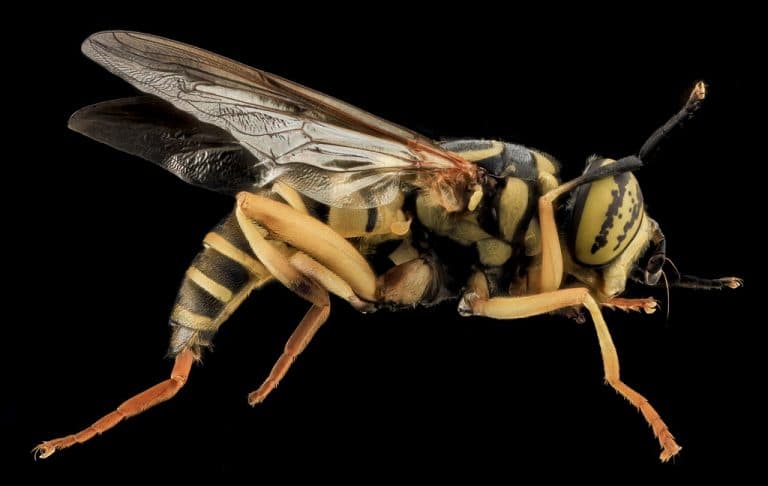
Executioner Wasp: The King Of Sting Facts

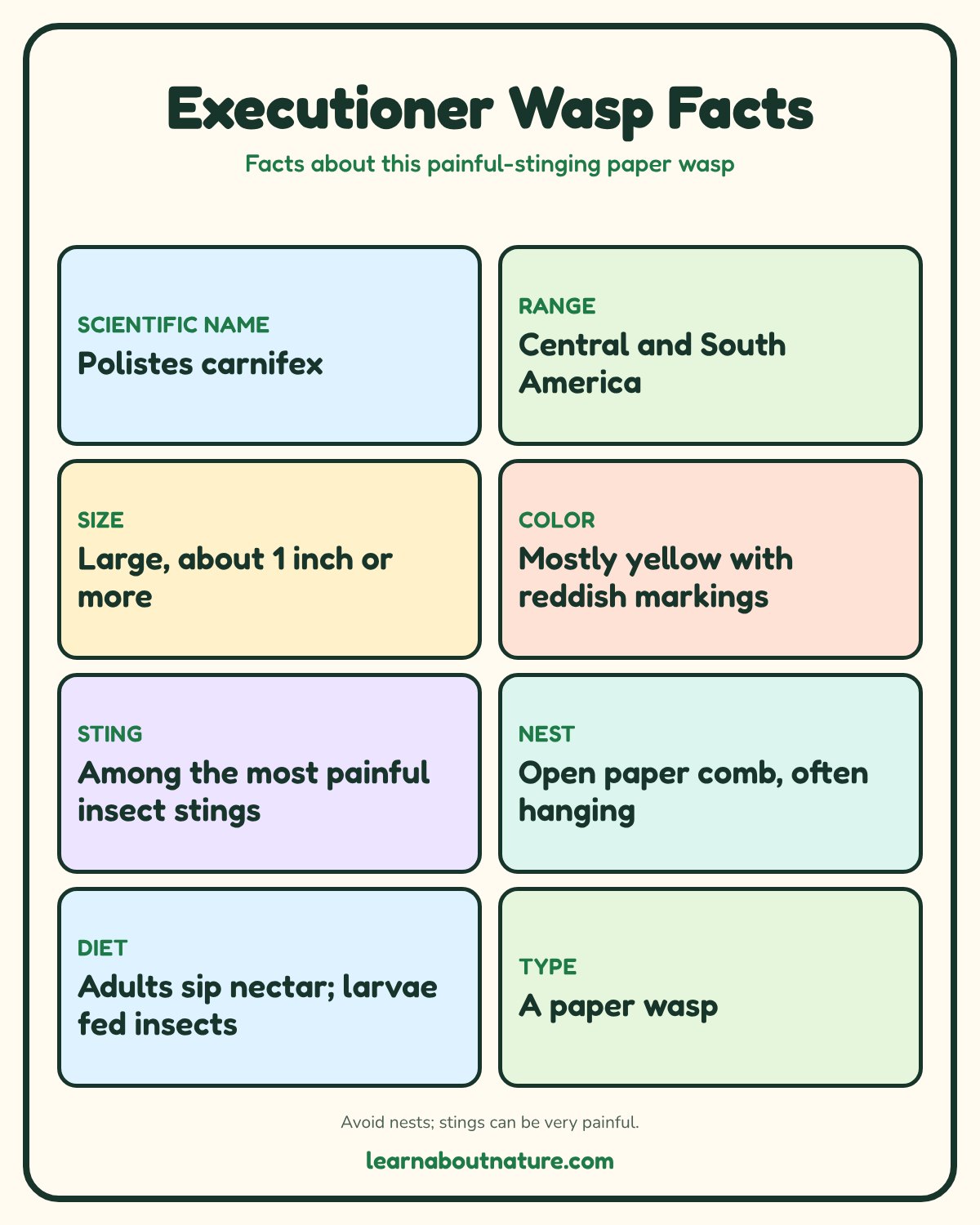
Wasps first appear in the fossil records dating back to roughly 240 million years ago during the mid-Triassic period, and have evolved into over 30,000 species that still exist today. One of these species is nicknamed ‘The King of Sting’ due to its potent venom and incredibly painful sting, the executioner wasp, or scientifically known as Polistes carnifex.
Executioner wasp Quick Facts
| Common name | Executioner wasp |
| Scientific name | Polistes carnifex |
| Kingdom | Animalia |
| Phylum | Arthropoda |
| Class | Insecta |
| Order | Hymenoptera |
| Family | Eumenidae |
| Genus | Polistes |
| Type | Insect (social paper wasp) |
| Diet | Caterpillars, nectar and pollen |
| Habitat | Humid coastal areas and tropical forests |
| Native range | Central and South America |
| Size | 1-1.2 inches long |
| Special feature | Sting rated 4 on the Schmidt pain scale |
There are roughly 200 species of paper wasp in the world, and about 5,000 species of Vespid wasps belonging to the Vespidae family, the executioner wasp of which belongs to both categories.
As the title suggests, that’s what we’ll be getting into today, the executioner wasp.
Range & Habitat
Executioner wasps are a species of social wasp found in Central and South America, mostly being spotted in Mexico, Paraguay, Argentina, and Brazil. Though they’re not commonly found in the United States, they are sometimes discovered in Texas.
Executioner wasps prefer humid, coastal areas, as well as open areas such as evergreen tropical forests.
They will build nests out of wood fibers that they’ve chewed into the consistency of a paper mache, pulp-like substance in tree branches or under eaves of buildings.
Queen wasps will lay one egg in each brood cell, laying many eggs each day. It takes about a week for them to hatch, and about 40 days until they’ve completed the larvae stage of their life cycle and turn into grown up, mature wasps.

Diet
Executioner wasps mainly feed on caterpillars before they turn into moths and butterflies. This gnarly insect often times decapitates its prey, much like that of a praying mantis.
Adult wasps kill caterpillars and bring them back to their nests for larvae to eat. Nectar and pollen from various flowers are also an important source of carbs for these insects.
Venom
Nicknamed the King of Sting, the executioner wasp is considered to have one of the most painful stings of any wasp.
You can see this demonstrated by Coyote Peterson on the Brave Wilderness YouTube channel. This man puts himself through all sorts of misery with all the bites and stings he allows animals such as this to inflict on him simply for the name of science, as well as our entertainment.
Mr. Peterson didn’t know exactly what he’d found at first, and initially thought he’d just discovered a new species. However, after researching the insect, he learned it was already an established species, though its sting was not yet recorded on Schmidt’s pain index scale.
Thanks to Peterson, now it is, and it’s rated at level 4, the highest rank possible as he quickly found out this is not something he wanted to ever go through again.
This insect has a truly wicked sting to it, being an animal you’d never want to anger because if you do, you’ll be in a world of hurt.
Immediately following the sting he took, Peterson stated it was the most painful sting he’d ever endured. Not to mention, he was only stung by a single wasp, one time. We mentioned above that they’re a species of social wasp, meaning there are often times a clan of them.
The pain encountered once stung is due to the histamine (inflammation, dilates blood vessels, affects muscle contractions) and norepinephrines (increases heart rate) properties in their venom that break down living cells and tissues around the sting site. It has a near unparalleled burning and throbbing sensation that can leave the effected area swollen and painful for days following the initial sting.
The pain and swelling can even last upwards of an entire week for some.
Followed by the initial searing pain, it also begins to itch as the venom works its way up your body. Your skin, particularly the sting site, will also be hot to the touch.
Chances are, you would be okay if you got stung. But, if you’re allergic to insect stings, or if you’re a child or elderly individual, this would be one of the very worst insects to get stung by and it could certainly lead to your death.
That doesn’t even mention, it’s a wasp, not a bee, meaning each female can sting multiple times in a single attack.
We say each female because male wasps and bees are considered harmless, as female stingers are simply modified egg laying organs that males do not produce.
Luckily for us however, they aren’t an aggressive species unless you get too close to their nesting areas. This will especially be true if they have larvae inside their nests.
Natural Predators
Though their potent stings protect them from many predators, executioner wasps do sometimes fall victim to other insects such as dragonflies and mantis’, arachnids like spiders, other inverts such as centipedes, as well as birds, some amphibians such as frogs, reptiles like lizards and turtles, as well as mammals like mice, weasels, and badgers.
Being a social wasp helps them in this regard, as they will generally have an army to defend them if need be. However, this is not always the case, especially early on in the hives production.
Colonies will often times be started by a single queen wasp, so they aren’t always with others in the time of need.
Size & Identification

The executioner wasp is known for its impressive size, growing between 1-and-1.2 inches at full maturity, with queens being the biggest of them.
For reference, common yellow jackets grow to about half an inch, 5/8 inch at full maturity.
In contrast to their size, you can identify an executioner wasp by observing their yellowish-brownish-red appearance; they actually look quite like a much bigger yellow jacket with a different color scheme.
Lifespan
Executioner wasps have an impressive longevity to them, with queens living much longer than the short-lived workers.
All in all, executioner wasps may be intimidating, and they may be dangerous to some, but they are an important part of our ecosystem as they pollinate flowers in their respective habitats, so be sure to be kind to them if you’re ever in their area.
If you enjoyed this piece, feel free to share it on social media!
And, if you enjoyed this piece, perhaps you’ll like our pieces on red paper wasps and great black wasps. Be sure to check them out as well!
Executioner wasp FAQs
What do executioner wasps eat?
Adult executioner wasps hunt caterpillars and carry them back to feed their young. They also drink flower nectar and eat pollen for energy.
How bad is an executioner wasp sting?
It is extremely painful. The sting is rated 4, the top level, on the Schmidt pain index. The pain and swelling can last for days, up to a week for some people.
Where do executioner wasps live?
They live in Central and South America, mostly in places like Mexico, Paraguay, Argentina and Brazil. They are only sometimes found in Texas.
How big is an executioner wasp?
They grow to about 1 to 1.2 inches long, with queens the biggest. That is about twice the size of a common yellow jacket.
Are executioner wasps aggressive?
Not usually. They only get aggressive if you get too close to their nest, especially when it has larvae inside.

I started writing in the fourth quarter of 2018. I wrote solely about MMA and boxing up until October of 2022, where I began writing about animals; primarily dangerous, venomous species. They’ve always fascinated me. Considering, my goal is to make a living by teaching people about these wonderful creatures. You can check out my Facebook page, where every article I’ve ever written currently sits, or you can check out my Twitter page, where I’ve shared all of my animal pieces to date.