Ladybug Mating & Reproduction
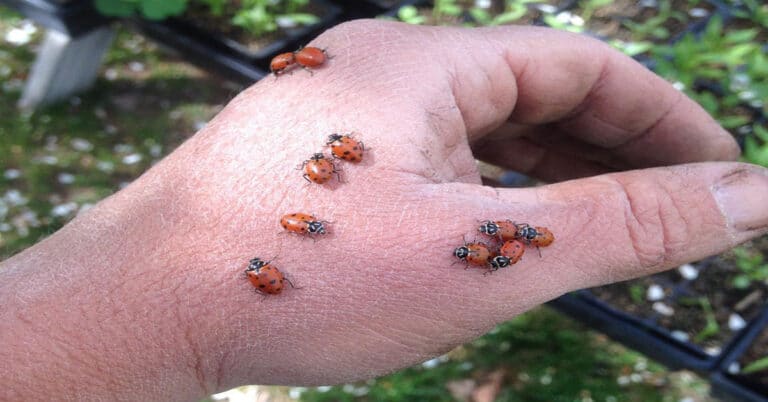
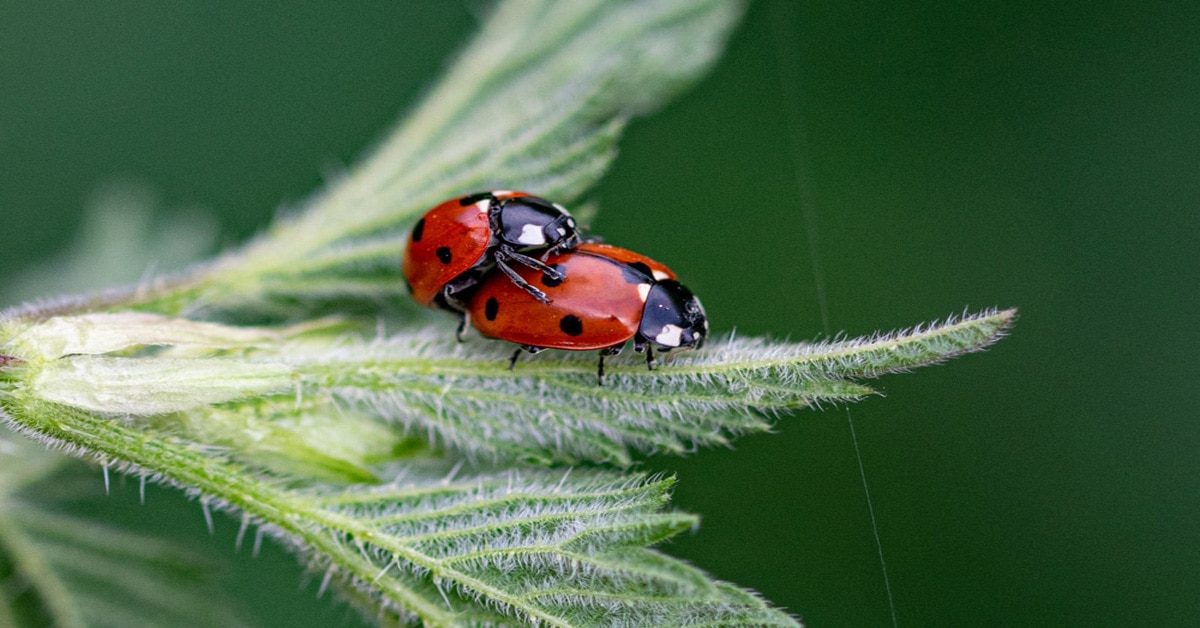
The ladybug life cycle starts with mom and dad ladybug mating. The ladybugs pictured to the right are mating Ladybugs reproduce sexually. Each species of ladybug has its own pheromones for attracting a mate. When they find each other, the male grips the female from behind and holds on tight. They can copulate (stay together) for more than 2 hours at a time. Female ladybugs can store a male’s sperm for 2-3 months before laying eggs. Ladybugs tend to lay their eggs where food is abundant.
How do we know the male from the female?
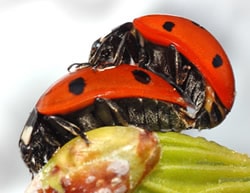
It’s almost impossible for the average person to tell them apart. But here are some clues that might help. First, females are usually larger than males. Second, if you observe one ladybug riding atop another ladybug, they are in the process of mating. A male ladybug will grab the female’s elytra (hard wings) and holds on tight so the one at the top is the male. An entomologist (bug scientist) can see the difference between males and females under a microscope.�Below are pictures taken with a microscope in a process called electron microscopy.
Scanning Electron Microscopy
What is It?
Scanning Electron Microscopy is a technique using a special microscope to see small things in great detail. The SEM can resolve from 15x to 100,000x power. The process is time consuming and tedious.
The insect, a Ladybug in this case, which is dead, is coated with a very thin layer of a metal, like gold. It is positioned on the stage. An electron beam is directed onto the specimen which scans back and forth over it. The electrons are scattered due to the metal; that is what produces the picture. But, only the surface of the specimen can be viewed.
Most SEM’s are equipped with a camera, so that a photograph can be taken.
Males
- Have a notch on the last sternite, shown by the yellow number 6.
- They have lots of setae (“hair-like” structures) on the last segment, shown by yellow number 6 .
- And, they have large flexor bands between the sternites, shown by the arrows above number 3.
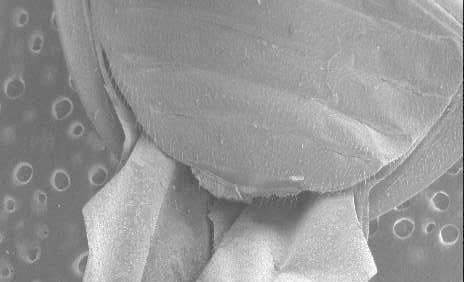
Females, in general
- Do not have a notch on the las
t sternite. - Do not have lots of setae, just a little.
- Do not have large flexor bands.
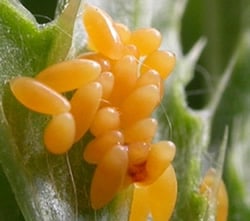
Photo by Gilles San Martin
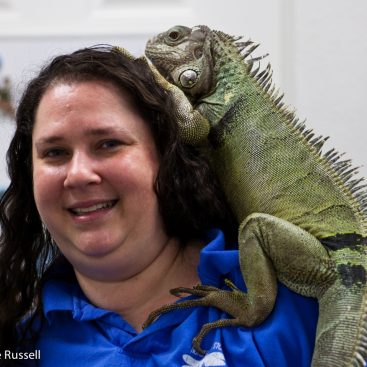
Having discovered a fondness for insects while pursuing her degree in Biology, Randi Jones was quite bugged to know that people usually dismissed these little creatures as “creepy-crawlies”.