Caiman Lizard
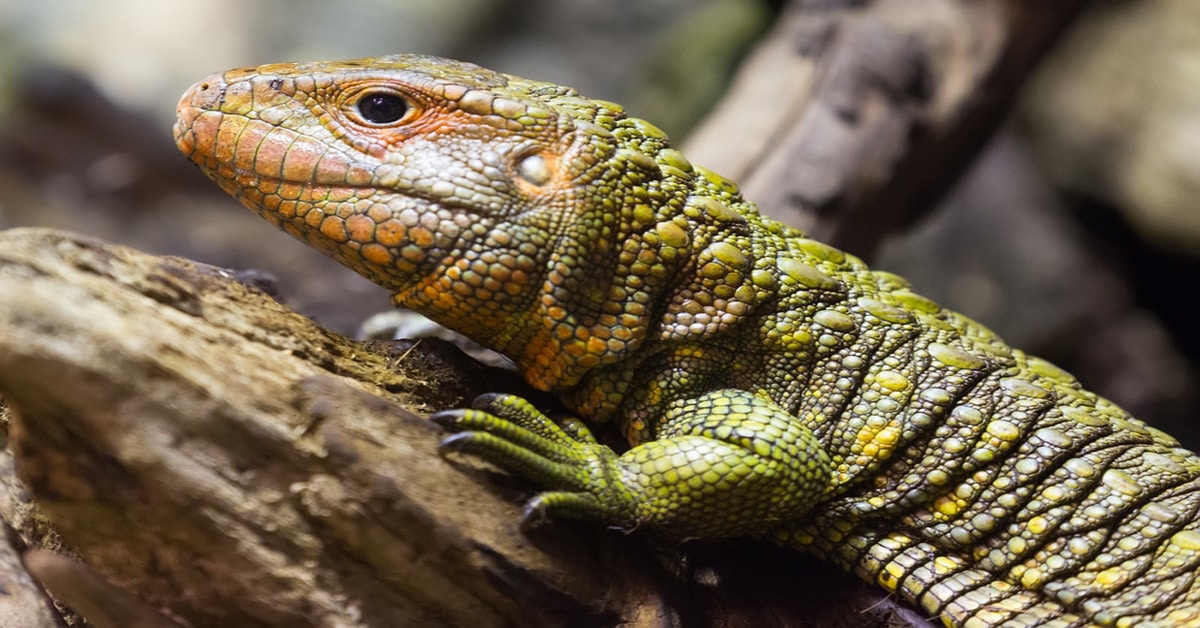
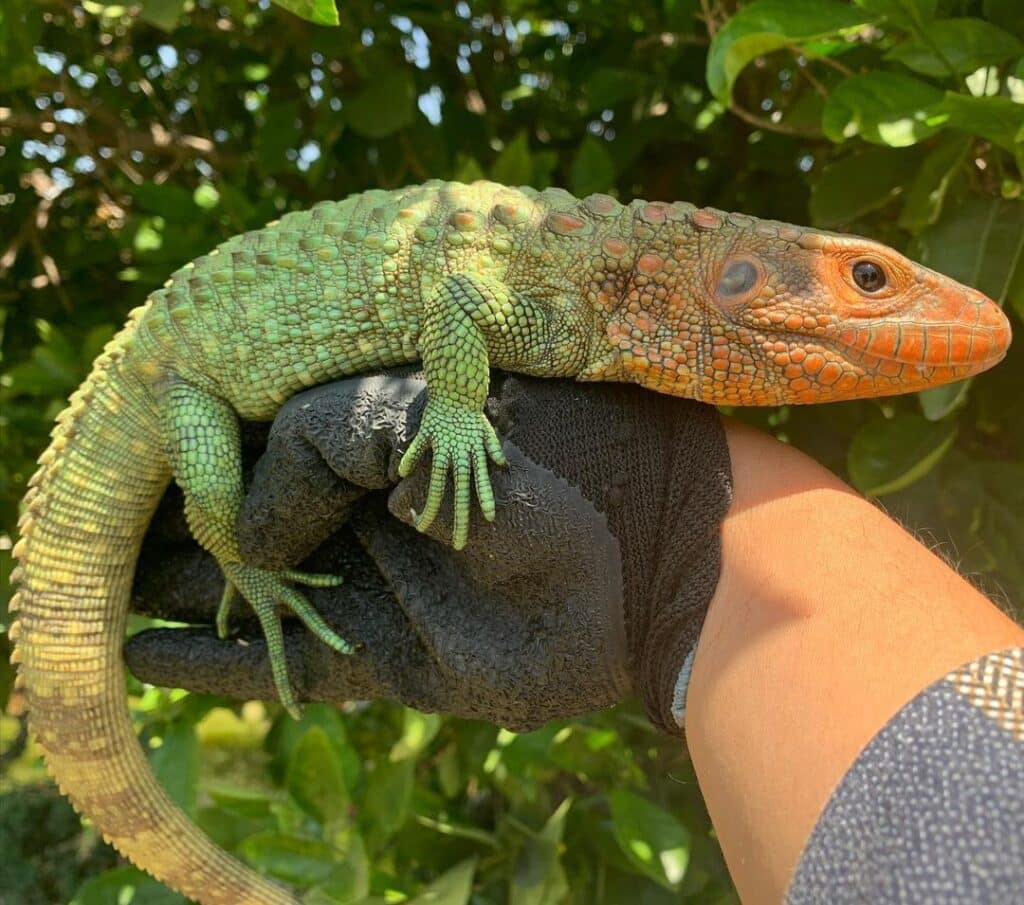
The caiman lizard is a big, bright lizard from the swamps and flooded forests of the Amazon in South America. It has a green body, a reddish-orange head and a back covered in thick, bumpy scales that look a little like a caiman’s, which is how it got its name. Caiman lizards are excellent swimmers and spend much of their time in or near water, where they hunt snails and crack their shells with strong, flat back teeth.
Scientific Classification & Quick Facts
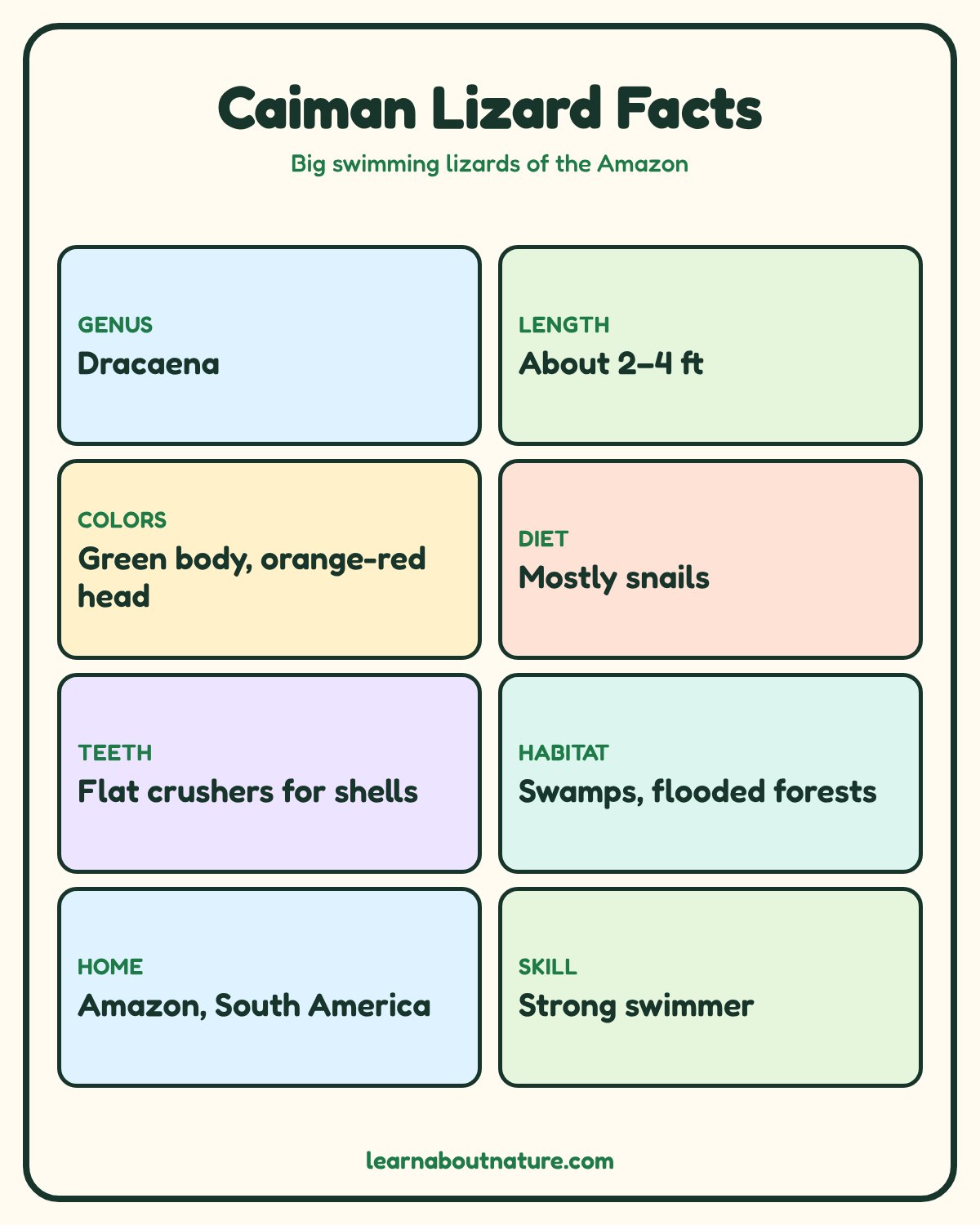
| Common name | Caiman lizard |
| Scientific name | Dracaena |
| Kingdom | Animalia |
| Phylum | Chordata |
| Class | Squamata |
| Family | Teiidae |
| Type | Reptile; large, water-loving lizard |
| Diet | Mainly snails; also crabs, fish and insects |
| Habitat | Forest swamps and riverbanks |
| Native range | Amazon Basin, South America |
| Size | 2-4 feet long |
| Weight | 3-6 pounds |
| Colours | Green body with reddish-orange head |
Habitat
These lizards spend most of their time in or near water when most lizards live in dry habitats, The habitat of these lizards is forest-swamps and areas adjacent to rivers where they have access to vegetation. They spend the daytime lying in the sun, on roots or overhanging branches. During the night, they usually conceal themselves in bushes and trees. The Caiman lizard is native to the Amazon Basin, Habitat loss is the biggest threat to their existence Poachers hunt them down for their skin.
Anatomy
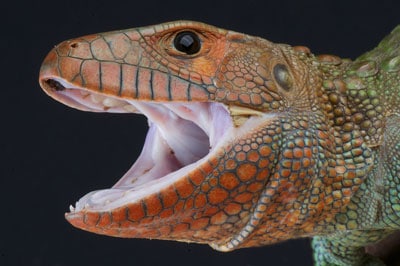
Physical adaptations to the environment and a specialized anatomy offer interesting attributes about the caiman lizard. Their coloration is interesting. Both males and females are green, and have reddish orange heads, The male’s head has a broad and redder configuration. Both sexes also have powerful tails that resemble whips. They help them to swim and also assist them in self-defense. You can find modified scales in the tails of male caiman lizards. They have very strong molar teeth, essential for assisting them with their hard-shelled creature diet. These lizards grow to between two to four feet and weigh around three to six pounds.
Behavior
Caiman lizards make use of their aquatic surroundings interestingly and Spend most of their time lazing over the water. When something disturbs them, they drop down at once and scoot. When they directly encounter predators, they turn aggressive, attempting to bite or lash their assailants with their tails. These lizards are neither solitary nor social animals.. In captivity, however, they live together quite peacefully and they interact with animals like turtles, fish and even other lizards.
Diet
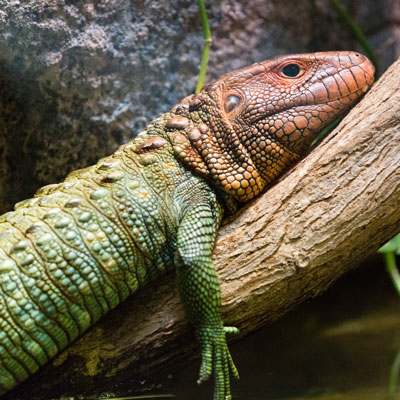
The Caiman lizard has a limited diet in its natural habitat. They subsist almost entirely on clams, apple snails and other snails.. When they eat snails, they have a habit of tilting their heads back for the snails to slide backward into their mouths, where, they crush them with their powerful molars and spit the shells out. In captivity, along with snails, caiman lizards also feed on fruit, fish, ground turkey, rodents, and hard-boiled eggs. Babies eat insects and crickets. They also need minerals and vitamin supplements.
Features
• The caiman lizard is s species of lizard. They are medium sized. They are natives of the jungles of Latin America. The caiman lizard is is one of the biggest lizard species in America. Caiman lizards are powerful creatures.
• The caiman lizard inhabits the rainforests and swamps of South America, Brazil, Ecuador, Colombia and Peru. You can spot Caiman lizards in flooded areas since they are aquatic animals.
• The caiman lizard is a large and powerful. Lizard. They often grow up to 120 centimeters from snout to tail. The Northern caiman lizard is one of two species of caiman lizard found on the continent. Since the caiman lizard spends most of its time either in or near water, its body has adapted in many ways to help it to lead an aquatic lifestyle.
• Caiman lizards fall in the realm of large carnivores. They prey on other animals only to get nutrients. The caiman lizard’s main food source are snails. They also feed on other invertebrates like crabs and insects. Occasionally, they eat larger animals such as rodents, fish, and frogs.
• Because of its larger size and semi aquatic and part tree-dwelling way of life, caiman lizards have few predators within their natural habitat. Large predatory mammals like jaguars do hunt the caiman lizard along other large reptiles which include crocodiles and snakes.
• There is little information on the breeding and reproduction of these lizards, but they seem to behave as other species of large lizards do. Post mating, the females dig holes in the riverbank and lay their eggs in them. They cover these holes to protect the eggs from predators. The babies remain independent when they hatch, Their lizard parents do not give them ant parental care.
The caiman lizard does not face the immediate threat of extinction, though their populations do decline in certain areas, mainly because of habitat loss that result from high levels of pollution and deforestation.
Caiman lizard FAQs
Where do caiman lizards live?
They live in the Amazon Basin of South America, in forest swamps and along rivers. They spend most of their time in or near water.
What do caiman lizards eat?
Mostly snails. They also eat clams, crabs, insects and sometimes fish, frogs and rodents.
How do caiman lizards eat snails?
They tilt their heads back so the snail slides into the mouth, crush it with their strong molar teeth and spit out the shell.
How big do caiman lizards get?
They grow to about 2 to 4 feet long and weigh around 3 to 6 pounds. Some reach 120 cm from nose to tail.
Are caiman lizards endangered?
Not immediately, but their numbers are falling in some places because of habitat loss, pollution and deforestation. Some are also hunted for their skin.

Randi Jones is the owner and founder of the Nature Gift Store, an online retailer specializing in nature-themed gifts, educational science projects, live animal nature kits and real butterfly artwork. A biology graduate who fell in love with insects, she founded the company in 2001 to make active learning about nature fun, accessible and engaging for children and adults. Her store offers real butterfly frames, home and garden decor and educational live animal kits, including ant farms, worm farms, tadpoles, ladybugs and hermit crabs, and she runs a bug museum in Washington featuring live animals like Eddie the Iguana alongside other reptiles and insects. Randi wrote most of the guides on this site. They first appeared on her long-running nature sites, including Monarch-Butterfly.com, Ladybug-Life-Cycle.com, Frog-Life-Cycle.com, Dragonfly-Site.com and Butterfly Pictures, which have now been brought together here at Learn About Nature.