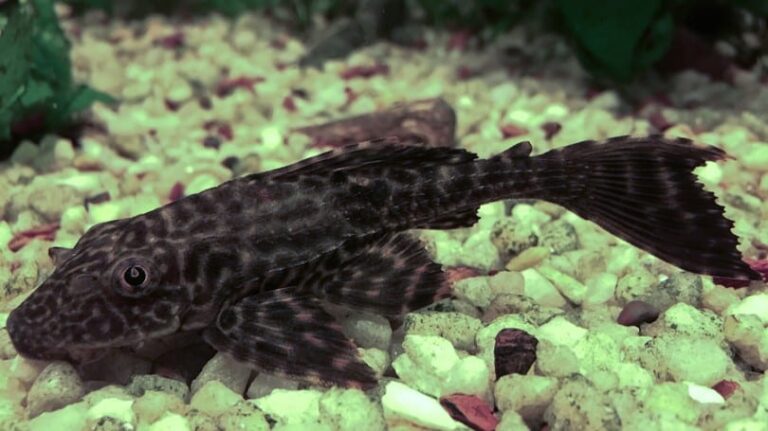
Clown Loach

Scientific Classification & Quick Facts
| Common name | Clown loach |
| Scientific name | Chromobotia macracanthus |
| Kingdom | Animalia |
| Phylum | Chordata |
| Order | Cypriniformes |
| Family | Cobitidae |
| Genus | Chromobotia |
| Conservation status | Least Concern |
| Type | Freshwater loach |
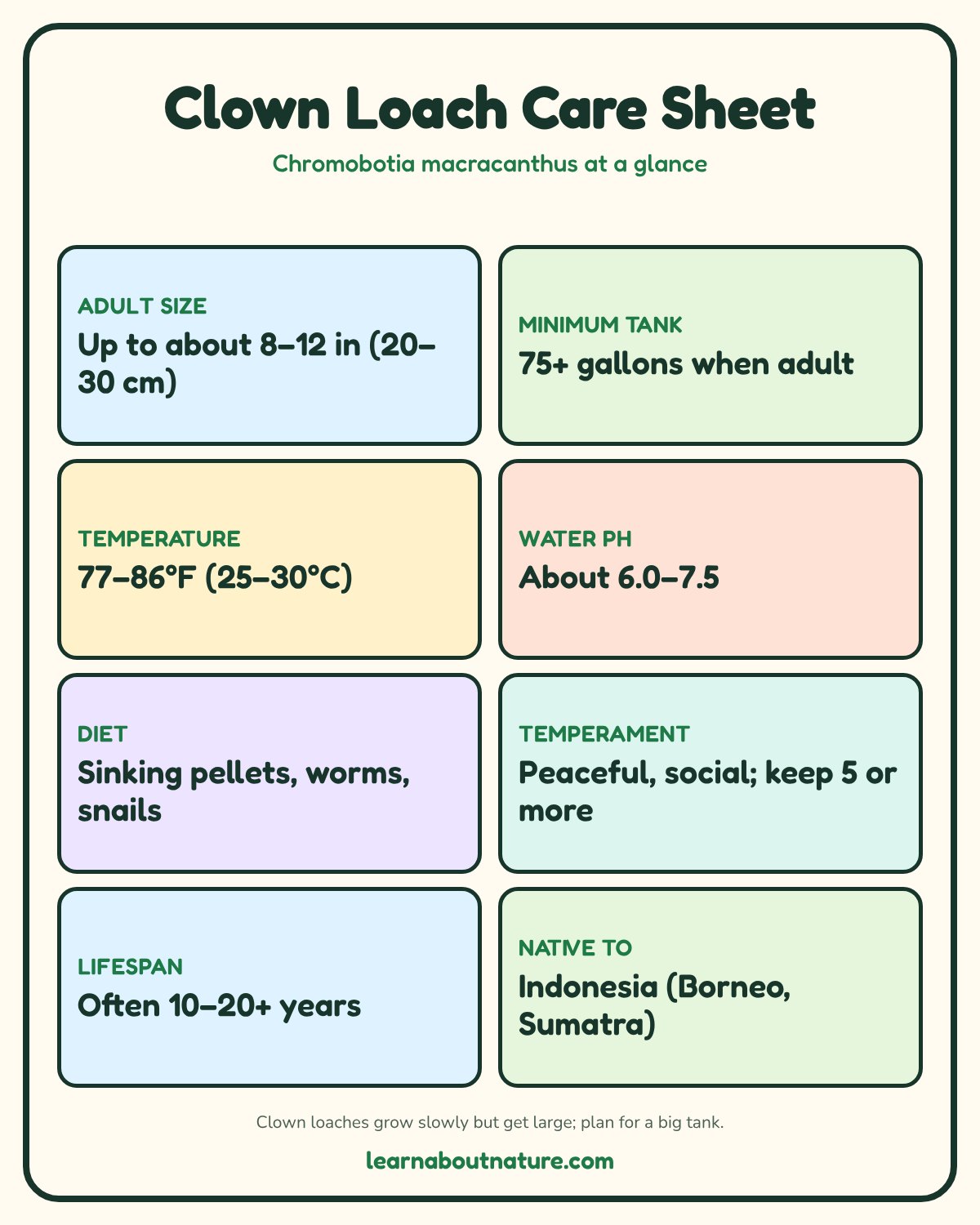
| Diet | Omnivore: sinking wafers, shrimp, vegetables, snails |
| Habitat | Clear streams; flooded plains in the rainy season |
| Native range | Borneo and Sumatra, Indonesia |
| Special feature | Makes clicking sounds; eats snails |
The clown Loach or Tiger Botia, whose scientific name is Chromobotia Macracanthus, belongs to the Botiidae family. It is a freshwater fish of the tropics. In the Chromobotia genus, this fish is a solitary member. The origination of clown Loach is from the Inland waters of Indonesia, situated on the Borneo and Sumatra islands. This clown Loach is trendy in the freshwater aquarium market; it is sold all over the world.
Habitat and Range
The clown Loach is endemic to the Borneo and Sumatra islands of Indonesia. The ideal habitat for a clown Loach fish is an area surrounded with clear stream; however, on account of the pressure of the floods during the monsoons, twice a year, these fish are forced to occupy the flooded plains or Backwater Rivers or lakes. Therefore, for a period of 7 to 8 months in a year, the clown Loaches are seen in hilly places where the plains are flooded. Breeding matured ones, travel to smaller waterways for their annual spawning.
Description
Data obtained concerning the biggest clown Loach differs. In the wild they can reach roughly 30 to 40 cm (12 to 16 in.), while in home aquariums adults more often reach about 15 to 30 cm (6 to 12 in.). The body of the fish is compressed laterally and is long., its dorsal portion is arched and the ventral surface is flat. It has a comparatively large head, its mouth is drooping, its lips are fleshy and thick, it has four pairs of barbells. The lower jaw barbells are tiny and not visible with the naked eye. When these territorial clown Loaches are happy, they produce clicking sounds. (They make this sound as a sort of warning/ weapon) or for mating. They produce this sound by grinding their pharyngeal teeth.
Growing at Home
Breeding
There are only few people who have been successful in breeding clown Loaches at their homes in aquariums. However, in case you have an interest in breeding them, then there are some guidelines to follow. By all means, the first step in breeding them is to search for a sexually matured breeding pair. Sexual maturity is generally attained after a long time. The guideline for this is to go for a pair that is 6 inches in length. The bigger the fish, the better it is for successful breeding. The tail of the clown loaches gives you an idea of their sex. The tail of the Male clown Loach droops inwards, while the tail of the female is almost traditional. Apart from this, the female is a little plumper than the male; experienced persons can identify this difference.
Tank
This clown Loach is exceptional; it is very big for hobbyist aquariums. The least size is 75 gallons the juvenile ones do well in groups. Their requirements include: an excellent filtration system, and current that is supplied from a standby, power-source, sincere care in the cleaning of the aquarium and regular replacement of the water. Provide the aquarium with additional lighting, a substrate made of preferably soft sand, with a lot of places to hide, made out of driftwood or rock-wood. Place strong and resistance proof plants in the aquarium, since the big clown Loaches are capable of punching holes in the leaves or can uproot them. Choose plants that are suited to the low-light surroundings.
The clown Loach are to some extent nocturnal and most of the time very active after dusk and early in the morning. Provide them an extra blue moonlight tube, if not any other type of light that gives blue color, which is switched on prior to the main light and is switched off after the main light. This enables the owner to watch the fish when they are very active. In addition, it prevents the fish from sudden shocks by a sudden switch to bright light.
Water Condition
As mentioned previously, clown Loach do not respond well to poor water conditions and are normally easily prone to illness or may even die when the water gets contaminated. It is recommended to change at least 1/4th of the water every week. The clown Loach does not tolerate inferior water; for which reason they are named as indicator fish, because their health is an indication of the quality of the water. This clown Loach fish is quite sensitive to the presence of chlorine in the water and the whole lot may die if there is chlorine in the water.
In case the quality of the water is a bit contaminated, this clown Loach gets affected by Ick (white spot disease, caused by a parasite). Besides, they are receptive to salts and the majority of ick medications. Therefore, watch your clown Loaches and use only prescribed medicines, and give them, only half of what is prescribed. If not, there is a risk of killing them with the medicines.
Nutrition
These Clown Loaches are omnivores and they have vegetables, just to balance the diet. Hence, you can give them a diet of this kind. For good growth, give your clown Loaches an optimal feed as recommended 3 to 5 times daily (even with this, the growth is gradual). Give them a balanced diet of all kinds of carnivores’ food. A nice base, consists of varieties of sinking wafers, shrimps, varieties of frozen items and while they are getting aged, give them slices of fish. The clown Loach produces a clicking sound when they are satisfied with the food. This helps you to know which foods they like. Similar to other fish, clown Loach also needs time to accept new items as food. But once they accept it, there is the chance of it becoming a favorite item. Among the fish that like snails, Clown Loach is one, hence they become controllers of snails.
Setup
Clown Loaches are kept in aquariums of size 75G / 280 L or even bigger. Bear in mind that although the clown Loach’s growth is gradual, finally they grow very big and requires a big aquarium of a minimum size of 125G / 470L.
Set your aquarium with a substrate of fine gravel or sand and permit the clown Loach to burrow. Give them, an aquarium with thick plants, but the type of plants varieties according to the size of the fish. Adults are kept only with plants of hardy types, like Anubias and Java, The adult either destroys or eats all other plants, whereas Juvenile are kept with most of the plants. Floating plants are recommended for making the lights dim, thereby making the clown Loach to become more energetic at day time.
Clown loach FAQs
Where do clown loaches come from?
Clown loaches come from the inland waters of Borneo and Sumatra in Indonesia. They live in clear streams and move to flooded plains and backwaters in the rainy season.
What do clown loaches eat?
They are omnivores. They eat sinking wafers, shrimp and frozen foods, plus some vegetables, and they are well known for eating snails.
Do clown loaches make noise?
Yes. They make clicking sounds by grinding their throat teeth, which they do when they are happy with food, as a warning, or when mating.
How big a tank do clown loaches need?
A big one. Clown loaches grow large, so the article recommends at least 75 gallons, and about 125 gallons for adults. They also like to live in groups.
Are clown loaches sensitive to water quality?
Yes. They get sick easily in poor water and are sensitive to chlorine, so they need clean, well-filtered water and about a quarter of the water changed every week.

Randi Jones is the owner and founder of the Nature Gift Store, an online retailer specializing in nature-themed gifts, educational science projects, live animal nature kits and real butterfly artwork. A biology graduate who fell in love with insects, she founded the company in 2001 to make active learning about nature fun, accessible and engaging for children and adults. Her store offers real butterfly frames, home and garden decor and educational live animal kits, including ant farms, worm farms, tadpoles, ladybugs and hermit crabs, and she runs a bug museum in Washington featuring live animals like Eddie the Iguana alongside other reptiles and insects. Randi wrote most of the guides on this site. They first appeared on her long-running nature sites, including Monarch-Butterfly.com, Ladybug-Life-Cycle.com, Frog-Life-Cycle.com, Dragonfly-Site.com and Butterfly Pictures, which have now been brought together here at Learn About Nature.