Asian Leaf Turtle – Sold for Pet Trade, Food, Or Traditional Medicine
Scientific Classification
| Kingdom: | Animalia |
| Phylum: | Chordata |
| Class: | Reptilia |
| Order: | Testudines |
| Family: | Geoemydidae |
| Genus: | Cyclemys |
| Species: | C. dentata |
| Binomial name: | Cyclemys dentata |
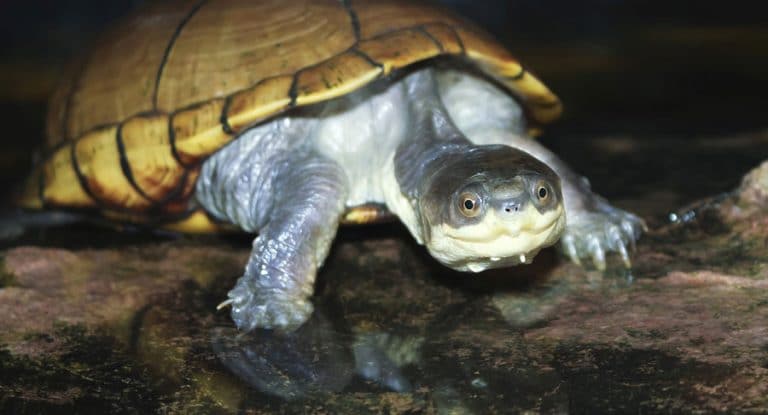
The Asian leaf turtle Cyclemys Dentata is a variety of turtles seen in South Eastern part of Asia. In the pet trade, we see them quite often with their shell similar to a hybrid of Cuora amboinensis. You can see this turtle in Bangladesh, Thailand, North India, Vietnam, Myanmar (Burma), West Malaysia, Indonesia (Bali), Sumatra, Borneo (Java), China, and the Philippines (Palawan- Calamian Islands). Earlier, the experts considered the multifaceted variety of these forms to represent just one variety, C. Dentata. At present, they acknowledge them as a group of multifaceted five full species such as C. atripons, C.tcheponensis, C.oldhamii, C.pulchristriata. Their categorization and allocation are vague, hence the status of their protection has not undergone evaluation.
Anatomy
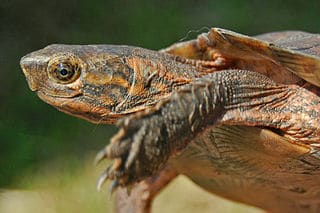
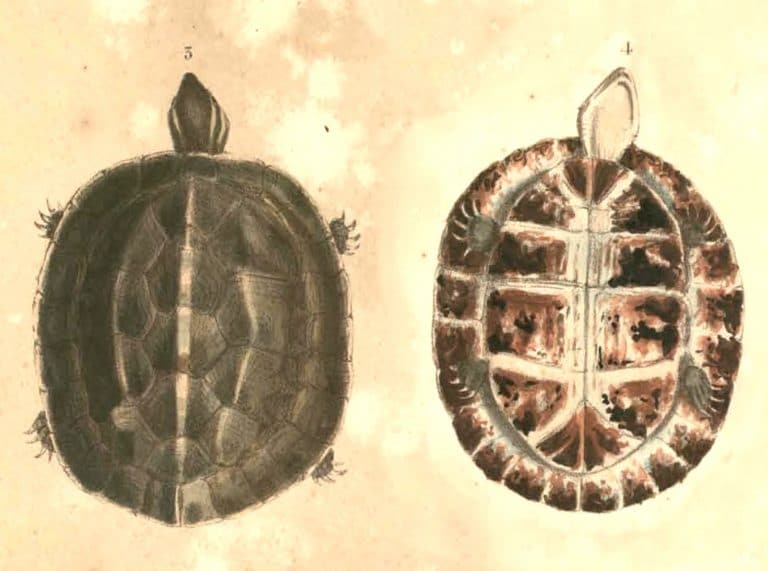
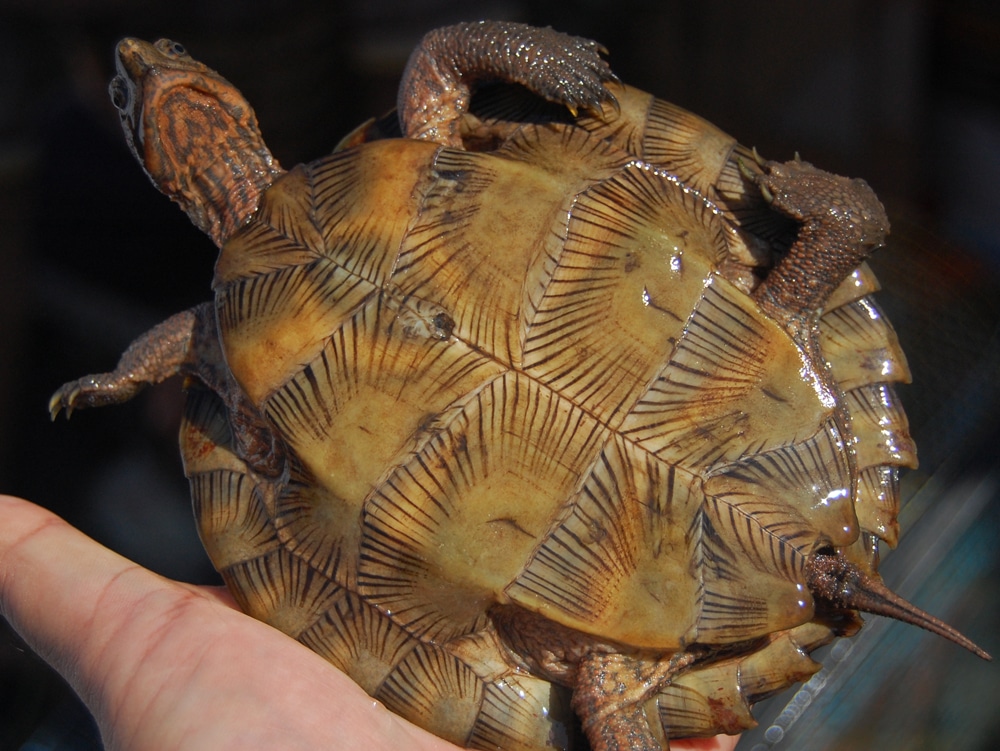
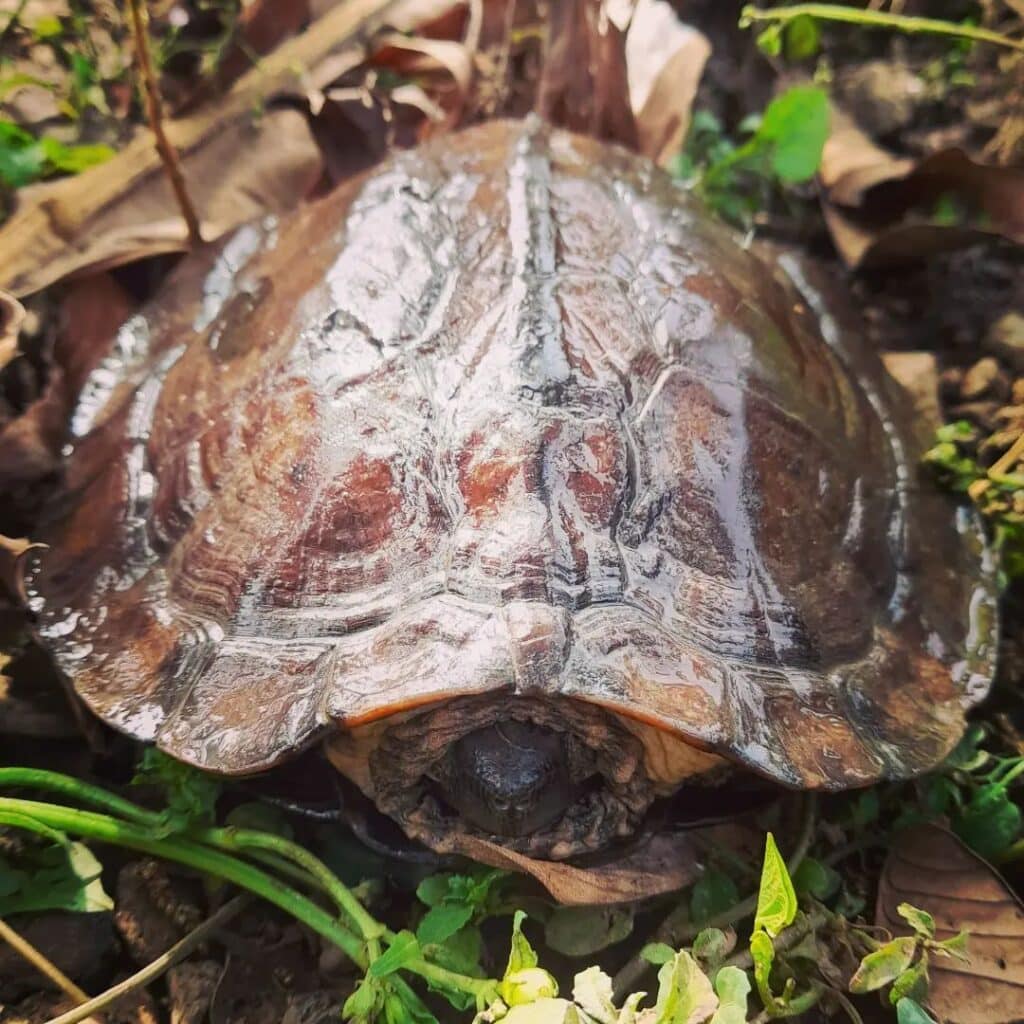
The size to which Asian leaf turtles grow is 4.5 to 6.5 inches wide and 6 to 9.5 inches long. Their shells are rectangular to round and most of the time green and brown in color. The surface of their shell is akin to plant leaves, thus they get their name, leaf turtles. These turtles are omnivorous, feed upon food such as insects, vegetation, worms, and fish, and even scavenge on dead carcasses. When these animals feel threatened, they squirt the contents in their digestive system. They have semi- webbed feet, suited well for terrestrial or aquatic mobility. There is proof that C. Dentata lives up to 14.7 years in custody.
Habitat
Adult leaf turtles while away their time mostly on land. You see them adjacent to streams, ponds, and other low-lying slow-moving water bodies in hilly forests, even though most of the times in lower elevations. You also see them at higher elevations, more than 1000m (3,300 ft) above sea level
As a Pet
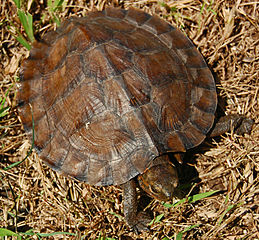
Hunters frequently capture and sell Cyclemys Dentata for traditional medicine uses and for the pet trade. The most common species of the Cyclemys species in the pet trade are c. Dentata that people normally breed in custody. They often choose them because they are more accustomed to handling and healthier and you can curtail their population while you breed them in custody.
Housing
The aquarium is the ideal method of accommodating Cyclemys turtle indoor for hatching. An aquarium, built up with rocks in one corner suited for dry basking, and with water to a depth of 2 to 4 inches (5 to 10 cm) for the Asian leaf turtle hatchlings, is ideal A convenient size of aquarium for these young ones is 20 gallons: 30” x 12” (75 x 30 cm). Increase the size of the aquarium as these animals grow.
Outdoor Housing
In warm seasons, it is far more advantageous accommodating the Asian leaf turtles in predator- proof outdoor housing and not indoors.
Heating and lighting
In a special area in the habitat, place a hardware store reflector clip light lamp of 900F (32 degrees C) for focusing on the basking spot. In addition, equip the habitat with a complete spectrum fluorescent light for UVB. This is essential for providing vitamin D3 synthesis (Useful for Calcium metabolism)
Food
This variety is omnivorous. While its diet in the natural habits consist of carrion, figs, fruits, fish and crustaceans, in custody try to imitate the same. Do not feed the Cyclemys in excess because obesity is a common problem. The right way of feeding adult turtles is twice or thrice a week, and for the juveniles that grow quickly, a little measure daily to every other day. The leaf turtles consume any of the commercially available turtle feed seen today in the market.
Water
The water quality is an important factor. Shelling out a little more money and spending more time with your leaf turtles secure them from many problems. You can do this by providing your pets with sufficient filtration system. It is at times not possible to provide such a system for the hatchlings because of the depth of the water. For them, use a power filter and make frequent water change or use a submersible foam filter.
Handling
Most people prefer handling these creatures as they adapt well to handling.
Having discovered a fondness for insects while pursuing her degree in Biology, Randi Jones was quite bugged to know that people usually dismissed these little creatures as “creepy-crawlies”.