Blue Racer Snake
Scientific Classification
| Kingdom: | Animalia |
| Phylum: | Chordata |
| Subphylum: | Vertebrata |
| Class: | Reptilia |
| Order: | Squamata |
| Suborder: | Serpentes |
| Family: | Colubridae |
| Subfamily: | Colubrinae |
| Genus: | Coluber |
| Species: | C. constrictor |
| Binomial name: | Coluber constrictor |
Coluber constrictor foxii is a sub-category of a non-venomous snake group, Coluber constrictor. They are also known as the eastern racers or blue racer snakes.
Anatomy
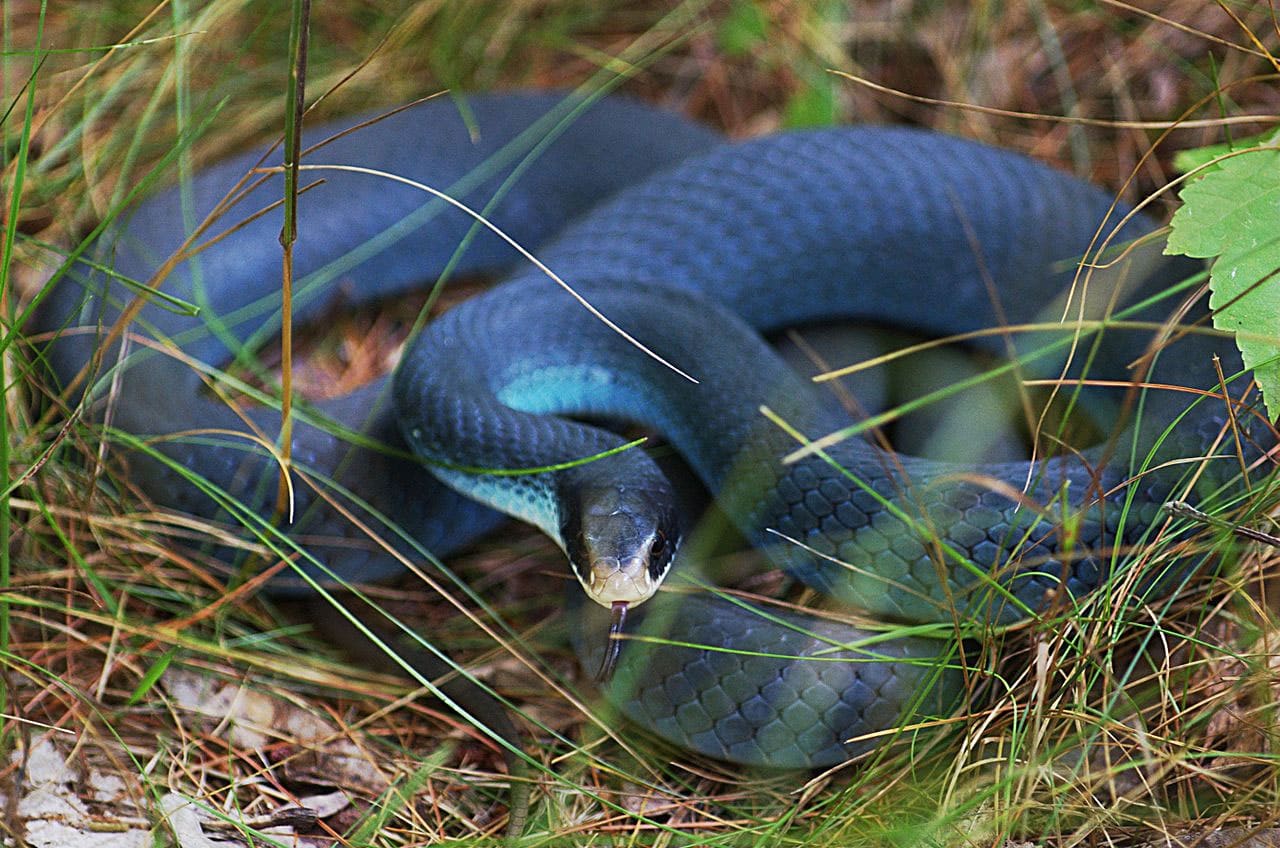
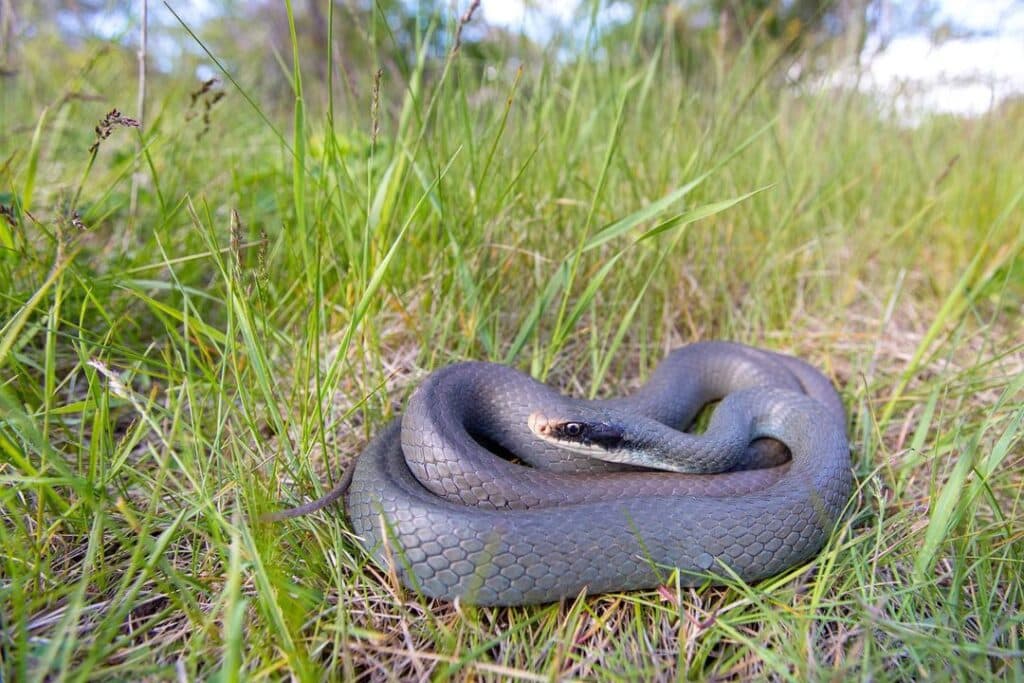
The eastern racers are characterized by creamy white scales on the belly, and pale gray or candid blue lateral scales, while their dorsum portion (upper side) is brown or dark gray in color. The rostal (near the snout) scales are brownish to orange in color. Black masks and comparatively bigger eyes are the unique features of the race.
The hatchlings as well as the yearlings tend to bear blotches on the back, which gradually become light as soon as they are about three years old. By the third season, the pattern is usually visible on the ventral side.
The large gray snake or the blue racer tend to have smoother scales across the 4-6 feet long body that is usually lighter in color than the head, even though the chin and throat are white in color. The abdomen is either white or pale blue in color, with a prorated anal plate. The juvenile snakes are grayish in color.
Being the largest snake of Ontario, the blue racer attains a length of 90 cm to 152 cm from snout to vent. Till date, the largest specimen, captured on Pelee island was 138 cm, snout to vent length.
Behavior
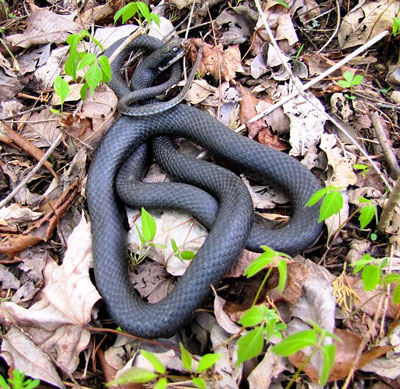
The blue racer snakes are comparatively less comfortable with human beings. Thus, they usually prefer to reside in areas with low population. Data from radio telemetry reports that both the blue racers as well as eastern fox snakes used to reside in the same general locations on Pelee Island. While the fox snakes preferred barns, garages, porches or foundations of buildings, the blue racers love natural surroundings. Thus, they prefer locations with minimum human activities.
Blue Racer, as the name itself speaks, is a very fast moving snake, that can race for about seven kilometers in an hour. One can have barely a glimpse of the snake, as it will instantly disappear amidst the grasses and other vegetation in a blink.
- Being of diurnal nature, the Blue racers are mostly active during the daytime
- They spend hours on the ground
- Numerous Blue Racers may reside in a single habitat
- The Blue Racers are very good foragers
- They can forage on grounds as well as in trees
- The snakes prefer a solitary life and reside in areas that have very little population
- When they are foraging, the blue racers face up, and race faster through the bushes
- If frightened they will take shelter in trees and bushes
- If disturbed, they will bite immediately
- The Blue Racers also vibrate their tails uniquely creating a buzzing sound, which warns the other snakes of its type
- During the chilling winter months they hibernate together across the rocky mountains.
Habitat
Open or semi-open habitats, old field shorelines, edge habits, savannas are ideal habitats of the Blue Racers. In the United States, Indiana, Michigan, Oregon, Wisconsin, Washington, Illinois, Ohio and Iowa are the states which have extant populations of blue racers. In Ontario, blue racer was last seen in 1983. On Pelee Island of Ontario, the blue racer is found across the eastern two thirds of the island.
They are found from Canada in north to Guatemala, Belize and Mexico in the south. Along the eastern sides of the Rocky Mountains, you can amply see the racer snakes.
As a Pet
In general, the Blue Racer Snake is not very good pet because of its threatening and aggressive nature. They can strike anyone and bite immediately. It is also very difficult to accommodate them in cages or even glass tanks due to their enormous size. It is not a good option to keep a Blue Racer at home, they should be freed.
Breeding
The favorable season for the snakes to mate starts usually from April-May. They lay five to 28 leathery eggs below the rocks, underground, burrows, or rotten woods. Occasionally you find them taking a rest communally.The hatchlings start coming out during the late summer and are of varied shades.
The Blue Racer Snake eggs typically start hatching out in August or September. The eggs are white colored, oval in shape, about 2.5- 3.9 cm in length, with leathery shells. The young snakes shape their own paths using their egg tooth and come out of the shell. The adults barely offer any special protection or care for the juveniles, who remain close to the parents for a few hours after birth. They attain maturity in about two- three years, and might live even more than twenty years.
Having discovered a fondness for insects while pursuing her degree in Biology, Randi Jones was quite bugged to know that people usually dismissed these little creatures as “creepy-crawlies”.