Thyme
Scientific Classification & Quick Facts
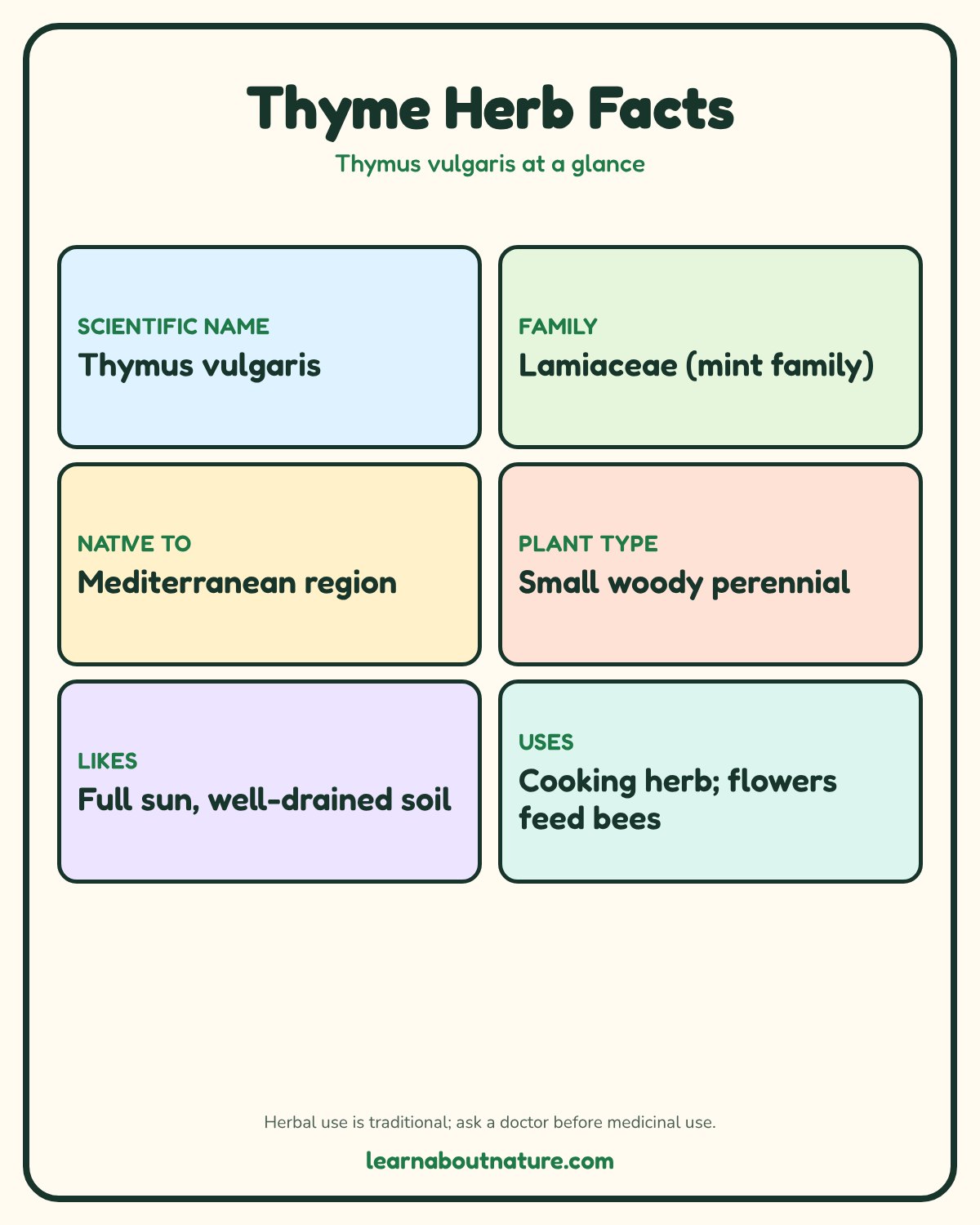
| Common name | Thyme |
| Scientific name | Thymus |
| Kingdom | Plantae |
| Phylum | Tracheophyta |
| Class | Magnoliopsida |
| Order | Lamiales |
| Family | Lamiaceae |
| Type | Perennial herb, small shrub |
| Habitat | Dry, sunny, well-drained soil |
| Native range | Mediterranean region |
| Colours | Bluish-purple to pink flowers |
| Flowering season | June or July |
| Height | 12 to 18 inches |
| Edible parts | Leaves |
Thyme is also known as thymus. It is a perennial herb that has medicinal and culinary uses. It is also used as an ornamental plant. The Thyme plant has antiseptic, anti-fungal, antispasmodic, and anti-parasitic properties. Its fragrance is appealing and is used to add flavor to many food dishes. In the year 1997, the Thyme herb was chosen as the HERB of the Year by the International Herbs Association. Thyme is a lovely and versatile plant for growing in an herb garden or a general garden. It attracts bees, butterflies, and birds. The Thyme plant grows to a height of 12 to 18 inches. Bees collect nectar from this plant and produce honey of high quality. Home gardeners grow this plant as a landscape plant. Thyme has preservative properties. So it has long been used for preserving meats and for medicinal uses also. This plant grows well in tough and dry conditions. It is a highly aromatic herb and grows well in sunny conditions.
History
The ancient people of Egypt used the thyme plant for embalming. The ancient Greeks believed upon thyme as a source of courage. They used in as an incense stick by burning it and also used in their bath. In the middle ages, in Europe, this herb was placed under the pillows to ward off nightmares and support a peaceful sleep. In funerals, thyme was used in coffins as incense. It was supposed to comfort the passage into the next life. In 65 BC to 8 BC, according to the writings of Horace, the Romans grew this crop to propagate bee culture. The name Thyme comes from the ancient Greek word “thymon”. Some old books claim the name comes from an Egyptian word, but there is no good evidence for this. In the Middle Ages, a sprig of thyme was also given to knights before battle as a symbol of courage.
Anatomy
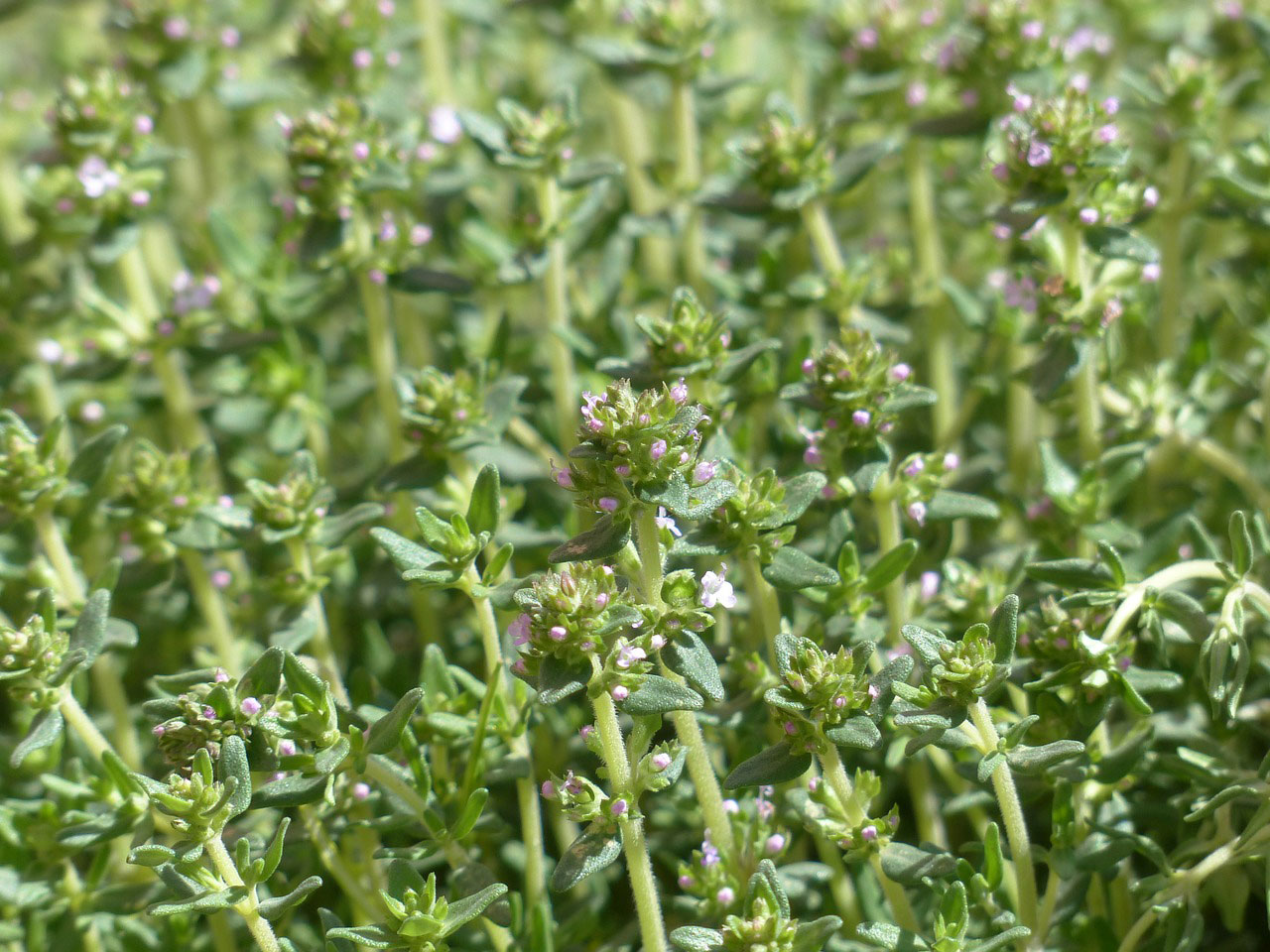
Thyme is a small shrub plant. It has many quadrangular woody stems. The stems are finely covered with hair. Its leaves are opposite and are ¼ to ½ inches long. The leaves are ovate to lanceolate and are slightly rolled at the edges and hairy underside. The flowers of the Thyme plants are bluish purple to pink in color and are two lipped and in a tabular form. The flowers are ¼ inches long and arranged in lethal clusters. The fruit of the plant contains four small seeds like nut-lets. Its flowers bloom in the month of June or July.
Habitat
The Thyme plant is native to the Mediterranean region. It was introduced in England by the Romans. Now, it grows wild there. It is also grown in Northern Africa. This creeping plant can be seen in cultivated beds, or as a border plant on walls or as a ground cover, as it is quite hardy. Thyme is one of the essential herbs used in French and Italian cuisine. This plant has an erect growth habit. It originates from the Mediterranean region.
Soil for Planting
This plant requires well drained soil. It prefers light, loamy soil. It is a very hardy plant and will grow under many conditions. The Thyme plant will grow in a PH range of 6.5 to 8.5. This plant also grows well in poor to fertile soil. Sandy dry soil is ideal for the plant. Organic compost is also ideal.
Planting
Thyme plant is easy to grow from a division. It also grows from the seeds. Seeds of thyme plant should be sown in the spring season in cold frames. Seeds are hard to germinate and can take a long time to sprout. It can also grow in a greenhouse in the autumn. It grows well in summer season.
Watering
The Thyme plant requires watering regularly. It requires fewer nutrients. It requires full sunlight. Watering should be done at the top 1 inch of the soil to dry out between watering. It cannot survive in severe cold.
Temperature and Humidity
This plant requires an average room temperature of 60 to 75 degrees F. The plants which grow inside the home require high humidity and air circulation. This plant grows well in warm and sunny climate. Outdoors, it grows well at the temperatures between 4 and 28 degree C. It grows best at temperatures of 16 degree C. Thyme plant prefers full sunlight to partial shade.
Flowering and Maturing Care
Thyme plant requires care and maintenance from weeds. Control of weeds is essential. Mulching is also ideal for the plant. If the quality of soil is poor, then it requires a little fertilizer. In the winter months, it needs care to survive in the cold. In early spring season, pruning is ideal for the plant to prevent the plant from getting woody.
Harvest
Harvesting of thyme plant is done in the midsummer season, just previous to flowering. Once it establishes, it is very hard to over harvest the plant. Harvesting is done by cutting 1 ½ to 2 inches from the ground.
Pests and Pesticides
Many pests and diseases can cause damage to the thyme plant. Alternaria Blight Pests attack the plant and can cause holes in the leaves of the plant. Round, small and yellow, black or brown colored spots appear on lower leaves. The Thyme plant is liable to Rhizoctonia and Botrytis Rot diseases. Pests such as Spider Mites and Aphids can also cause damage to the plant. Molds and Rots are also a problem for the plant in damp and humid conditions.
Uses
The Thyme plant has many uses such as culinary, medicinal, cosmetics, Aromatic and decorative. The Thyme herb is used as antiseptic. It is used in the flavoring of Herbal Butter, Vinegars, Tea, Soups, Stews, Stuffing, Fish, Bread, Poultry, Mayonnaise, Broccoli and Mushrooms. Its dried and fresh form is used in salads. It has many medicinal qualities. The leaves of the thyme plant are used in the making of herbal tea. Thyme is used to cure skin problems and to treat indigestion and sore throat. Tea of the thyme herb is very useful in preventing acne and reducing oiliness. This herb helps in boosting the immune function of the body and to fight against infection. People have traditionally used it for respiratory problems such as coughs and bronchitis. Inhaling the vapors of thyme herb can loosen congestion. Essential oil of the Thyme is obtained from its leaves. It is very useful, and is used in making soaps, perfumes, medicines, mouthwashes and toothpastes. Because of its fungicidal properties, it is used to prevent mildew. The dried flowers of this plant are used in the stored clothing to repel moths.
Thyme FAQs
What is thyme used for?
Thyme is used to flavour soups, stews, fish, poultry and bread. It is also used in herbal tea, soaps, perfumes and mouthwashes.
Where does thyme come from?
Thyme is native to the Mediterranean region. The Romans brought it to England, where it now grows wild.
How tall does thyme grow?
Thyme grows 12 to 18 inches tall. It is a small woody shrub with tiny leaves, and it can also spread as ground cover.
When does thyme flower?
Thyme flowers in June or July. The little flowers are bluish-purple to pink, and bees and butterflies love them.
How much water does thyme need?
Thyme needs only a little water. Let the top inch of soil dry out between waterings, and give it lots of sun.

Randi Jones is the owner and founder of the Nature Gift Store, an online retailer specializing in nature-themed gifts, educational science projects, live animal nature kits and real butterfly artwork. A biology graduate who fell in love with insects, she founded the company in 2001 to make active learning about nature fun, accessible and engaging for children and adults. Her store offers real butterfly frames, home and garden decor and educational live animal kits, including ant farms, worm farms, tadpoles, ladybugs and hermit crabs, and she runs a bug museum in Washington featuring live animals like Eddie the Iguana alongside other reptiles and insects. Randi wrote most of the guides on this site. They first appeared on her long-running nature sites, including Monarch-Butterfly.com, Ladybug-Life-Cycle.com, Frog-Life-Cycle.com, Dragonfly-Site.com and Butterfly Pictures, which have now been brought together here at Learn About Nature.