Rubber Tree

The rubber tree (Ficus elastica), also called the rubber plant or rubber fig, is a tropical fig tree with big, glossy leaves. In the wild it grows into a huge forest tree, but most people know it as a tough, easy-going houseplant that can live for many years indoors.
Scientific Classification & Quick Facts
| Common name | Rubber tree |
| Scientific name | Ficus elastica |
| Kingdom | Plantae |
| Phylum | Tracheophyta |
| Class | Magnoliopsida |
| Order | Rosales |
| Family | Moraceae |
| Genus | Ficus |
| Type | Large tree, popular houseplant |
| Habitat | Full sun to partial shade; fast-draining potting soil |
| Colours | Glossy leaves, rose-colored new sheaths |
| Height | Up to 50 feet |
| Special feature | Thick, big, shiny leaves |
Where Rubber Trees Come From
Rubber trees are native to the warm, wet forests of northeast India, Nepal, Bhutan, Myanmar, southern China, Malaysia and Indonesia. There they can tower 30 meters (about 100 feet) or more above the forest floor.
Like many figs, a wild rubber tree can start life high up on another tree, sending long aerial roots down to the ground. In Meghalaya, India, people have guided these living roots across rivers for generations to make famous “living root bridges” that get stronger as the tree grows.
What It Looks Like
The leaves are thick, leathery and shiny, usually 10 to 35 cm (4 to 14 inches) long. Each new leaf grows inside a soft sheath, often pink or red, that peels away and drops off as the leaf unrolls. It is fun to watch a new leaf appear at the tip of a stem.
If you break a leaf or stem, a milky white sap called latex oozes out. This sticky sap is what gave the plant its name.
Is Rubber Made From This Tree?

Photo by: Irvin Calicut
In the 1800s, latex from Ficus elastica was collected to make rubber. Today, though, almost all natural rubber comes from a different plant, the Para rubber tree (Hevea brasiliensis) from South America. Workers cut thin grooves in its bark and collect the latex in cups, then process it into rubber for tires, gloves, balls and much more.
Growing a Rubber Plant at Home
Light
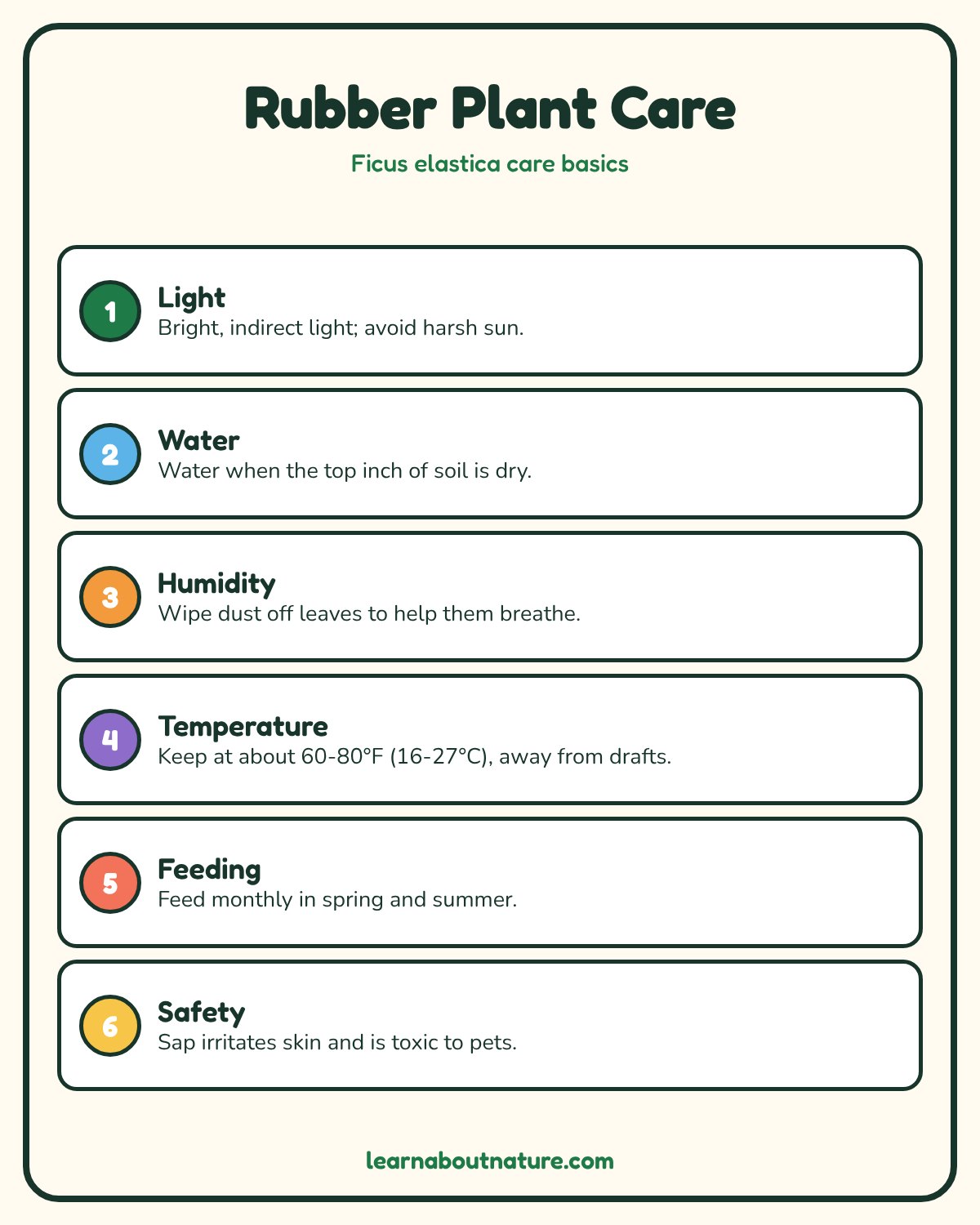
Rubber plants like plenty of bright, indirect light. A spot near a sunny window, but out of hours of harsh direct sun, is ideal. A simple test: during the day you should be able to see your shadow on the wall behind the plant. In too little light, the plant grows slowly, gets leggy and may drop its lower leaves.
Soil and Pots
Use a good-quality indoor potting mix that drains quickly, not heavy garden soil. Always choose a pot with drainage holes so extra water can escape.
Young plants grow fast and may need a bigger pot every year or two, usually in spring. Move up only one pot size at a time (a few centimeters, or an inch or two, wider) and use fresh potting mix. A plant that stays slightly snug in its pot is fine; a badly root-bound plant will stop growing well.
Watering
Water when the top 2 to 3 cm (about an inch) of soil feels dry, then let any extra water drain away. In spring and summer, when the plant is growing, this may be about once a week. In winter, it grows more slowly, so water less often.
Overwatering is the most common problem. Soggy soil can rot the roots and cause yellow or brown leaves that fall off. Drooping leaves can also mean the soil has got too dry, so always check the soil with your finger before watering.
Temperature and Humidity
Keep your rubber plant in a warm room, ideally between about 16 and 27 C (60 to 80 F), and never below about 13 C (55 F). Keep it away from cold drafts, open doors in winter and blasting heaters. Normal household humidity is usually fine. Gently wiping the leaves with a damp cloth removes dust and helps them shine and take in light.
Feeding and Pruning
During spring and summer, feed the plant about once a month with a liquid houseplant fertilizer mixed at half strength. Skip feeding in winter.
Pruning is optional. If your plant gets too tall or you want it bushier, use clean, sharp pruners to cut a stem just above a leaf or leaf node. New shoots will usually grow from below the cut. Wear gloves, because the sap can irritate skin, and keep it away from your eyes. Remove any dead or yellow leaves as they appear.
Pests and Problems

Rubber plants are fairly tough, but they can be bothered by mealybugs, scale insects, aphids, whiteflies and spider mites. Check under the leaves now and then. If you spot pests early, you can often wipe them off with a damp cloth or treat them with a gentle option such as insecticidal soap.
The sap is mildly toxic and can upset the stomach of pets and people if chewed, so keep the plant away from cats, dogs and small children who like to nibble leaves. Ask a vet if a pet has eaten some.
Popular Varieties
- ‘Decora’ – the classic rubber plant, with broad, dark green, glossy leaves that often have a reddish tinge underneath.
- ‘Robusta’ – a strong, fast grower with large green leaves.
- ‘Burgundy’ or ‘Black Prince’ – very dark leaves that look almost black, with red new growth.
- ‘Tineke’ – green leaves splashed with cream and pale green.
- ‘Ruby’ – variegated leaves with pink and cream tones.
Variegated types usually need a bit more light than plain green ones to keep their bright colors.
Rubber tree FAQs
How tall does a rubber tree grow?
A rubber tree can grow up to 50 feet tall, so it needs a lot of space.
How much light does a rubber plant need?
It likes full sun to partial shade, but not direct sun all day. A good spot is one where your shadow shows on the wall behind the plant.
How often should you water a rubber plant?
Keep the soil damp while the plant is growing, about once or twice a month. Water less in winter, because too much water makes the leaves turn brown and yellow and fall off.
What temperature does a rubber plant need?
Keep it above 55 degrees F (about 12.7 C).
How do you repot a rubber plant?
Move it to a pot about one inch wider when it outgrows its pot. A root-bound plant gets stunted if its roots are crowded or hurt.

Randi Jones is the owner and founder of the Nature Gift Store, an online retailer specializing in nature-themed gifts, educational science projects, live animal nature kits and real butterfly artwork. A biology graduate who fell in love with insects, she founded the company in 2001 to make active learning about nature fun, accessible and engaging for children and adults. Her store offers real butterfly frames, home and garden decor and educational live animal kits, including ant farms, worm farms, tadpoles, ladybugs and hermit crabs, and she runs a bug museum in Washington featuring live animals like Eddie the Iguana alongside other reptiles and insects. Randi wrote most of the guides on this site. They first appeared on her long-running nature sites, including Monarch-Butterfly.com, Ladybug-Life-Cycle.com, Frog-Life-Cycle.com, Dragonfly-Site.com and Butterfly Pictures, which have now been brought together here at Learn About Nature.