Alligator Snapping Turtle

Scientific Classification & Quick Facts
| Common name | Alligator snapping turtle |
| Scientific name | Macrochelys temminckii |
| Kingdom | Animalia |
| Phylum | Chordata |
| Class | Testudines |
| Family | Chelydridae |
| Genus | Macrochelys |
| Conservation status | Endangered |
| Type | Reptile (largest freshwater turtle) |
| Diet | Fish, worms, shrimp and other live prey |
| Habitat | Wetlands, lakes and river systems |
| Native range | Southeastern United States |
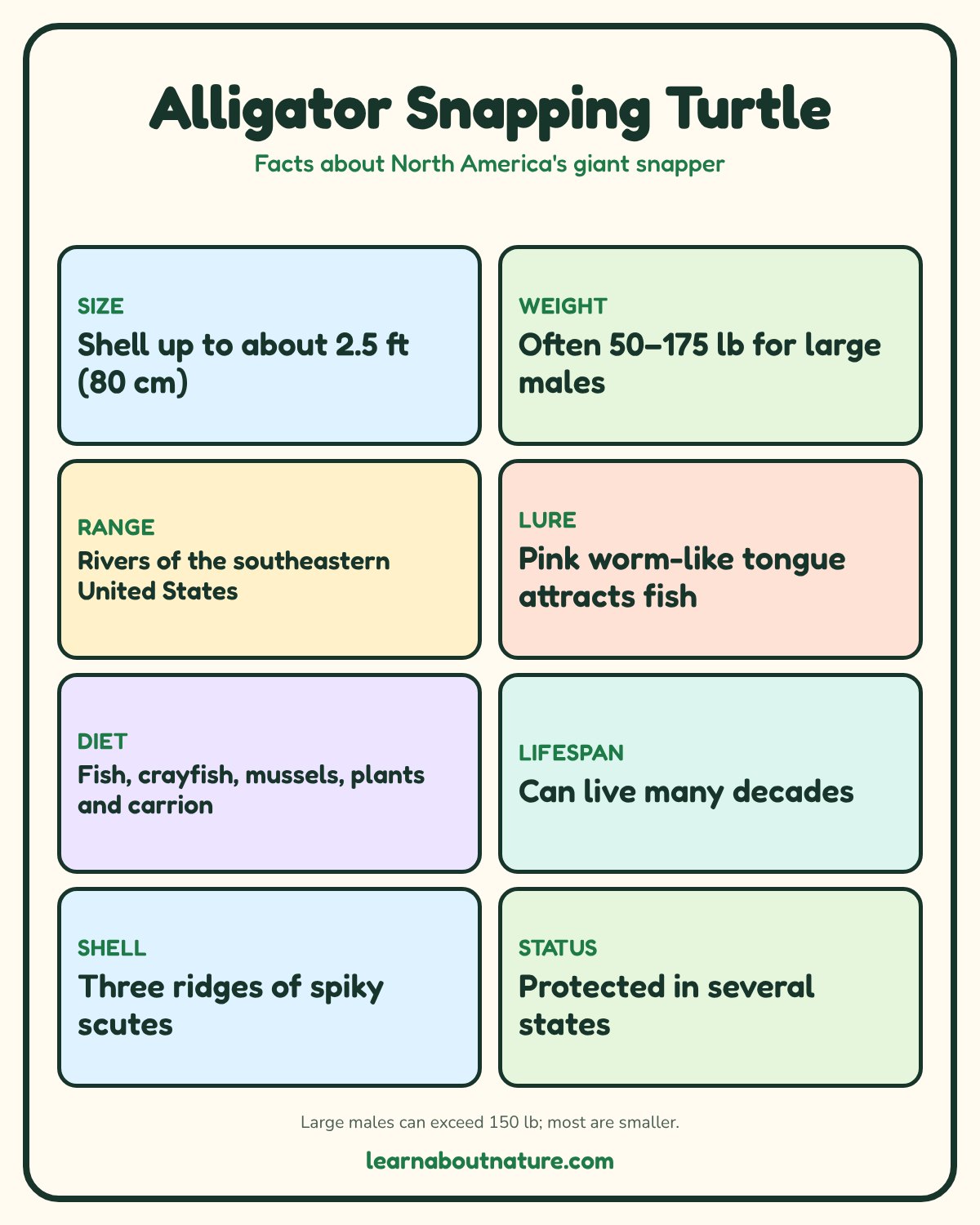
| Size | Shell 15–25 in (38–64 cm) long |
| Weight | Roughly 155–175 lb (70–80 kg) for big males |
| Special feature | Wormlike tongue lures fish into its mouth |
Weight is often the criteria on which one determines the size of a turtle. Accordingly, the alligator snapping turtles or “turtles Macrochelys temminckii” are the world’s largest freshwater turtles. They are associated, but only minutely with the common snapping turtle. In the macrochelys family, the alligator snapping turtles are the only existing species, whereas the common snappers belong to the Chelydra family. The alligator snapping turtle is mainly found in the waters of the southeast part of The United States. They also exist in places like Missouri, and Western Illinois, from East Texas to the Florida panhandle, Southeastern Iowa, north to southeastern Kansas, southern Indiana, eastern Tennessee, and western Kentucky. Normally only the nesting females come out into the open land.

Lifespan
They attain sexual maturity at the age of 11 to 13 years. When in captivity, they live up to 70 years, and in the wild they may live 50 years or more.
Anatomy

Alligator snapping turtles have spiky shells and a face with a prehistoric-look for which reason people call them the dinosaur of the turtle world. The typical feature of this turtle is the three large, prominent keels or ridges that run along the length of the shell from the front to the back. It has a big head with powerful jaws. What makes them different from the other snapping turtles is their eyes on the sides of the head. Alligator snapping turtles are the largest freshwater turtles. Adult males commonly weigh around 155 to 175 pounds (70 to 80 kg), and females are smaller.
Habitat
Alligator snapping turtles are purely aquatic, they seem to stay immersed in water and stay motionless for a considerable period while algae start growing on their carapace. Other than for swallowing some air, they hardly come to the surface. Prior to coming to the surface for air, they can remain in water for 40 to 50 minutes. Other than females coming to the land for laying eggs, you hardly see these turtles on land. Their selected habitats are wetlands, lakes and river systems.
You can find alligator snapping turtles only in the United States, from north Florida extending to east of Texas towards north up to lowa.
Breeding
Mating takes place during spring and the females lay eggs after two months. The incubation period is 100 to 140 days. The nest temperature determines the sex of the offspring. The looks of the new hatchlings are no different from the adults. Males grow in cool climates, while females need warmer temperatures for growth.
As a Pet

Housing
The female alligator snapper weighs from 35 to 70 pounds and male up to 200 pounds, and their shell length is 15 to 25 inches. Therefore, they require a very big aquarium to stay. The least size for an adult is a 200 gallon. In North America, the largest freshwater turtle has a 800-gallon tank for its housing. A stock tank or outdoor pond is also fine.
Food
Alligator snappers remain stationary for most of the time; but venture to hunt their live prey. You can feed them with worms, feeder fish, live minnows and shrimp supplies proteins. Purchased turtle food, chopped fish or cooked chicken is also good. They have a specially designed tongue that permits them to catch the prey with less effort. An enticing projection of the tongue attracts inquisitive fish to swim directly into the turtle’s mouth.
Water
The bigger the habitat less water needed for changing. For determining the PH value, temperature and hardness, monitor the water quality. Maintain the PH value of nearly 7.0.
Handling
Owing to their lively attitude and sharp jaws, handle the alligator turtle with much care. It is possible for an adult turtle to easily bite off your finger. Besides, they hurt you with their sharp claws. These alligator snapping turtles may not appear as the best pets for new keepers owners looking for a turtle as a pet because they are violent by nature. Snappers are not a good pet for some.
Alligator snapping turtle FAQs
How big do alligator snapping turtles get?
They are the world’s largest freshwater turtles. Big males weigh about 155 to 175 pounds (70 to 80 kg) and have a shell 15 to 25 inches long.
What do alligator snapping turtles eat?
They eat live prey such as fish, worms, shrimp and minnows. They sit still and use a pink, worm-like tongue as bait to lure fish right into their mouths.
Where do alligator snapping turtles live?
They live in rivers, lakes and wetlands in the southeastern United States, from East Texas to the Florida panhandle and north to Iowa. They stay in the water almost all the time.
Can alligator snapping turtles bite hard?
Yes. They have powerful jaws, and an adult can easily bite off a finger, so they are not good pets for beginners.
How long can alligator snapping turtles stay underwater?
They can stay under for 40 to 50 minutes before coming up for air.

Randi Jones is the owner and founder of the Nature Gift Store, an online retailer specializing in nature-themed gifts, educational science projects, live animal nature kits and real butterfly artwork. A biology graduate who fell in love with insects, she founded the company in 2001 to make active learning about nature fun, accessible and engaging for children and adults. Her store offers real butterfly frames, home and garden decor and educational live animal kits, including ant farms, worm farms, tadpoles, ladybugs and hermit crabs, and she runs a bug museum in Washington featuring live animals like Eddie the Iguana alongside other reptiles and insects. Randi wrote most of the guides on this site. They first appeared on her long-running nature sites, including Monarch-Butterfly.com, Ladybug-Life-Cycle.com, Frog-Life-Cycle.com, Dragonfly-Site.com and Butterfly Pictures, which have now been brought together here at Learn About Nature.