Euphrasia Eyebright
Scientific Classification
| Kingdom: | Plantae |
| (unranked): | Angiosperms |
| (unranked): | Eudicots |
| (unranked): | Asterids |
| Order: | Lamiales |
| Family: | Orobanchaceae |
| Genus: | Euphrasia |
Euphrasia or Eyebright fits in the genus comprising of 450 varieties of an herbal variety of blossoming plants, from the Orobanchaceae family (earlier it belonged to the Scrophulariaceae family), and it has a cosmopolitan distribution. These herbs are partially parasites living on other plants or grasses. Eyebright is the usual name by which it is called because of the treatment of infections related to the eye. Several varieties are established in the snowy meadows of subordinate or mainland regions of the Alpines. Normally they bear flowers at the terminus, they are zygomorphic, and they possess lower petals just like a lip.
History
Several varieties are established in the snowy meadows of subordinate or mainland regions of the Alpines. Normally they bear flowers at the terminus, they are zygomorphic, and they posses lower petals just like a lip.
Anatomy
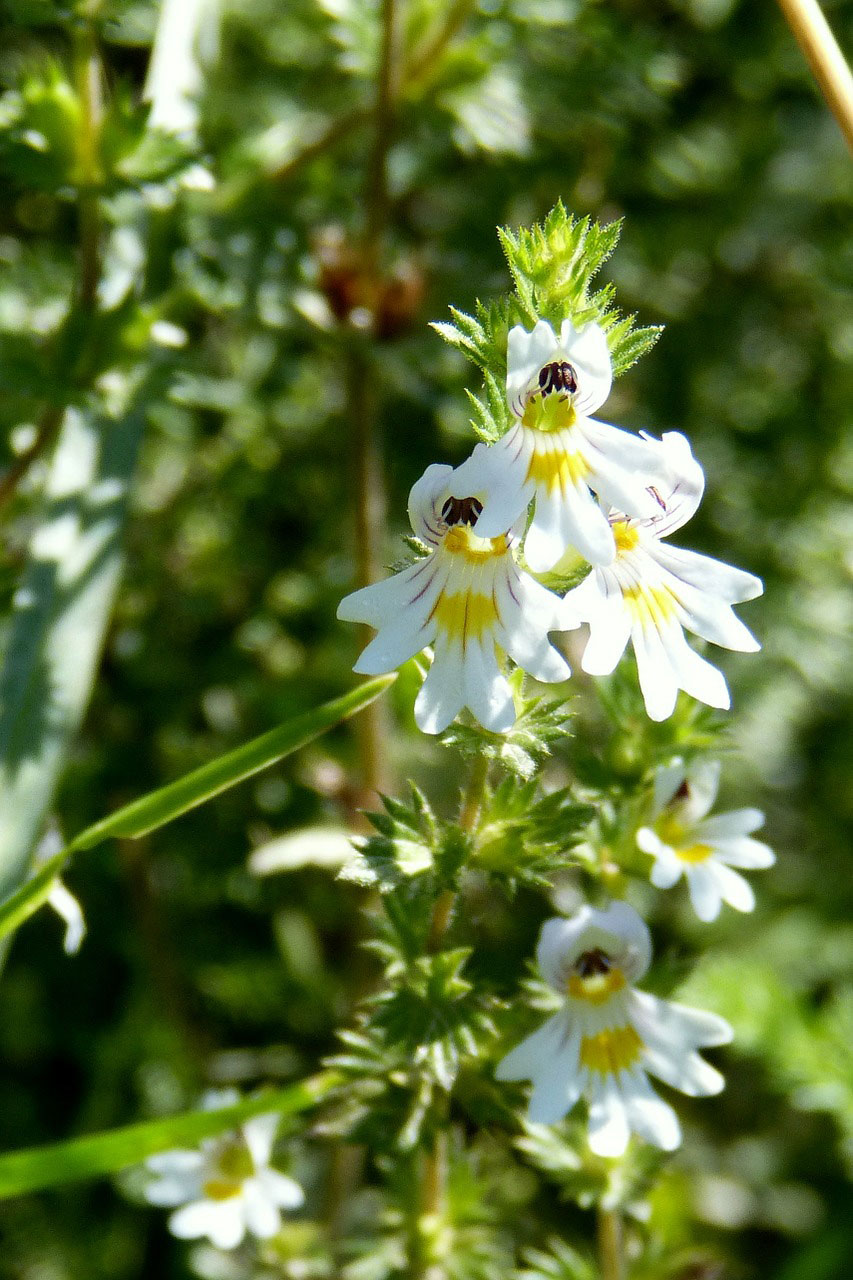
The height to which the Eyebright grows is 2-8 inches. It is wiry and upright. In specimens that are small, there are no branches or otherwise they have several branches, opposite to each other. The length of the leaves, extends from 1/6 to ½ inches and width almost ¼ inch, oriented in opposite directions on the bottom of the stem and above, they are oriented in an alternate manner, most of them are in the shape of a lance and rarely much broader than mentioned earlier. They have 4 to 5 serrations on either side. The flowers are colored lilac, white or purple with veins, spiked at the terminals, interspersed with leaf-like bracts.
Habitat
Chalky pastures and moist grasslands are ideal for the growth of the Eyebrights. On the grass they are partially parasitic. Hence the places where they thrive are high ranges, grassy regions and meadows.
Soil
Make the soil loose to almost 1 inch deep, either by joining your fingers together or by a rake. Scatter the seeds on the loosened soil. Eyebright seeds being delicate, avoid too much pressure on it. Disperse the seeds around the host grasses, depress the seeds confidently into the soil and spread loosened soil on it.
Temperature and Humidity
Keep them away from a humid climate and from direct sunlight, maintain the temperature at 50 to 77°F (10 to 25°C)
Planting
These seasonal herbs grow to heights of 2 to 8 inches, having profound cut leaves and flowers, purple or white in color, with yellow variations. It belongs to the Figwort group of plants. Its flowers bloom between July and September. Every upright stem has branches opposite to each other and leaves of length ½ inches. The flowers grow on the apex of the spokes having a double lipped corolla.
Watering
Maintaining the Eyebright dry in April and the first half of May is the best system of watering, agreeable to them, for enhancing the growth, water very frequently. When the weather is gloomy and cold, do not water them.
Uses
The traits of the Eyebright are antibiotic, anti-inflammatory, astringent and antioxidant. The traditional cure of eye diseases was by the use of this Eyebright, it tightens the mucous membrane about the eyes. Blepharitis and conjunctivitis are cured very effectively by Eyebright. Its most important characteristics is that it is an excellent cure for decreasing the excess of mucus related to sinusitis, cold, issues related to the middle ear and higher respiratory situations.
Pests & Diseases
Often they are free of pests; however, rarely they are affected by aphids and powdery mildew.

Having discovered a fondness for insects while pursuing her degree in Biology, Randi Jones was quite bugged to know that people usually dismissed these little creatures as “creepy-crawlies”.