Rotifers

Rotifers are tiny animals, most of them smaller than half a millimeter, that live in fresh water, damp soil and moss all over the world. They are nicknamed wheel animals because the ring of beating hairs on their heads looks like a spinning wheel under a microscope.
Scientific Classification & Quick Facts
| Common name | Rotifer |
| Scientific name | Rotifera |
| Kingdom | Animalia |
| Type | Microscopic animal (wheel animal) |
| Diet | Dead matter, algae and phytoplankton |
| Habitat | Fresh water, wet soil, mosses and puddles |
| Size | Mostly 0.1-0.5 mm long |
| Lifespan | Females of one common group live 2-3 weeks |
| Special feature | Crown of cilia looks like a spinning wheel |
Why Rotifers Are Animals
Many rotifers are about the same size as single-celled protists such as Paramecium, so people sometimes mistake them for protists. But rotifers are true animals made of many cells, usually around a thousand.
Despite their tiny size, rotifers have proper organs, including a mouth, a set of jaws, a stomach, an intestine, a simple brain, muscles and kidney-like organs for getting rid of extra water. Most species have exactly the same number of cells in every adult, which is unusual among animals.
Origin of the Name
The name rotifer comes from Latin and means ‘wheel bearer’. Around the mouth is a crown of cilia, tiny beating hairs, called the corona. The cilia beat in waves, which makes the corona look as if it is spinning like a wheel.
Anatomy

Photo by: Micropix
Most rotifers measure about 0.1 to 0.5 mm long, though some are as small as 50 micrometers and a few reach more than 2 mm. Their bodies usually have three main parts:
- The head, which carries the corona of cilia. The corona sets up a whirlpool that pulls food toward the mouth and, in many species, also drives the rotifer through the water.
- The trunk, the main part of the body, which holds most of the internal organs.
- The foot, a narrow, tail-like part at the back, usually ending in one or more toes. Glands in the foot make a sticky glue so the rotifer can anchor itself while feeding.
The body is covered by a clear, flexible outer layer. In some species it is thickened into a stiff shell called a lorica. In many rotifers the trunk and foot are ringed so they can slide in and out like a telescope. These rings are only on the outside; the body is not truly divided into segments.
Rotifers also have small sensory bumps, sometimes called antennae, and many have one or two red eyespots that sense light.
Feeding and Digestion
Most rotifers are filter feeders. The beating corona sweeps tiny particles toward the mouth, including bacteria, single-celled algae and bits of dead material. Some rotifers are hunters that grab small protists or even other rotifers.
Just behind the mouth is a muscular throat called the mastax. Inside it is a set of hard, tiny jaws called trophi, which grind or grab food. The trophi are found only in rotifers and their close relatives, and their shape is so different from species to species that scientists use them to identify rotifers. Food then passes into the stomach and intestine to be digested.
Nervous System
A rotifer has a small brain that sits just above the mastax. Nerves run from the brain to the corona, muscles and other parts of the body. Many rotifers also have a pair of eyespots near the brain to help them sense light.
Where Rotifers Live
Rotifers are found in almost every freshwater habitat, from lakes and ponds to rivers and streams. Many live on the bottom or cling to water plants, while others drift as part of the plankton. A few kinds live in the sea.
They also live in the thin films of water around soil particles and in damp moss and lichens on tree trunks, rocks and roofs. You can find them in puddles, rain gutters, birdbaths, leaf litter, rotting wood and even on mushrooms growing near dead trees. Some live on the bodies of water insects and crustaceans, and rotifers are common in sewage treatment plants, where they help clean water by eating bacteria.
Surviving Drying Out
Some rotifers, called bdelloids, have an amazing survival trick. When their home dries up, they curl into a tight ball and dry out completely, losing almost all their water. In this state they can survive drought, freezing and other harsh conditions for years. When water returns, they soak it up and come back to life within hours.
In 2021, scientists reported reviving bdelloid rotifers from Siberian permafrost that had been frozen for around 24,000 years.
Kinds of Rotifers
About 2,000 species of rotifers have been described. They are usually split into three main groups:
- Monogononts: the largest group, with around 1,500 species. Most live in fresh water.
- Bdelloids: roughly 450 species. They live in fresh water, moss and soil, and many can survive drying out.
- Seisonids: a tiny group of only a few species that live attached to small marine crustaceans.
Scientists now know that the spiny-headed worms (Acanthocephala), parasites with a hooked snout and no mouth or gut, are close relatives of rotifers. They are grouped with rotifers in a larger group called Syndermata.
Reproduction

Photo by: Cihelio
Rotifers have some very unusual ways of reproducing. Bdelloid rotifers are all female. No males have ever been found, and the females lay eggs that hatch into new females without being fertilized. This is called parthenogenesis.
Monogonont rotifers usually reproduce the same way, with females producing daughters from unfertilized eggs. But when conditions change, for example when the pond becomes crowded or the season shifts, some females start producing males. Males are much smaller than females, often have no working gut, and live for only a few days. They mate with females, whose fertilized eggs become tough resting eggs that can survive winter or drought and hatch when conditions improve.
Female rotifers usually have an ovary and a yolk gland that supplies food for the eggs. Many species attach their eggs to plants or other surfaces, or carry them on their bodies. A few, such as Rotaria, keep the eggs inside until they hatch. Young rotifers hatch looking like small adults and grow up fast. Many monogonont females live for only one to three weeks.
Rotifers in the Food Web
Rotifers are an important part of freshwater zooplankton, the tiny animals that drift in water. They eat bacteria, algae and decaying matter, helping to recycle nutrients.
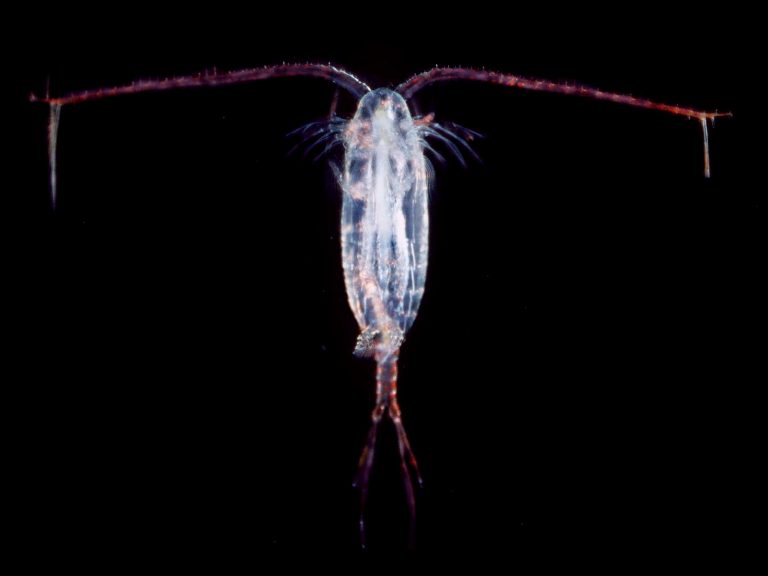
In turn, many animals eat rotifers, including copepods, insect larvae, comb jellies, jellyfish, starfish larvae, bryozoans and young fish such as salmon and herring. Fish farms even raise rotifers by the billions as live food for newly hatched fish.
Rotifer FAQs
What are rotifers?
Rotifers are microscopic animals that live mostly in fresh water. They are called ‘wheel animals’ because the ring of hairs around their mouth looks like a spinning wheel.
What do rotifers eat?
Rotifers filter tiny bits of food from the water. They eat dead organic matter, single-celled algae and phytoplankton, and a few kinds eat other rotifers.
Where do rotifers live?
Rotifers live in lakes, streams, puddles and rain gutters. They also live in the thin films of water in wet soil, on mosses and lichens, and in leaf litter.
How big are rotifers?
Most are only about 0.1 to 0.5 millimetres long. The smallest are about 50 micrometres and the biggest are over 2 millimetres.
What eats rotifers?
Copepods, fish like salmon and herring, comb jellies, starfish and jellyfish all eat rotifers.

Randi Jones is the owner and founder of the Nature Gift Store, an online retailer specializing in nature-themed gifts, educational science projects, live animal nature kits and real butterfly artwork. A biology graduate who fell in love with insects, she founded the company in 2001 to make active learning about nature fun, accessible and engaging for children and adults. Her store offers real butterfly frames, home and garden decor and educational live animal kits, including ant farms, worm farms, tadpoles, ladybugs and hermit crabs, and she runs a bug museum in Washington featuring live animals like Eddie the Iguana alongside other reptiles and insects.