Black Skirt Tetra
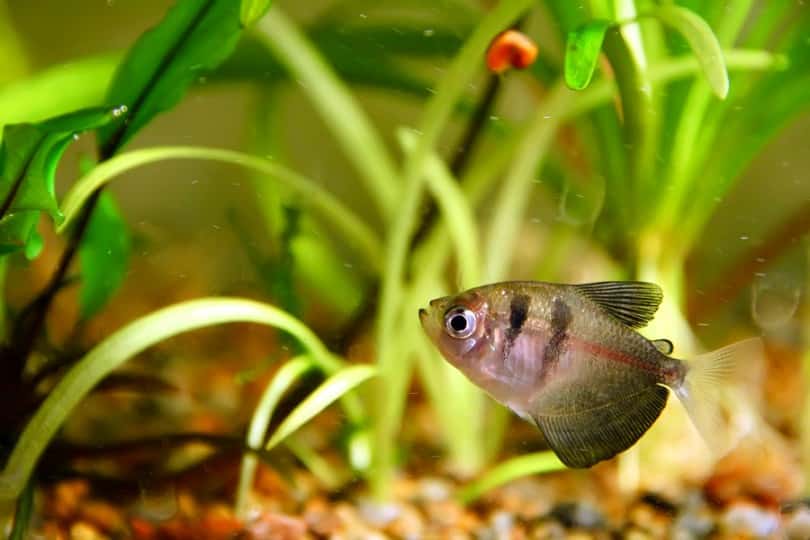
The black skirt tetra (Gymnocorymbus ternetzi) is a small, hardy freshwater fish from South America. It gets its name from its big, dark fins that flow like a skirt, and it is also called the black tetra, black widow tetra, or petticoat tetra.
Scientific Classification & Quick Facts
| Common name | Black skirt tetra |
| Scientific name | Gymnocorymbus ternetzi |
| Kingdom | Animalia |
| Phylum | Chordata |
| Order | Characiformes |
| Family | Characidae |
| Genus | Gymnocorymbus |
| Conservation status | Least Concern |
| Type | Freshwater tetra |
| Diet | Mostly carnivore: worms, insects, crustaceans |
| Habitat | Subtropical river basins; upper and middle water |
| Native range | Brazil, Paraguay, Bolivia, Argentina |
| Size | About 6 cm (2.5 in) long |
| Colours | Grey fading to black; black anal and dorsal fins |
| Special feature | Schooling fish and expert jumper |
What Does a Black Skirt Tetra Look Like?
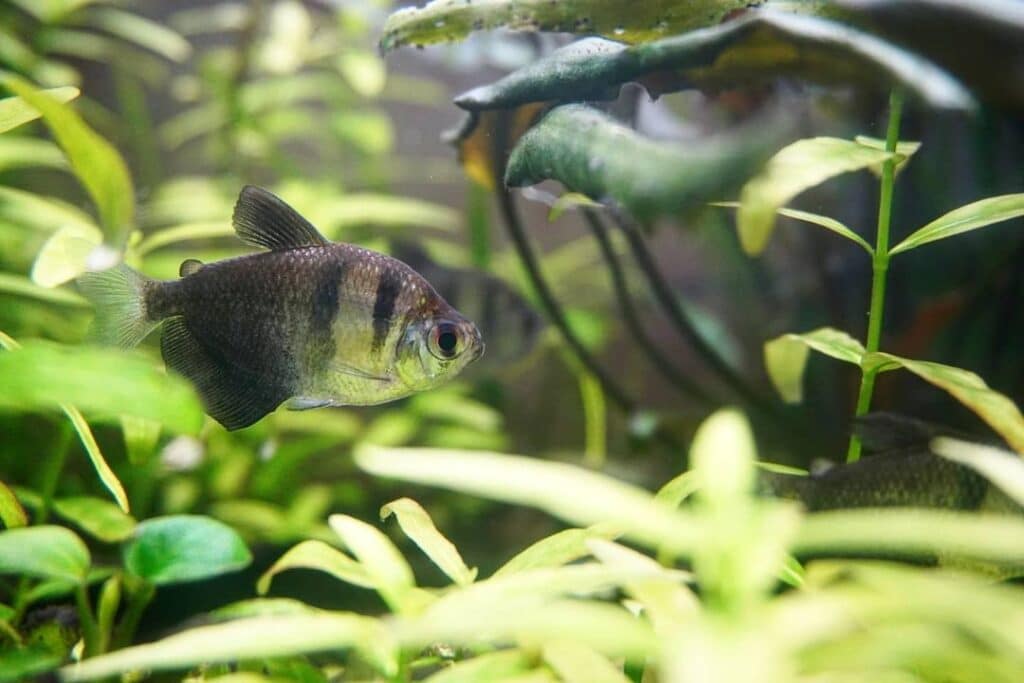
Black skirt tetras grow to about 5 to 6 cm (2 to 2.5 inches) long. Their bodies are tall and flattened from side to side, almost diamond-shaped. They are silvery gray, getting darker toward the tail, and have two dark vertical bars just behind the gills.
Their most famous features are the large black dorsal fin on the back and the wide, dark anal fin underneath, which together make the “skirt.” Young adults, at around a year old, have the boldest colors. As the fish get older, the black slowly fades to a silvery gray.
Black skirt tetras belong to the characin family (Characidae), the same big family as many other tetras.
Telling Males and Females Apart
It takes a sharp eye, but there are clues. Females are usually rounder and plumper in the belly, especially when carrying eggs. Males are slimmer, with a slightly more pointed dorsal fin and a broader anal fin. Some males also show small white spots on the tail fin.
Long Fins and Color Varieties
Breeders have produced long-finned black skirt tetras as well as white, “albino,” and brightly colored types. Some colorful fish are genetically bred, but others have been artificially dyed or injected with color. Dyeing is stressful and harmful to the fish, so it is best to avoid buying dyed tetras.
Habitat and Range
In the wild, black skirt tetras live in the Paraguay and Guapore river basins of South America, in parts of Brazil, Bolivia, Paraguay, and Argentina. These are warm, subtropical waters, usually between about 20 and 26°C (68 and 79°F).
They are mostly found in the middle and upper layers of slow streams and quiet waters with lots of plants. People have also released them into the wild in a few other countries, such as Colombia, where they are not native.
What Do They Eat?
In nature, black skirt tetras are omnivores that mostly eat meat. They feed on tiny worms, small crustaceans, and insects, plus a little plant material and algae.
In an aquarium, they are happy eaters and will take almost any food. A good, high-quality tropical flake should be the main meal, with treats such as frozen or live brine shrimp, bloodworms, and some spirulina or other plant-based food for variety.
Keeping Black Skirt Tetras at Home
Because they are tough and easygoing, black skirt tetras are a great fish for beginners. The most important rule is that they must live in a group.
Tank Size and Setup
Keep at least six black skirt tetras together. Alone or in tiny groups, they become stressed and shy, hide a lot, and are more likely to get sick. A tank at least 60 cm (24 inches) long that holds 15 to 20 gallons (about 60 to 75 liters) or more gives a small school room to swim.
Black skirt tetras are active swimmers, so give them open water in the middle of the tank, with plenty of plants around the sides and back. A dark gravel or sand bottom and soft lighting help their colors look their best. Always use a lid, because these fish are good jumpers!
For a natural “biotope” look, copy a South American stream: use river sand, driftwood, and twisted roots, and add a few dried leaves (such as Indian almond leaves) to tint the water a light tea color. Replace the leaves every few weeks.
Water Conditions
Keep the water between about 20 and 26°C (68 and 79°F), with a pH of 6 to 8 and soft to moderately hard water (about 5 to 19 dGH). Black skirt tetras can handle a range of conditions, but sudden changes are stressful, so make changes slowly and do regular partial water changes.
Tank Mates
Black skirt tetras are generally peaceful and do well with other calm fish of a similar size. However, they can be fin nippers, especially in small groups. It is best not to keep them with slow fish that have long, flowing fins, such as bettas or angelfish. Keeping a bigger school usually makes them less nippy, because they spend more energy chasing each other.
Breeding
Black skirt tetras are egg scatterers. To breed them, set up a separate breeding tank with lots of fine-leaved plants or spawning mops. The female scatters her eggs among the plants, and a male fertilizes them. During spawning, males may guard a small area.
The parents will eat their own eggs, so take them out right after spawning. The eggs usually hatch in about a day. Feed the tiny fry very small foods such as infusoria or a powdered egg yolk mix at first, then newly hatched brine shrimp, moving to larger foods as they grow.
Black skirt tetra FAQs
How big do black skirt tetras get?
Black skirt tetras grow to about 6 cm (2.5 inches) long.
What do black skirt tetras eat?
In nature they mostly eat tiny worms, insects and crustaceans, plus a little algae and plant matter. In a tank they accept flakes, frozen and live foods.
How many black skirt tetras should I keep together?
Keep at least five or six. Lone fish or very small groups get stressed, hide a lot and are more likely to get sick.
Where do black skirt tetras come from?
They come from river basins in southern Brazil, Paraguay, Bolivia and Argentina.
Do black skirt tetras jump?
Yes, they are expert jumpers, so the aquarium needs a secure cover. They are also strong swimmers and need open space as well as plants.

Randi Jones is the owner and founder of the Nature Gift Store, an online retailer specializing in nature-themed gifts, educational science projects, live animal nature kits and real butterfly artwork. A biology graduate who fell in love with insects, she founded the company in 2001 to make active learning about nature fun, accessible and engaging for children and adults. Her store offers real butterfly frames, home and garden decor and educational live animal kits, including ant farms, worm farms, tadpoles, ladybugs and hermit crabs, and she runs a bug museum in Washington featuring live animals like Eddie the Iguana alongside other reptiles and insects.