Different Types of Turtles

Very few people seem to know the fact that there are about 350 species of turtles found all across the globe. On the basis of their physical structures and behaviors, you can classify them into several categories.
How Many Types of Turtles Are There?
There are about 350 living species of turtles and tortoises, grouped into 14 families in the order Testudines. The main types are sea turtles, tortoises, pond and box turtles, snapping turtles, softshell turtles, mud and musk turtles, and side-necked turtles, which fold their heads sideways instead of pulling them straight back.
Largest and Smallest Turtle Species
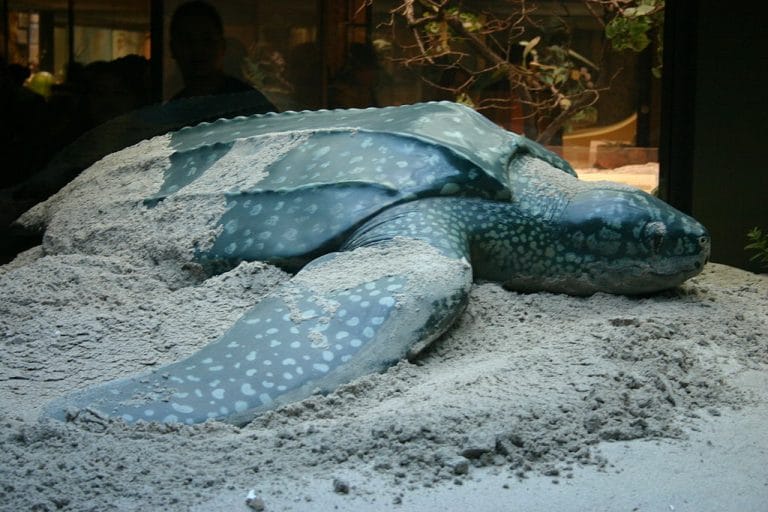
Of all the types, the largest turtle in the world is the leatherback sea turtle, growing up to about 6.6 ft long and, in rare cases, weighing about 2,000 lbs, while the smallest turtle has an average length of 3.1 inches and weighs around 5 Oz is the speckled padloper tortoise.
It is evident from this huge difference between the smallest and the largest species of turtle, that there is a huge incongruity in the reptilian families. With the passage of time, the evolution of the species has occurred, resulting in more diversity among the turtles, each having its own unique characteristics.
There are even more than 300 types of turtles because most people come to know only about the reptiles that are in the pet trade.
The fossil records show that reptiles have existed on Earth for more than 200 million years. Given below is a small portion of the facts and evidence about some species of turtle.
Turtle or Tortoise- Difference

Many people seem to be confused with the apt usages of the terms “turtle” and” tortoise “. To put it in a simple manner, the term “turtle” applies to the members of the reptilian family that reside in Oceans and fresh water, while they call those thriving on land as “tortoises.” However, the main reason for the confusion is due to language interpretations. In British English, the term ‘turtle’ refers to those reptiles residing mainly in the sea, and ‘tortoise’ refers to the ones inhabiting in the land, while in American English, ‘turtle’ is a general term coined for all the species belonging to this family; and the species thriving in the sea are more specifically mentioned as ‘sea turtles‘.
Classification of Turtles
Two Suborders
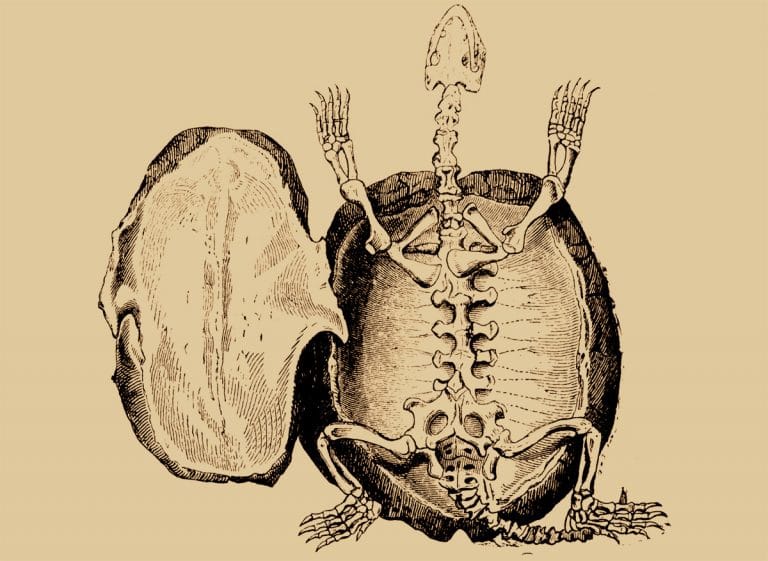
Turtles are the reptiles coming from the Testudines order, which you can further divide into fourteen families, altogether about 97 genera of the species reptiles.
The fourteen families can be further subdivided into two suborders:
Testudines Order
Suborder
Cryptodira (11 families)
Cheloniidae
Chelydridae
Dermatemydidae
Dermochelyidae
Emydidae
Geoemydidae
Kinosternidae
Platysternidae
Testudinidae
Trionychidae
Pleurodira (3 families)
Chelidae
Pelomedusidae
Podocnemididae
Cryptodira (consisting 11 families)
Those turtles belonging to the Cryptodira sub-order have the characteristic ability to retract their head into the shell. Here is a description of each of the 11 families with a brief representative description of one sample turtle from each family.
1. Carettochelyidae
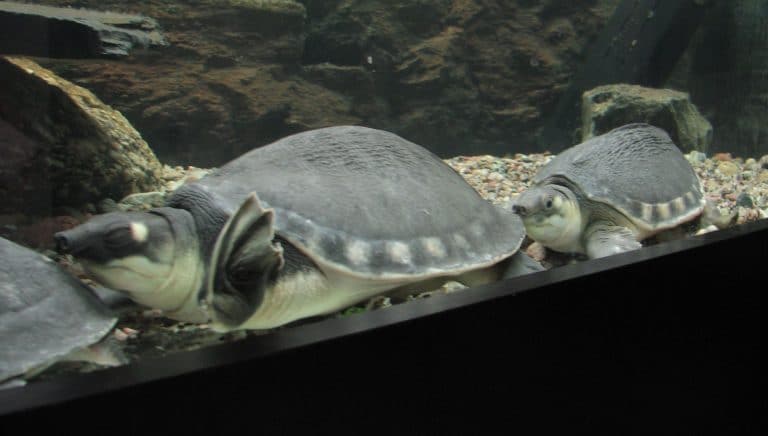
Carettochelys insculpta or pig-nosed turtle, Fly River turtle or pitted-shelled turtle is the only living species of the family Carettochelyidae, subfamily Carettochelyinae. You find these turtles in south of New Guinea and Northern Australia.
Description of Pig-Nosed Turtle (Carettochelys insculpta)

Carettochelys insculpta or the pig-nosed turtle live mainly in the Southern part of New Guinea and Northern Australia. These turtles are almost entirely aquatic and there is not much information on them.
2. Cheloniidae
Belonging to the Chelonioidea super family, the Cheloniidae are a family of sea turtles including:
Caretta Caretta or Loggerhead sea turtle
Lepidochelys olivacea or the Olive Ridley
Lepidochelys-kempii or Ridleys sea turtles (Kemp’s)
Chelonia mydas or Green sea faring turtle
Description of Lepidochelys Olivacea or the Olive Ridley Sea-Turtle

Among the smallest sea turtles existing, the Olive Ridley got its name from the Olive color of its shell. These adult turtles reach a length of between 2 and 2½ feet and can weigh between 80 to 110 pounds. The very high number of vertebral costal scutes (6 to 9 pairs) identifies this species. Some people call this turtle as a Pacific version of the Sea Turtle. You can find these turtles in the typically warm tropical waters of the Indian and Pacific Oceans
Description of the Green Sea Turtle (Chelonia mydas)

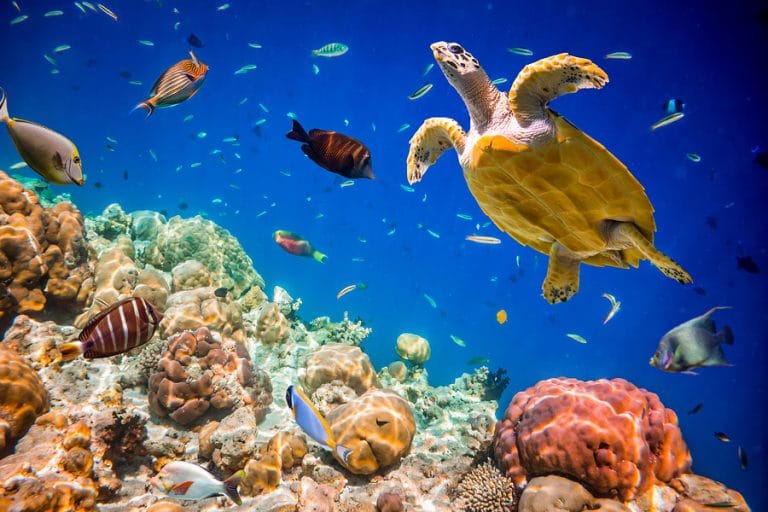
The Green Sea Turtles are distinct because they have only a single pair of prefrontal scales unlike other sea turtles that have two pairs in front of their eyes. These Turtles also go by name Black Sea Turtle and have a serrated jaw in a small blunt head. Its body is flat and oval. The plastron varies from between white and yellow and has pale yellow, deep yellow to green and brown colors that accentuate the stripes on the body.
3. Chelydridae
This includes a family of freshwater turtles with only two living genera that are widespread in the Western Hemisphere and include:
Chelydra, the snapping turtle
Macrochelys. (Includes the Alligator snapping turtle)
Description of Chelydra, the Snapping Turtle

The ordinary snapping turtle (Chelydra serpentina) belongs to the family of Chelydridae and is a large fresh water turtle. In nature, their range extends southwest of the boundary of Rocky Mountains to the southeast of Canada and faraway east of Nova Scotia and Florida. The snapping turtle also possesses a shell or carapace that encloses their back just like other turtles. The shell length of the snapping turtle is usually between 8 and 18 inches. The array of color of their shell ranges from deep brown to tan or even black. In the course of its growth, the shell of the snapping turtle receives an algae and mud coating. The tail length of the snapping turtle is equal to the length of its shell; a sharp ridge running right through its length. Its head is dark in color, while its tail, legs and neck have a yellow hue. Its mouth has a beak shape, and it is bony, strong and toothless. The snapping turtle has a rough skin having distinctive bumps on their legs and necks named tubercles. They have webbed feet with sturdy claws. A plastron that is a hard plate covers the stomach of turtles. The plastron of the snapping turtle being small, you can see much of its body.
4. Dermatemydidae
It was John Edward Gray in 1870 who named this family of river turtles whose only living genus is Dermatemys or the Central American River Turtle
Description of Dermatemys

This is a Central American River Turtle, or Dermatemys mawii, the Mesoamerican river turtle with a local nickname Tortuga Blanca or “Hickatee.” This represents the only extant (living) species of the Dermatemydidae family. This is an aquatic nocturnal turtle mainly inhabiting larger lakes and rivers of Central America, and you find them spread over from the South of Mexico to the North of the Honduras. Due to heavy exploitation, the IUCN has classified them in the list of critically endangered animals.
5. Dermochelyidae
Most of this family of sea turtles is extinct. The sole living genus includes the leatherback sea turtle, Dermochelys coriacea, that includes the largest living sea turtles in the world
6. Emydidae
You find them widespread in the Western Hemisphere and they number about 10 genera and 50 species except for 2 species of pond turtles
Description of the Western Pond Turtle
(Actinemys Marmorata or Emys Marmorata)

These turtles belonging to the family Emydidae also go by the name or Pacific pond turtle. They are of medium size and grow up to about 8 inches (20 cm). They mainly inhabit the West coast of Mexico and America from Western Washington to Northern Baja California. The carapace of the turtle is dull olive or brown and the plastron has blotches on a yellow skin.
7. Geoemydidae
The Geoemydidae are an extremely large and diverse family of turtles with about 70 species belonging to the order of the Testudines or the Chelonii that have a characteristic special cartilaginous or bony shell evolved from their ribs to act as a shield. This family includes the Neotropical wood turtles and the Eurasian pond and river turtles.
8. Kinosternidae
Consisting of four genera that includes 25 species, these turtles are mostly small and include the musk turtles and the mud turtles
Description of Musk Turtles

Musk turtle belongs to the species of Sternotherus odoratus of a small group inhabiting southeastern provinces of Canada and most of the regions of the Eastern parts of the United States. “Stinkpot,” is another name as it gives out a musky foul smell from the scent glands that you find on the rim of its carapace, perhaps to drive away the predators. The name stinkpot signifies the tiny glands that are under the edge of its shell that emits for self-defense, a foul smelling musk. While in captivity these turtles do not do this often. However, it is not a problem regarding hygiene. (Your house will not smell bad for keeping one)
The habitation of common musk turtle is always where there are water bodies like shallow, clear water lakes, rivulets, ponds, lakes or rivers; you can hardly find these turtles anywhere else. When they are in the water, these turtles remain in the shallow portion of the water body. At times we find them basking on the overhanging branches of trees above the water or submerged fallen tree trunks.
Stinkpot or musk turtles have high dome shaped shells, small in size, brown, gray or black in color. Their length is almost 5.1 to 14cm (2.0 to 5.5”) and their aggregate weight is 603gm (1.329lb). Their legs are short and they have long necks
9. Platysternidae
Found in Southern China and Southeast Asia, this includes big-headed turtle (Platysternon megacephalum)
Description of The Big-Headed Turtle
(Platysternon Megacephalum)

Peculiarly, this big-headed turtle uses its tail to enhance the reach of its claws to climb over obstacles in fast streams and rivers. Its beak assists in climbing bushes and trees. They occasionally use the tail like a scorpion’s arch. Because it cannot pull its head into the shell, it defends itself by using its powerful jaws. For food it eats fish and snails.
10. Testudinidae
This is a family of land reptiles and includes the Aldabrachelys gigantean or the Aldabra giant tortoise
Description of Aldabrachelys gigantean or the Aldabra giant tortoise

These are giant land tortoises living in the Seychelles in the Aldabra Atoll. They are about the bigger world tortoises, for which reason people refer to them as gigantic Aldabrachelys. They have a high domed carapace with a tan or brown color, heavily scaled stout and strong limbs to support its weight and a very long neck that can eat leaves from the branches of trees at one meter from the ground surface. Their size averages around 4 feet (120 cm) and a male will weigh about 550 pounds or (250kg), with the females slightly smaller with a carapace size of 35 inches of 90 cm and weighing about 330 pounds or (150 kg)
11.Trionychidae
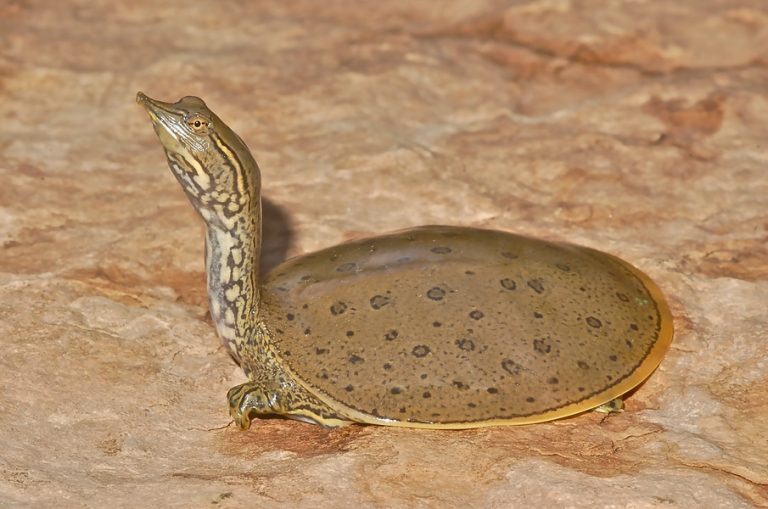
The Softshells or Pancake turtles belong to this taxonomic family. The soft shells are some of the largest fresh water turtles in the world, but they can adapt to highly brackish areas and belong mainly to Asia, Africa and North America
Description of the Florida Softshell turtle
((Apalone ferox) ) is a type of soft shell turtle

The Florida Softshell turtle (Apalone ferox) is a type of a soft shell turtle whose habitat is the Southeastern United States. The typical characteristic of the Florida Softshell turtle is that its carapace color is deep brown fading to olive green. The color of its belly is cream or white. The carapace conceals and shields the juvenile turtles from their predators. They have stout tails. Their tails, legs and head are more or less of the same color. Running through from the rear of the eye all along their neck is an orange or cream line with a black border. Both the male and female have on their shell blotches, streaks or dark spots. The infant smooth Softshell turtles have olive, black or brown colored shells, with many stains. In appearance, they are like spiny Softshell turtles.
The habitat of the smooth Softshell turtles is South-central and central parts of the United States. They spread over from Pennsylvania to New Mexico and south of the Florida panhandle. Simply put, their habitat is North America.
Peurodira (consisting of 3 families)
1. Chelidae
Belonging to the suborder of Pleurodira, the Chelidae live throughout South America, parts of Indonesia, New Guinea and Australia. Most people refer to these turtles as the Austro-South American side-neck turtles. A famous example of these turtles is Chelus fimbriatus or the Mata mata freshwater turtle endemic to the Amazon and Orinoco basins in South America. It is the only living species belonging to the genus Chelus.
Description of Chelus Fimbriatus or the Mata Mata freshwater turtle

The full-grown mata mata turtle weighs 15kg (33lb), and has a life span of 40-75 years. These sedentary turtles are large. The head with many flaps of skin and tubercles is flat and triangular. The snout tubular and manifests in a long form with a “horn”. A mature Mata mata has an oblong carapace that is either brown or black.
2. Pelomedusidae
These are a family of round shaped fresh water turtles that inhabit Southern and Eastern Africa, and have a size range of 12 to 45 cm (4.7 to 17.7 inches). These turtles cannot withdraw their heads into their shells, and instead, have to fold them beneath the upper edge of their shells, for which reason people refer to them as African Side-Necked Turtles, an example of which is African Helmeted Turtle (Pelomedusa subrufa)
Description of African Helmeted Turtle
(Pelomedusa subrufa)

This omnivorous side-necked turtle goes also by the name of Crocodile turtle or marsh turtle. You can find them mostly in stagnant and freshwater bodies. They inhabit most of Africa and southern Yemen. These are rather small turtles with a carapace length of up to 20 cm. They have a yellowish under side while the tops of the limbs and tail have a grayish brown color.
3. Podocnemididae
These side necked turtles belonging to the suborder Peurodira inhabit northern South America and Madagascar. They are all aquatic and inhabit flowing water and streams. Their streamlined shells aid in swimming. A classic example of this family is Podocnemis unifilis or the Yellow-spotted River Turtle
Description of the Yellow-spotted River Turtle
(Podocnemis unifilis)

The Turtle (Podocnemis unifilis) is one of the larger river turtles inhabiting South America. It can attain a length 45 cm and an eight kg weight. The brown or black upper shell (carapace) and the yellow spots on the lateral sides of the head (that account for its “spotted” name), distinguish this turtle. You will find these side-necked-turtles in the Amazon Basins of South American lakes and tributaries. They feed mainly on small invertebrates, fish weeds and fruits during the flood season.
Various Turtle Types
Sea Turtles
Sea turtles belong to the families Dermochelyidae and Cheloniidae that account for 7 living species of these marine reptilian animals. You can find sea turtles in all the World oceans except the Arctic Ocean. When you think “turtles” these are the species that come to mind. Their division is as given under:
Dermochelyidae family-One monotypic genera only (non family member- leatherback sea turtle
Cheloniidae family- polytypic genera (1) + monotypic genera (4)
True Tortoises
True Tortoises belong to the family Testudinidae and covers all the land based species of these reptiles. They undergo a further sub-division into 2 subfamilies is as follows
Testudininae – 38 species
Xerobatinae – 6 species
Aldabra Giant Tortoise
These 44 living species represent the entirety of the true tortoise population on the earth, showing the great diversity of this family of turtles. An extremely popular associate of the turtle family is the Aldabra giant tortoise that many acknowledge as the largest of the species in the world.
Snapping Turtles
Belonging to the Chelydridae family, snapping turtles, in the monotypic-genera consist of two species-the “Common” and the “alligator” types. These turtles spread abundantly across South and North America
Mud Turtles and Musk Turtles
Mud and Musk turtles belong to family Kinosternidae and are small animals. Though consensus on the classification is not available in the case of these turtles, most expert group them as 25 living species under four genera. These species of turtles live in the muddy bottoms of stagnant or slow moving water bodies and release a foul smelling odor that gives them the title, “Musk Turtles.”
Softshell Turtles
The Trionychidae family includes what the experts call Softshells or the Softshell turtles. Their distinct characteristics include a carapace with a hard center and leathery edges without the customary horny scales, the sole exception being the spiny Softshell, exhibiting scaly projections on its carapace. These turtles are found in North America, Africa and Asia and consist of 2 sub-families (Trionychinae and Cyclanorbinae) that include 13 living turtle genera.
Central American River Turtles
The family Dermatemydidae has only one survivor and that is the Central American river turtle that inhabits the Central American rivers. IUCN or the International Union for Conservation of Nature that is the largest and oldest world environmental organization has included this turtle in the list of endangered species. Similar to the impending extinction of the pig nosed turtle, when the Central American river turtles cease to exist, it will result in the total extinction of the entire family Dermatemydidae forever.
Side-necked Turtles
Side-necked turtles, have this special distinction of turning their neck towards the side and tucking their head into a hollow close to their anterior legs, and do not retract it inside the shell. These turtles normally inhabit the earth’s southern hemisphere. The geographical range of these turtles classifies them into 2 families- “Chelidae,” that includes the side-necked turtles of extant side-necked turtle species are further classified into two families based on their geographical range – family Chelidae, which comprises side-necked turtles (Austro-American), and the Pelomedusidae family, comprising:
The American side-neck river turtles
The Madagascan big-headed turtles
The African side-neck turtles
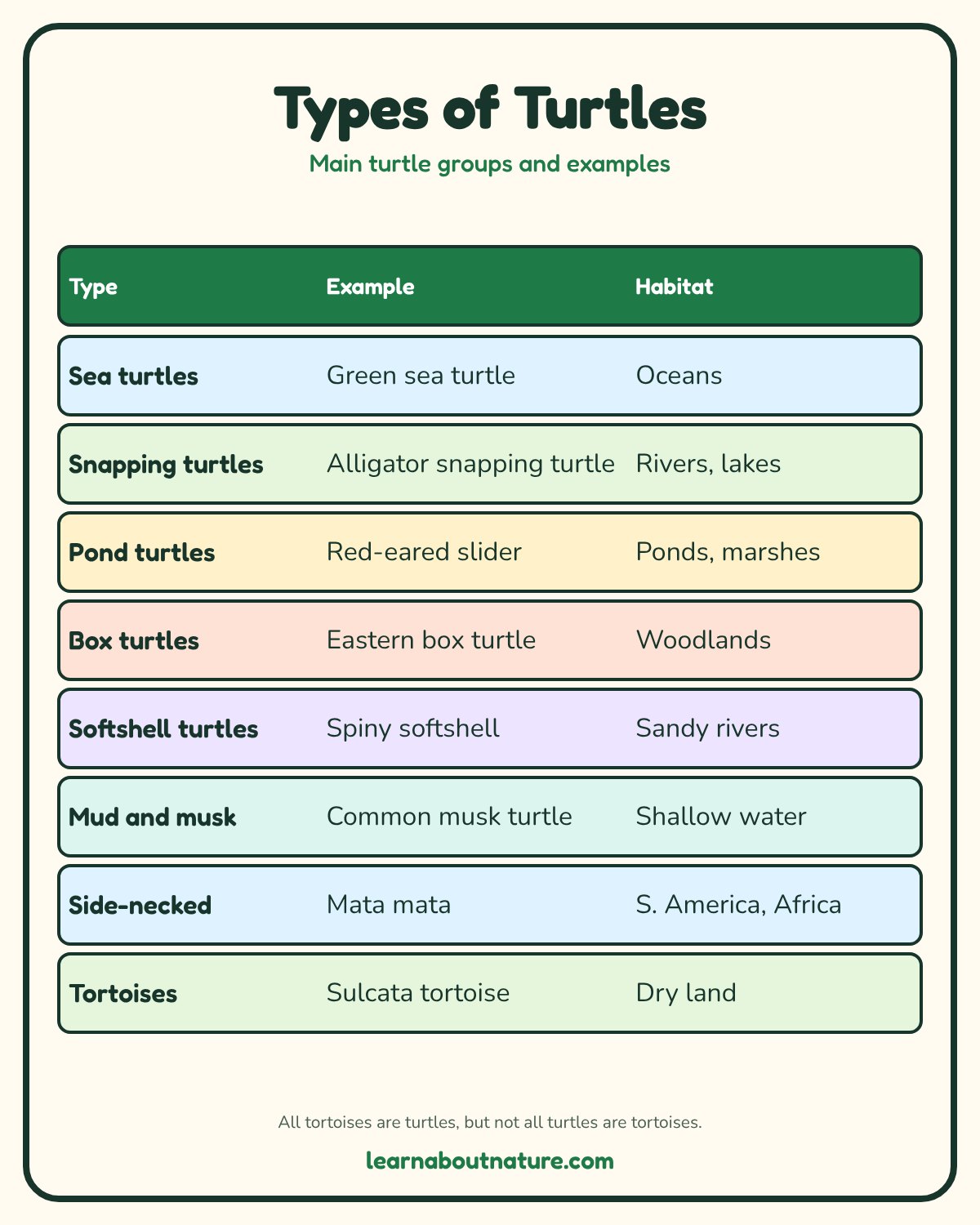
Main Types of Turtles at a Glance
With so many families, it helps to group turtles by where and how they live. This table shows the main types you are most likely to read about or see.
| Type | Family | Where they live | Examples |
|---|---|---|---|
| Sea turtles | Cheloniidae, Dermochelyidae | Oceans worldwide | Green, loggerhead, leatherback, hawksbill |
| Tortoises | Testudinidae | On land, often dry areas | Galapagos, Aldabra, desert, Greek tortoise |
| Pond, box and slider turtles | Emydidae | Ponds, rivers, woods in the Americas and Europe | Red-eared slider, painted turtle, box turtle |
| Asian river and wood turtles | Geoemydidae | Asia, Europe, Central and South America | Asian box turtles, Reeve’s turtle |
| Snapping turtles | Chelydridae | Freshwater in the Americas | Common and alligator snapping turtles |
| Mud and musk turtles | Kinosternidae | Shallow, slow water in the Americas | Common musk turtle, eastern mud turtle |
| Softshell turtles | Trionychidae | Rivers and lakes in Asia, Africa, North America | Spiny softshell, Chinese softshell |
| Side-necked turtles | Chelidae, Pelomedusidae, Podocnemididae | Southern Hemisphere freshwater | Mata mata, African helmeted turtle |
A few unusual families contain just one living species, such as the pig-nosed turtle, the big-headed turtle and the Central American river turtle.
Types of Pet Turtles
Only a small number of turtle species are commonly kept as pets. Each needs very different care, and most live for decades, so it is important to research a species before bringing one home.
- Red-eared slider. The most common pet turtle. It needs a large tank with clean water, a basking spot and UVB lighting, and can live 30 years or more. Released pets have become invasive in many countries.
- Painted turtle. A colourful North American pond turtle with similar needs to sliders.
- Musk and mud turtles. Small turtles that suit smaller tanks and spend most of their time walking on the bottom.
- Box turtles. Mostly land-living turtles that need a humid enclosure or outdoor pen rather than a deep tank.
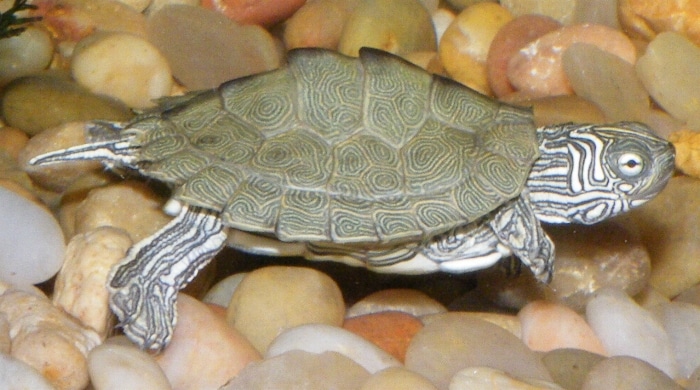
- Map turtles. Active swimmers that need very clean water.
- Tortoises. Species such as the Russian, Hermann’s and Greek tortoise need a dry, warm enclosure and a plant-based diet. Large tortoises like sulcatas grow far too big for most homes.
Many places have laws about which turtles can be kept, and wild turtles should never be taken from nature. Turtles can carry Salmonella bacteria, so always wash your hands after handling them.
How to Identify a Turtle
To work out what kind of turtle you are looking at, check a few key features in order:
- Feet. Flippers mean a sea turtle. Thick, stumpy, elephant-like legs mean a tortoise. Webbed feet with claws mean a freshwater turtle.
- Shell shape. A high dome usually means a tortoise or box turtle. A flat, smooth shell suits swimming turtles. A flat, rubbery pancake-like shell means a softshell.
- How it hides its head. Turtles that pull the head straight back are Cryptodira. Those that fold the neck sideways under the shell edge are side-necked turtles.
- Plastron. A small, cross-shaped underside suggests a snapping or musk turtle. A hinged plastron that closes like a box means a box turtle.
- Head and markings. Look for features such as a red stripe behind the eye (red-eared slider), yellow spots (spotted or yellow-spotted turtles) or a hooked beak (hawksbill).
- Location. Where you found it is often the biggest clue, since most turtles have limited ranges.
If you find a turtle crossing a road, it is usually best to move it in the direction it was heading, if it is safe to do so.
Why Many Turtle Types Are Endangered
Turtles are among the most threatened groups of animals. More than half of all turtle and tortoise species are considered threatened with extinction, a higher share than for birds or mammals.
- Wildlife trade. Many Asian turtles are collected for food, traditional medicine and the pet trade.
- Habitat loss. Wetlands are drained, rivers are dammed and nesting beaches are built on.
- Slow life cycles. Many turtles take 10 to 20 years or more to reach breeding age and few eggs survive, so populations recover slowly.
- Bycatch. Sea turtles drown in fishing nets and on hooks.
- Pollution. Plastic bags and other litter can be swallowed, especially by sea turtles that mistake them for jellyfish.
- Road deaths and predators. Females crossing roads to nest are often killed, and raccoons, foxes and dogs dig up eggs.
You can help by never buying wild-caught turtles, keeping beaches dark and clean during nesting season, picking up litter and supporting local wetland protection. Some species, such as the Central American river turtle and many Asian box turtles, are critically endangered.
Turtle Types FAQs
How many species of turtles are there?
There are roughly 350 living species of turtles and tortoises, all in the order Testudines. They are grouped into about 14 families and two suborders: Cryptodira, which pull their heads straight back into the shell, and Pleurodira, the side-necked turtles, which tuck their heads sideways.
What is the difference between a turtle and a tortoise?
All tortoises are turtles, but not all turtles are tortoises. Tortoises live on land, with domed shells and sturdy, elephant-like legs. Other turtles spend much of their lives in water, with flatter shells and webbed feet or flippers. Usage also differs between British and American English.
What is the largest turtle in the world?
The leatherback sea turtle is the largest living turtle. Adults can be over 2 metres long and weigh several hundred kilograms, with some reaching more than 600 kilograms. Instead of a hard shell, it has leathery skin over a flexible layer of small bones.
What is the smallest turtle?
The speckled padloper tortoise of South Africa is generally considered the smallest turtle in the world. Adults usually have shells only around 6 to 10 centimetres long. It lives in rocky areas and shelters in crevices to hide from predators.
What are side-necked turtles?
Side-necked turtles belong to the suborder Pleurodira. Instead of pulling their heads straight back into the shell, they bend their neck sideways and tuck the head under the edge of the shell. They live in the Southern Hemisphere, in South America, Africa, Madagascar and Australasia.

Randi Jones is the owner and founder of the Nature Gift Store, an online retailer specializing in nature-themed gifts, educational science projects, live animal nature kits and real butterfly artwork. A biology graduate who fell in love with insects, she founded the company in 2001 to make active learning about nature fun, accessible and engaging for children and adults. Her store offers real butterfly frames, home and garden decor and educational live animal kits, including ant farms, worm farms, tadpoles, ladybugs and hermit crabs, and she runs a bug museum in Washington featuring live animals like Eddie the Iguana alongside other reptiles and insects. Randi wrote most of the guides on this site. They first appeared on her long-running nature sites, including Monarch-Butterfly.com, Ladybug-Life-Cycle.com, Frog-Life-Cycle.com, Dragonfly-Site.com and Butterfly Pictures, which have now been brought together here at Learn About Nature.