Snake Charmer
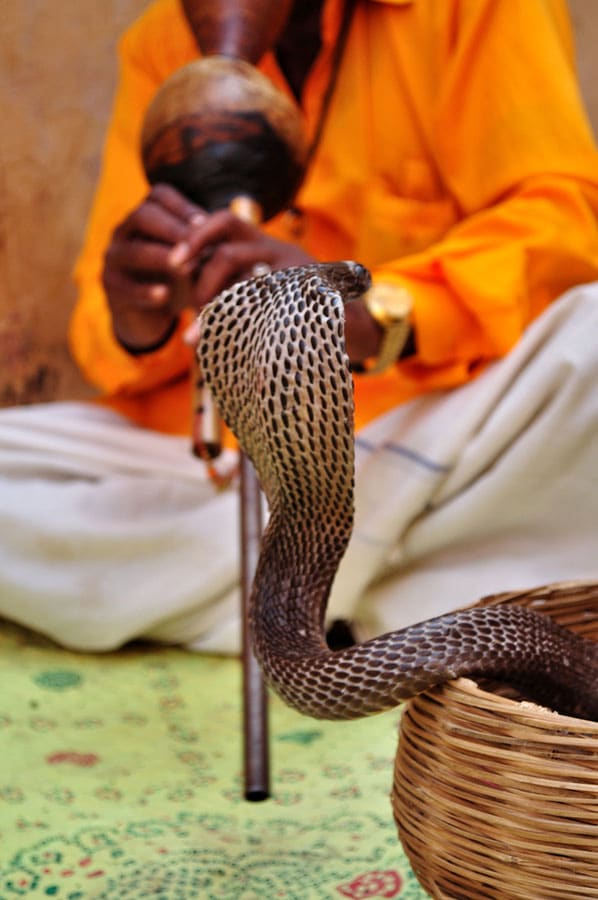
At some time or the other, when we see the snake charmer sitting with crossed legs, blowing his flute, it makes us awestruck, as at that time, his venomous cobra, wakes up from the basket and spreads wide its puffed-up hood, rocks its hood hither and thither in tune with the music. The snake charmer song has captivated and hypnotized snakes and the audience for centuries. The first snake charmers originated in early Egypt. Actually, the snake is deaf and reacts more to the sense of the movement of the flute-like instrument.
The act of pretending to spellbind or hypnotize a snake by playing a musical device known as the pungi is called snake charming. This includes characteristic acts like holding a snake or doing other noticeable risky performances and also several other acts on the street, such as hand tricks and juggling. It is in India that we usually see this, even though you can also see performers in nations in Asia like Bangladesh, Thailand, Pakistan, Malaysia, and Sri Lanka, just like the North African countries of Tunisia, Morocco, and Egypt.
Earlier Egypt practiced snake charming in some form or other, but the practice of snake charming we see today started in India. It ultimately reached all over Southeast Asia, North Africa and the Middle East. In spite of the some kind of golden age celebration in the 20th century, today snake charming is in extinction. This accounts for several factors, mainly the current enforcement order of 1972 that banned owning snakes. Against this, the snake charmers recently joined together and objected the loss of their only source of income, for which the government made certain proposals to them.
History

One of the first mention about the snake charmer appeared in the Bible, Psalm (58:3-5): The wicked turn aside from birth; liars go astray as soon as they are born. Their venom is like that of a snake, like a deaf serpent that does not hear, that does not respond to the magicians or to a skilled snake-charmer.
The snake charming that we see today, perhaps had its origin in India, Hinduism, considered serpents sacred; they believed that animals had a relationship with the Nagas, and several pictures of gods portray cobras protecting them. Therefore the Indian people consider snake charmers as sacred.
The foremost snake charmers were more of customary healers by profession. In the course of their training, they studied how to heal snake bites. Most of them studied the perfect way to handle snakes, and they were invited to take off the serpents from their homes. Baba Gulabgir (or Gulabgarnath) was made their teacher, because legend mentions that his teachings were to respect and not to get scared of reptiles. This practice ultimately extended to close-by regions, and finally reached Southeast Asia and North Africa.
Snake Charming Techniques
Snake charmers in particular stroll the roads with the serpents held either in pots hanging from a bamboo pole slinging over their shoulder or in baskets. In between performances, they wrap the container with a cloth. The costume in Pakistan and India and nearby countries is usually the very long hair, earrings, white turban and necklaces of beads or shells. The moment the charmer locates a suitable place to settle, he lays his baskets and pots beside him. He then sits on the ground crossing his legs with the closed basket or pot in front of him, uncovers the basket or pot and blows an instrument resembling a flute manufactured from gourd shell called a pungi. As though attracted by the tune, the snake ultimately comes out of the basket or pot; In case it is a cobra, there is a chance for it to bring out its hood.
Safety Measures
When the snake charmer is at home, he keeps the snakes in closed enclosures like pots, baskets or sacks. Prior to taking them in front of people, he trains them. The charmers, who do not de-fang their pets, put the snake in a hard vessel like the pungi. Here the snake understands that when it strikes an object, it gets painful. Sometimes he removes the snake’s fangs. By this, it does not mean it is harmless: because the poison emerging from the wounds that remain after removal of the teeth that conducts venom, are liable to circulate. Still, the belief is that this type of snakes does not bite, and if they do so, the danger is very much less. The Hindu knows well that his cobra is used to being teased and handling, it dances with little enthusiasm; thus he reserves some fresh serpents with him.”
For the sake of safety, the charmers of Northern Africa sew closed the mouth of the snake that is performing, providing limited gap for the snake to make movement of its tongue in and out. This is because the audience belonging to that area, particularly believes that the snakes can bring out the venom through its tongue and not its fangs, they are convinced observing the snake tongues shine unsteadily through the gap. The reverse effect on the snake is that they die due to mouth infection or starvation, where new snakes need to be substituted.
Snakes are cold-blooded reptiles; and rely on the surrounding temperature to maintain their warmth. Scientists opine that the temperature in the tropics of Colombia were at a time warmer by 10 degrees when compared to today.
Jack Conrad, a specialist of snakes from the American Museum of Natural History, made a remark on Titanoboa as follows: “This snake is of weight that exceeds that of a bison and its length exceeds that of a city bus. It is capable of consuming anything as big as a cow. A person will be an instant toast”
Lifestyle

The profession of snake charming is hereditary. Therefore, those planning to practice this profession start their training at the very early stage from their fathers. In 2007 a corrupting influence of a video brought out headlines of an infant handling a de-fanged cobra. Snake charmers belonging to the association of the Sapuakela or Sapera castes, have no other option other than this profession. Actually the whole settlers of snake charmers and their families originate from certain portions of India and adjacent countries in Bangladesh. They particularly come from the nomadic ethnic family Bede. They most probably reside adjacent to rivers and travel by boat to other cities during festivals and on market days.
Snake charmers of North Africa normally settle in souks and open-air markets for performing. In the main tourist places and in coastal resorts, you can observe charmers preparing food for the tourists, but in many other places they play snake charming for the local audiences; A main source of income is selling pamphlets of magic related cures for snake bite.
However, now in India, snake charmers have been given a new lease of life, that of supplying snakes to vaccine collection centers, like those promoted by the famous Whitaker in South India. They collect the poisonous snakes in the wild, bring them to the centers for venom extraction and leave them back in the wild for rejuvenation and recollection another day. This has helped the community of snake charmers to make good money as the prospects of their earlier profession are on the decline.
Snake Charming FAQs
Do snakes really respond to the snake charmer’s music?
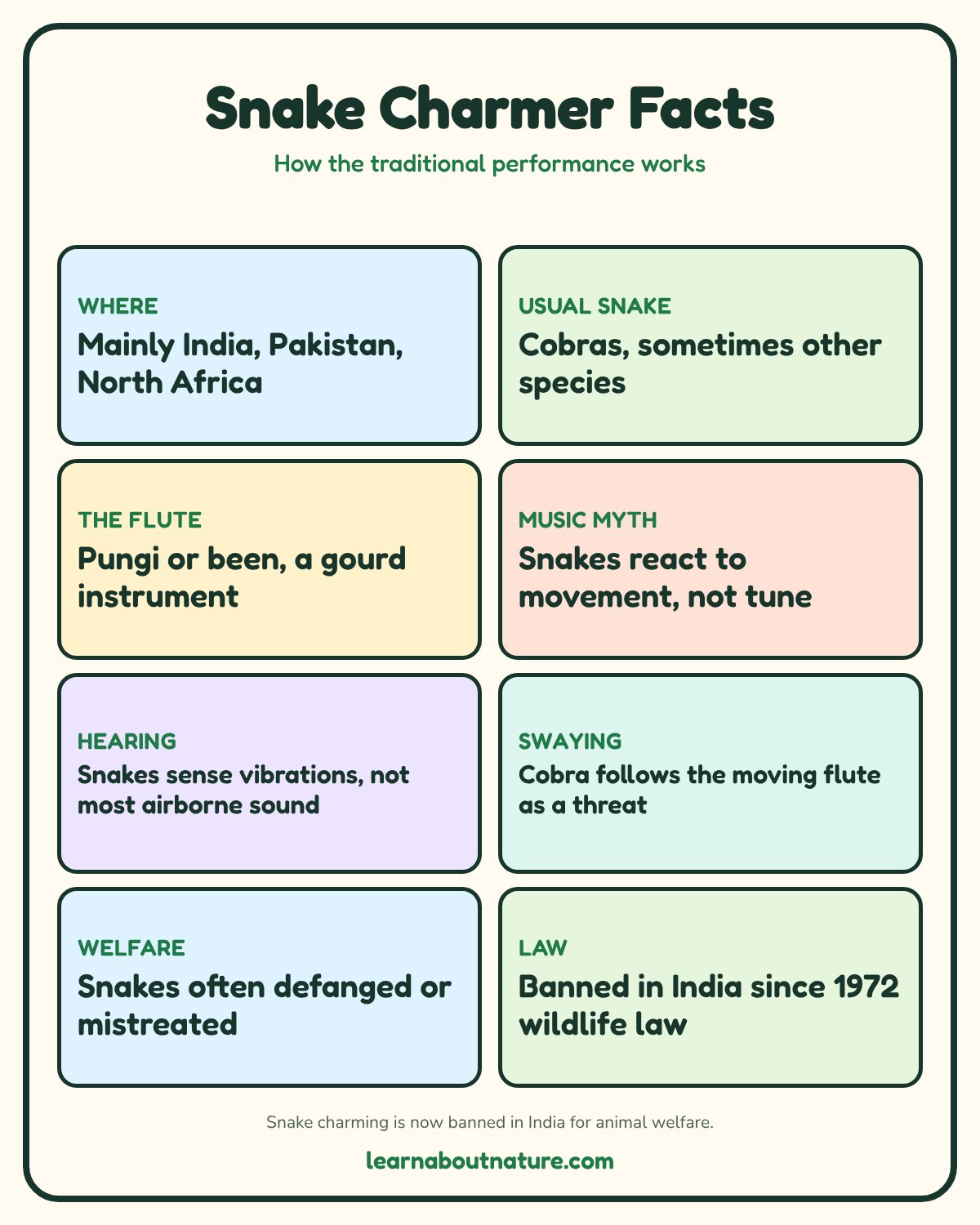
No. Snakes have no external ears and cannot hear airborne music the way people do, though they sense vibrations. A cobra follows the movement of the charmer’s swaying pungi, treating it as a possible threat, which makes the snake appear to dance.
Where did snake charming come from?
Forms of snake handling were known in ancient Egypt, but the snake charming most people picture today is strongly associated with India, where it became a hereditary profession. It later spread to Pakistan, Bangladesh, Southeast Asia, North Africa and the Middle East.
Is snake charming legal in India?
Snake charming has been banned in India under wildlife protection laws since 1972, as native snakes are protected species. Enforcement was weak for years, but stricter enforcement has greatly reduced the practice, and many traditional charmers now work in snake rescue or education.
How do snake charmers stay safe?
Some charmers keep a safe distance and rely on the cobra’s slow, upright strike. Others use cruel methods such as removing fangs, sewing mouths shut or milking venom before performances. These practices harm the snakes and are one reason animal welfare groups oppose snake charming.

Randi Jones is the owner and founder of the Nature Gift Store, an online retailer specializing in nature-themed gifts, educational science projects, live animal nature kits and real butterfly artwork. A biology graduate who fell in love with insects, she founded the company in 2001 to make active learning about nature fun, accessible and engaging for children and adults. Her store offers real butterfly frames, home and garden decor and educational live animal kits, including ant farms, worm farms, tadpoles, ladybugs and hermit crabs, and she runs a bug museum in Washington featuring live animals like Eddie the Iguana alongside other reptiles and insects. Randi wrote most of the guides on this site. They first appeared on her long-running nature sites, including Monarch-Butterfly.com, Ladybug-Life-Cycle.com, Frog-Life-Cycle.com, Dragonfly-Site.com and Butterfly Pictures, which have now been brought together here at Learn About Nature.